A Secret of God in the Calligrapher’s Hand: An Ottoman Qit’a of 1785
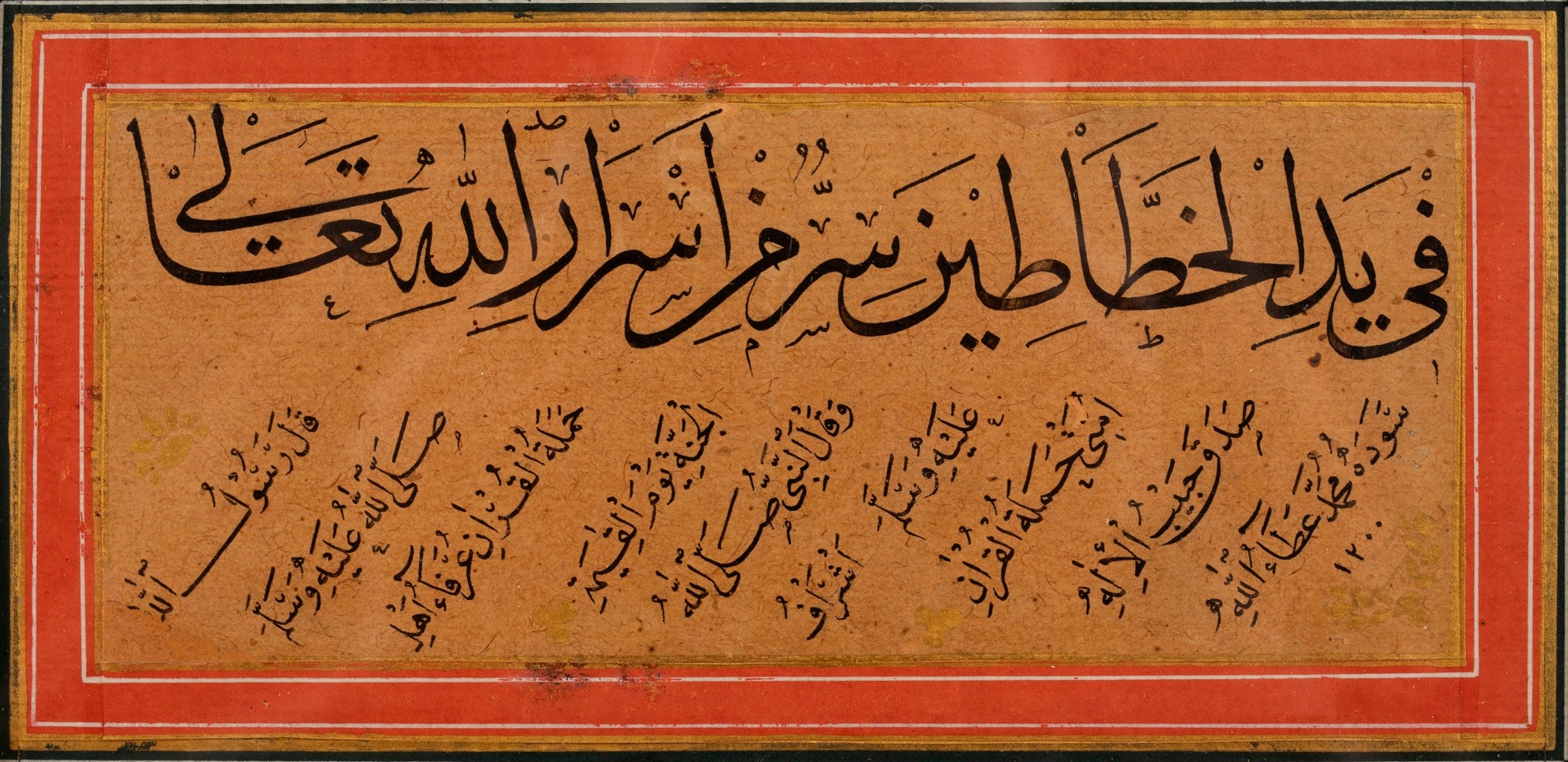
We open our calligraphy section with a panel whose subject is calligraphy itself. Across the top, in large and stately letters, an Ottoman student wrote a saying that every calligrapher knows:
فِي يَدِ الْخَطَّاطِينَ سِرٌّ مِنْ أَسْرَارِ اللهِ تَعَالَى
Fī yadi l-khaṭṭāṭīna sirrun min asrāri llāhi taʿālā
“In the hands of the calligraphers is one of the secrets of God, the Exalted.”
For the calligraphers of the Islamic world, beautiful writing was never only a craft. To write the words of God and of His Prophet with care, proportion and grace was a form of devotion, a skill passed from master to pupil and received, many believed, as a gift. This small panel, written in Istanbul in 1785, says so in its own words.
| Form | Calligraphic panel (qitʿa), ink on paper, laid down within coloured and gilded borders |
| Scripts | One line of large muhaqqaq above; diagonal lines of small naskh below |
| Text | An aphorism on calligraphy; two sayings attributed to the Prophet ﷺ in praise of those who carry the Qur’an |
| Calligrapher | Mehmed Ataullah, identified as Şanizade Mehmed Ataullah Efendi (about 1771–1826) |
| Date | 1200 AH (1785–86 CE) |
| Tradition | Ottoman, Istanbul |
Reading the panel
Beneath the great line, the smaller text is written in short diagonal lines, a favourite device of Ottoman calligraphers that turns the lower half of the panel into a field of slanting rhythms. Read in order, it contains two sayings in praise of the ḥamalat al-Qurʾān, “the carriers of the Qur’an”, those who learn it by heart and live by it:
قَالَ رَسُولُ اللهِ صَلَّى اللهُ عَلَيْهِ وَسَلَّمَ: حَمَلَةُ الْقُرْآنِ عُرَفَاءُ أَهْلِ الْجَنَّةِ يَوْمَ الْقِيَامَةِ
The Messenger of God ﷺ said: “The carriers of the Qur’an will be the leaders of the people of Paradise on the Day of Resurrection.”
وَقَالَ النَّبِيُّ صَلَّى اللهُ عَلَيْهِ وَسَلَّمَ: أَشْرَافُ أُمَّتِي حَمَلَةُ الْقُرْآنِ
And the Prophet ﷺ said: “The noblest of my community are the carriers of the Qur’an.”
The text closes with ṣadaqa ḥabību l-ilāh, “the Beloved of God has spoken the truth”, and then, in the last line on the right, the signature and date: sawwadahu Muḥammad ʿAṭāʾullāh, 1200. Sawwadahu means literally “he blackened it”, the modest formula with which calligraphers signed their work, as if they had done no more than put ink on paper.
Both sayings are recorded in later collections of hadith, notably those of al-Ṭabarānī. Hadith scholars have judged their chains of transmission weak, but they were widely quoted in praise of those who memorise the Qur’an, and they were a natural choice for a young student honouring the Book he had studied.
Two of the six scripts
The panel pairs two of the “six scripts” (al-aqlām al-sitta) of classical Arabic calligraphy. Muhaqqaq, used for the large upper line, is a broad, majestic script with long, almost horizontal strokes, once the favourite for great copies of the Qur’an. Naskh, used below, is the clear, rounded everyday script of books and Qur’ans, and the ancestor of most Arabic printing today. Setting a large display script above lines of small naskh was a classic Ottoman format for practice and presentation pieces, and the gilded borders and margins framed the finished work for an album or for the wall.
A future physician at his studies
The panel is signed simply “Mehmed Ataullah”. It has been identified as an early work of Şanizade Mehmed Ataullah Efendi, born in Istanbul around 1771, who would become one of the most remarkable Ottoman scholars of his age. Trained at the Süleymaniye medical madrasa, he wrote the Hamse-i Şanizade, a five-part medical course covering anatomy, physiology, medicine, surgery and pharmacology, whose anatomy volume is often called the first modern anatomy book of the Ottoman Empire. He also served as the empire’s official court historian, and was known as a poet, musician and painter. He died in 1826.
In 1785 he would have been only about fourteen or fifteen, still a student. That a teenager who was not to become a professional calligrapher could write like this shows how central fine handwriting was to an Ottoman education, and how seriously its pupils took the “secret” placed in their hands.
In this section
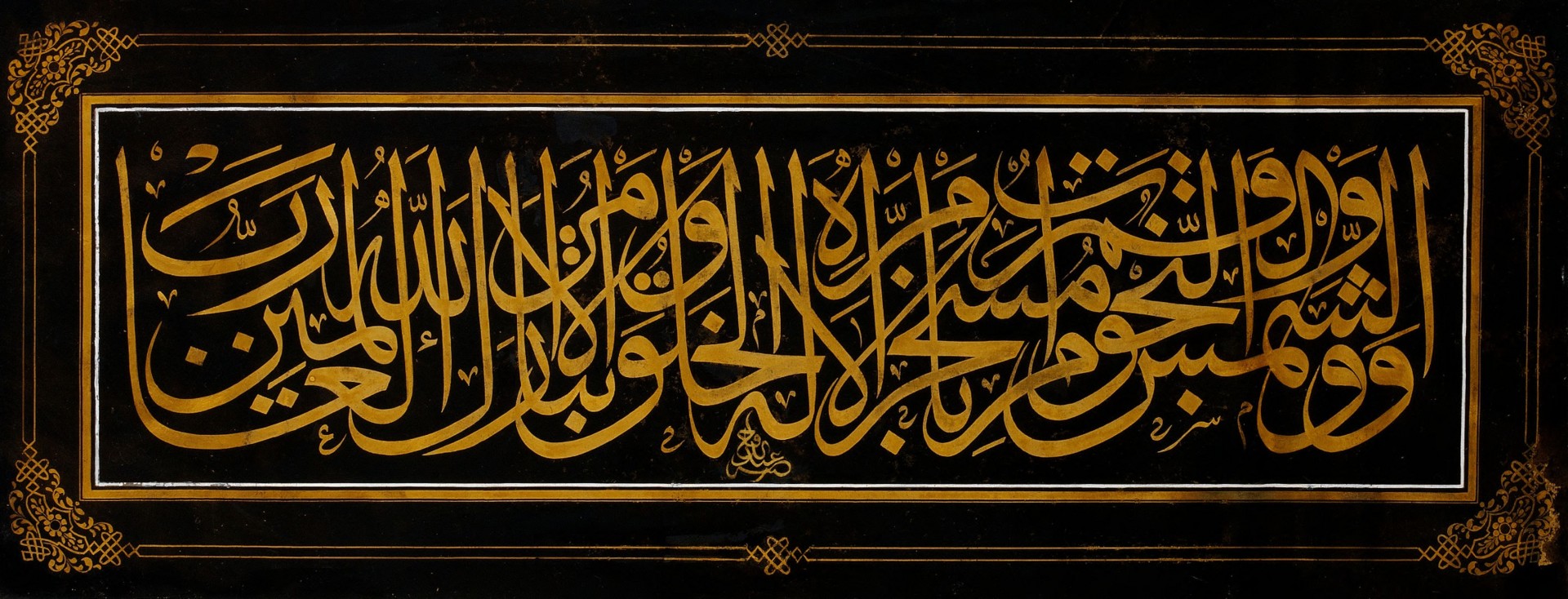
Kashmir Pages’ calligraphy section presents works of Islamic calligraphy, old and new, with their text, translation and the story behind each piece. Next, read His Are the Creation and the Command, a nineteenth-century panel in jali thuluth, the monumental form of the same tradition.
Sources and further reading
- Lyon & Turnbull, Edinburgh, Asian & Islamic Works of Art, 13 May 2020, lot 307: “Ottoman calligraphic panel (qit’a) signed Mehmed Ataullah, dated AH 1200 / AD 1785–86”.
- “Şânîzâde Mehmed Atâullah Efendi”, Kure Ansiklopedi.
- Sheila S. Blair, Islamic Calligraphy, Edinburgh University Press, 2006.
Image: Ottoman calligraphic panel signed Mehmed Ataullah, AH 1200 / 1785–86. Photograph © Lyon & Turnbull, Edinburgh, reproduced with credit from the sale of 13 May 2020, lot 307. If you hold rights in this photograph and would like it removed, please contact us.
You May Also Like
His Are the Creation and the Command: A Jali Thuluth Panel by Abdülfettah Efendi