His Are the Creation and the Command: A Jali Thuluth Panel by Abdülfettah Efendi
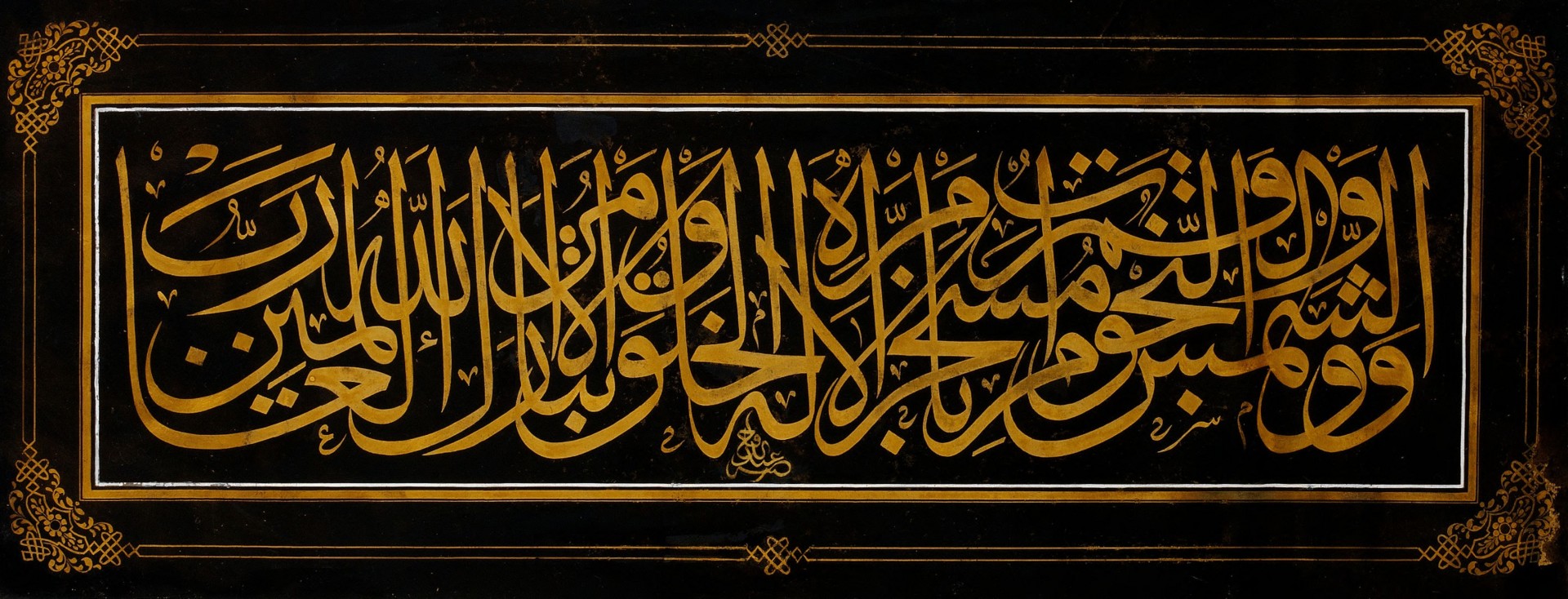
Gold letters rise and sweep across a band of black, tall shafts standing like columns over a river of curves. This nineteenth-century Ottoman panel by the master calligrapher Abdülfettah Efendi carries the closing words of a verse about the order of the universe, written in jali thuluth, the monumental script of mosques and great inscriptions.
| Form | Calligraphic panel (levha), gold on a black ground, with gilded corner ornaments |
| Script | Jali thuluth (Turkish celî sülüs) |
| Text | Qur’an, Surat al-A’raf (7), the closing words of verse 54 |
| Calligrapher | Abdülfettah Efendi (1815–1896), signed |
| Date | Second half of the nineteenth century |
| Size | 32.5 × 83.4 cm |
| Collection | Sakıp Sabancı Museum, Istanbul (130-0105) |
The verse
The panel bears the second half of the fifty-fourth verse of Surat al-A’raf:
وَالشَّمْسَ وَالْقَمَرَ وَالنُّجُومَ مُسَخَّرَاتٍ بِأَمْرِهِ ۗ أَلَا لَهُ الْخَلْقُ وَالْأَمْرُ ۗ تَبَارَكَ اللَّهُ رَبُّ الْعَالَمِينَ
Wa-sh-shamsa wa-l-qamara wa-n-nujūma musakhkharātin bi-amrih. Alā lahu l-khalqu wa-l-amr. Tabāraka llāhu rabbu l-ʿālamīn.
“…and the sun, the moon and the stars, made subservient by His command. Surely His are the creation and the command. Blessed is God, Lord of all the worlds.”
The whole verse reads: “Your Lord is God, who created the heavens and the earth in six days, then established Himself upon the Throne. He covers the day with the night, which pursues it swiftly; and the sun, the moon and the stars are made subservient by His command. Surely His are the creation and the command. Blessed is God, Lord of all the worlds.” (Qur’an 7:54, our translation.)
Creation and command
The phrase at the heart of the panel, alā lahu l-khalqu wa-l-amr, “His are the creation and the command”, has been read in many ways. For the commentators it means that God not only brought all things into being but continues to govern them: the sun, moon and stars move as He commands. The heavens are not independent powers, but servants.
Sufi teachers drew a further meaning from the two words. They spoke of the ʿālam al-khalq, the “world of creation”, the realm of bodies and things that can be measured, and the ʿālam al-amr, the “world of command”, the unseen realm from which the spirit comes. The idea was important to the Kubrawi masters, the order of Shah-i-Hamadan, and to the Naqshbandis, both of whom shaped the spiritual life of Kashmir. In this reading the verse describes the whole of reality, seen and unseen, as belonging to God.
The script: jali thuluth
Thuluth is one of the six classical scripts of Arabic calligraphy: tall and elegant, with long vertical shafts and deep, sweeping curves. Jali (“clear” or “large”) thuluth is the same script enlarged for display, on the walls and domes of mosques, on gateways and fountains, and on framed panels like this one, meant to be read from across a room.
In jali thuluth the calligrapher rarely writes the words in a simple line. Letters are stacked and overlapped, some words rising above others, and the spaces between are filled with vowel marks and small ornaments, so that the whole inscription forms a single balanced composition. Here the verse runs in one long band from right to left, its shafts standing in a regular rhythm, with some words lifted above others to fit the whole verse into a single line. The signature, small and discreet, sits below the centre.
Abdülfettah Efendi
Abdülfettah Efendi was born in 1815 on the island of Chios (Sakız) and became one of the leading calligraphers of nineteenth-century Istanbul. He received his licence (icâzet) in thuluth and naskh in 1832 from Hâfız Mustafa Şâkir Efendi, and in 1847 a second licence in ta’lik from Yesârîzâde Mustafa İzzet Efendi, one of the great masters of that script.
He is remembered above all for his monumental jali thuluth. In his early work he followed the school of Mahmud Celâleddin, and later the style of Mustafa Râkım, the master who had reshaped jali thuluth at the beginning of the century. The great inscriptions of the Süleymaniye Mosque in Istanbul are among his works, and many of his designs were carved in stone on buildings and tombstones. In 1857 he was appointed to a post at the imperial mint. He died in 1896 and is buried in the cemetery of the tomb of Sultan Mahmud II in Istanbul.
Sources and further reading
- M. Uğur Derman, “Abdülfettah Efendi”, TDV İslâm Ansiklopedisi.
- Sakıp Sabancı Museum, Istanbul, digital collection, object 130-0105.
- Sheila S. Blair, Islamic Calligraphy, Edinburgh University Press, 2006.
Image: levha in jali thuluth by Abdülfettah Efendi, second half of the nineteenth century. Sakıp Sabancı Museum, Istanbul (130-0105). Public domain, via Wikimedia Commons.

You May Also Like
O Soul at Peace: Surat al-Fajr in an Illuminated Qur’an of 1874