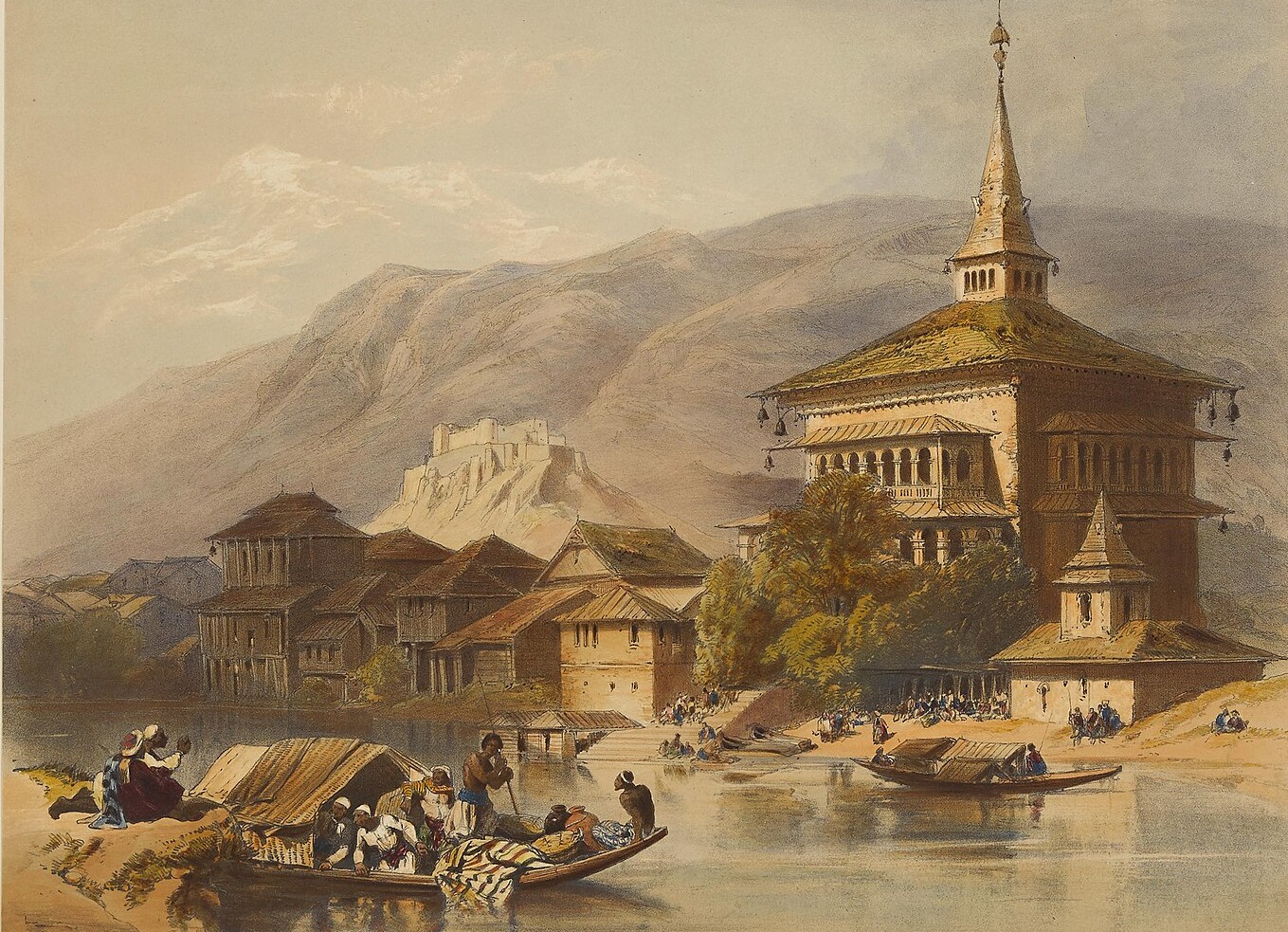
Shah-i-Hamadan and the Khanqah-e-Moula
Walk down to the Jhelum between Fateh Kadal and Zaina Kadal and you cannot miss it. Logs of deodar laid crosswise, roof upon roof, a thin spire, carved balconies hanging over the river. Inside, every wall is painted. There is no other mosque like it anywhere. This is the Khanqah-e-Moula. In Srinagar nobody needs telling whose memory it keeps: Mir Sayyid Ali Hamadani’s. Shah-i-Hamadan, people say. Or Amir-i-Kabir.
Even the British noticed how much he mattered. Walter Lawrence, who travelled from village to village in the 1890s, put it bluntly: of all the saints of the valley, Shah-i-Hamadan was the one “who has exercised the most direct influence on the religion of Kashmir”. So who was he?
From Hamadan
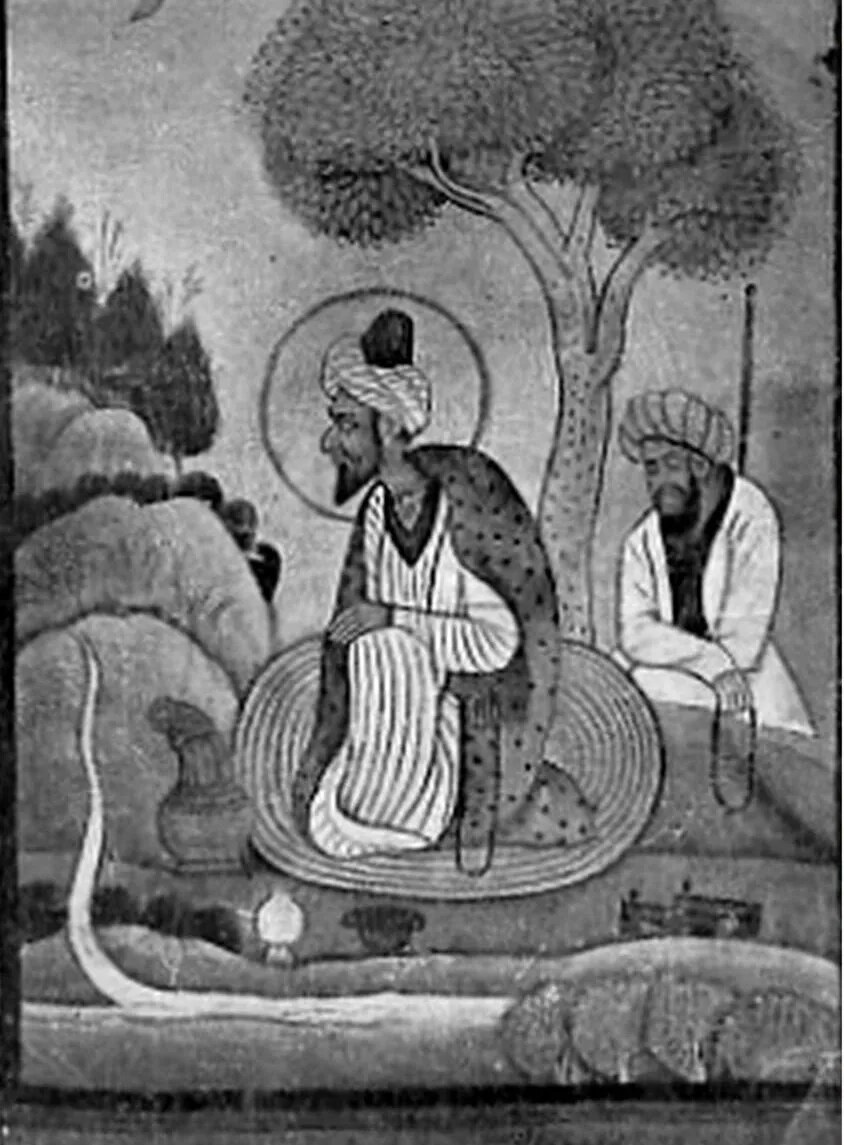
He was born in 1314, in the year 714 of the Hijra, at Hamadan in western Iran. His family were Sayyids. Young Ali took to the Sufi path early and attached himself to the Kubrawis, a brotherhood going back to Najm al-Din Kubra, who died in 1221. Kubrawis were strict about the law. They were equally strict about the inner work: dhikr, long retreats, obedience to a guide. His own guide was Sharaf al-Din Mahmud Mazdaqani, a pupil of the famous Ala al-Dawla Simnani.
Then he travelled. The old biographies have him crossing Iran and Central Asia again and again, and writing as he went. Dozens of books carry his name, in Persian and in Arabic: treatises on the path, letters, commentaries, a few poems. The one people still read is the Dhakhirat al-Muluk, the “Treasure of Kings”. Think of it as advice to a sultan. Be fair, fear God, look after the weak. Scribes from Bukhara to Delhi kept making copies of it for hundreds of years.
Why did he come east? Kashmiris had their own answer. The traveller G. T. Vigne heard it in Srinagar in the 1830s. Shah-i-Hamadan, he was told, had rebuked the conqueror Timur to his face, “told him that he would not remain in his country, and by virtue of his sanctity was able to transport himself through the air to Kashmir”. He came down, the story goes, on the very spot where his mosque stands today. A legend, of course. But Timur’s wars really did push many scholars and Sufis out of Iran in those years, and the story may remember that.
In Kashmir
He reached the valley in the time of Sultan Qutb-ud-Din, who ruled from about 1373 to 1389. How many times he came, and for how long, nobody can say for certain. Three visits, says the common account; the last ended in 1383, and one stretched over several years. Abul Fazl, Akbar’s man, gave him one line two hundred years on: “Mir Sayyid Ali Hamadani resided for some time in this city, and a monastery founded by him still preserves his memory.” That is all.
He did not come alone. Seven hundred Sayyids came with him, says tradition (a suspiciously tidy figure). Scholars, dervishes, and craftsmen too. Ask an old man in Zaina Kadal who taught Kashmir to weave shawls, or to make papier-mâché, and he will probably point you to those companions. Historians hedge. Several of these crafts only turn up clearly in the records a good while later. Fair enough. But the belief itself is worth noting, because for most Kashmiris the Persian half of their culture starts with Amir-i-Kabir and nobody else.
What did he teach? Kubrawi discipline, certainly, and the law. But also warmth, the circles of remembrance, sermons that people remembered. And to the Sultan, advice in the spirit of his Dhakhirat al-Muluk: be just. There is one more story, a much-loved one. It links him with Lal Ded, the mystic poetess of the same years. Lawrence found both Hindus and Muslims telling of a meeting between the two, and noted that Muslims held her name “in great respect, and speak of her as Lal Dedi”. Did they meet? We cannot know. That the story is told at all says a good deal.
Death and burial
He left Kashmir for the last time in 1384. He never got home. Somewhere in the mountains west of the valley he died, in January 1385 (Dhu al-Hijja 786). Abul Fazl puts the place in the hills of Bajaur and adds that “his body was conveyed to Khuttalan by his last testament”. He lies at Kulob, in today’s Tajikistan, and pilgrims still go there. The version Lawrence heard in Kashmir is livelier: the coffin, they said, “made miraculous marches” all the way.
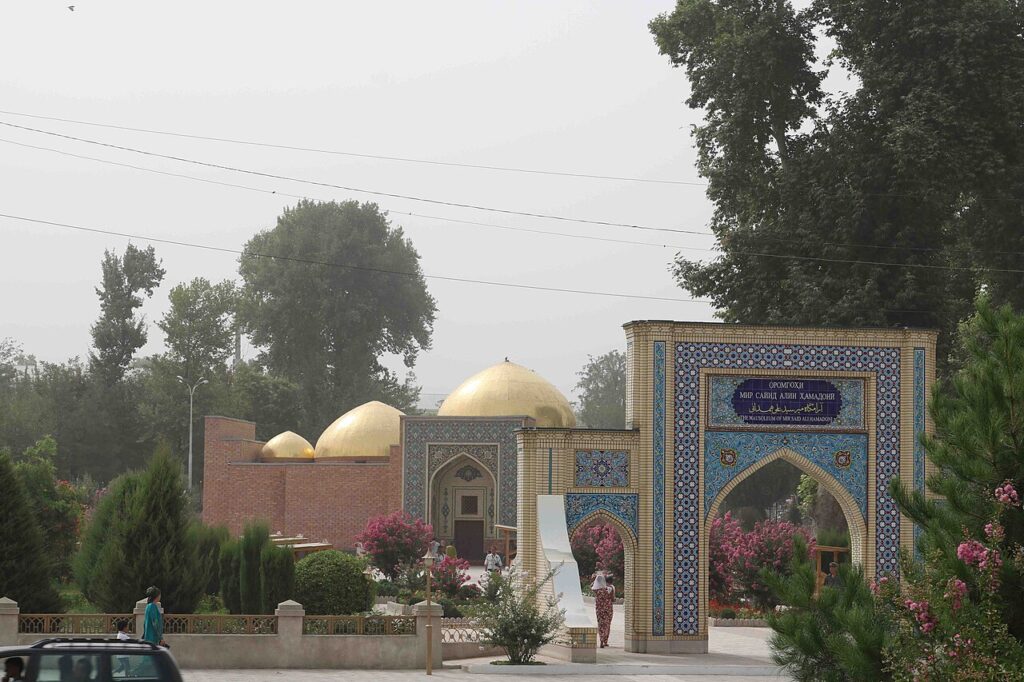
The Awrad-i-Fathiya
If you have woken early in Srinagar you have probably heard his real legacy without knowing it. The Awrad-i-Fathiya. Arabic, his own composition, page after page of praise and of asking forgiveness. Fajr ends, someone begins, and within a breath the whole mosque has taken it up. On a still morning it carries across the water at Fateh Kadal before the shops have opened. Inside the Khanqah, though, it is something else again. Ask a Kashmiri what mornings sounded like when they were small and this is often what they describe. You can find prayers of this kind in The Dhikr Book of Kashmir in our Library.
The Khanqah-e-Moula
A khanqah is a Sufi lodge. People pray there, study there, sometimes sleep there. This one is said to stand where Shah-i-Hamadan used to pray. Lawrence’s account is that the building “was commenced in the reign of Sultan Kutb-ud-Din”, and that later the saint’s son, Mir Muhammad Hamadani, “with the assistance of Sultan Sikandar, increased the size of the building, and was given the revenue of three villages for its maintenance”. Most writers date the main work to 1395.
Wood burns. Old Srinagar burned all the time, and the Khanqah has gone up more than once. Most of what stands today is the rebuilding of the 1730s (with a great deal of mending since). Moorcroft, an English horse-doctor who sat out the winter of 1822–23 in the city, jotted it down as “constructed chiefly of the wood of the Deodar pine, and … equipped with a pyramidal steeple of timber, capped with brass”.
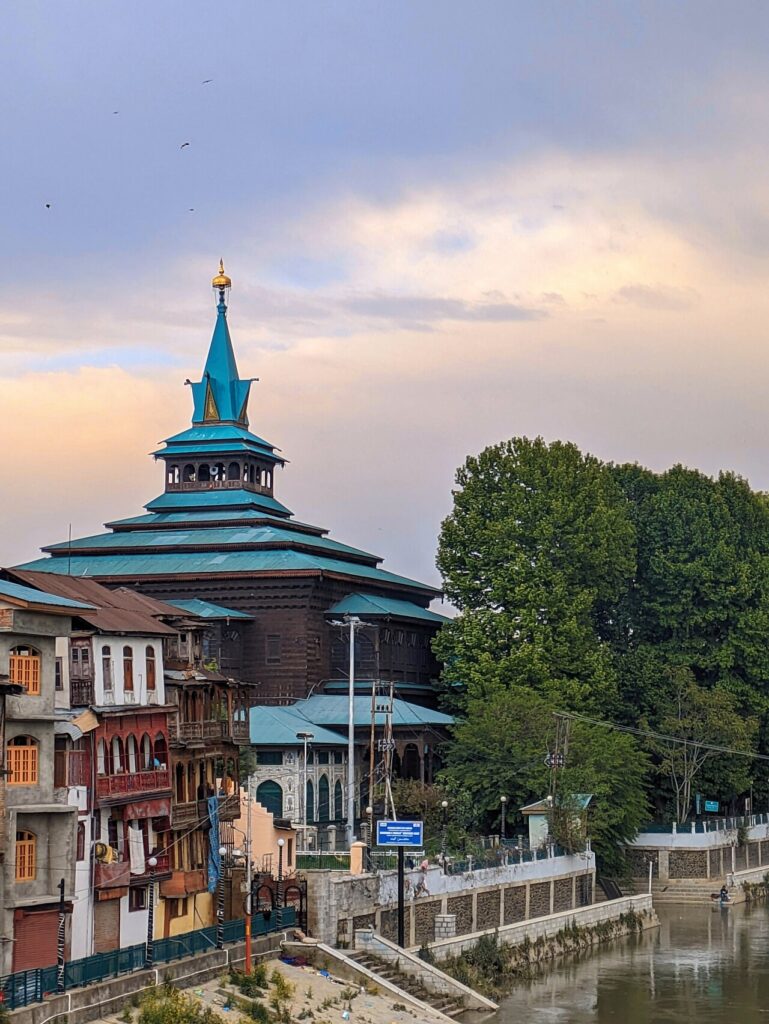
How it is built
Go up close to a wall. Deodar beams, squared off, crossing each other course by course, with brickwork wedged in the gaps. Where they meet at the corners the ends stick out. Hence the stripes. It is square, two floors, with balconies hung on the outside. The roof climbs in steps to a little open room, from which the azaan used to be given, and from that the spire rises. Old prints show bells on the eaves. Whether any still ring is another question.
Inside, it is colour. Wooden pillars, carved. Painted panels nearly everywhere you look, flowers and stars and medallions and the ninety-nine names, done in that particular Kashmiri red and green and gold (see our piece on painted work). The ceilings are khatamband. You can feel how many hands, over how many generations, went into it.
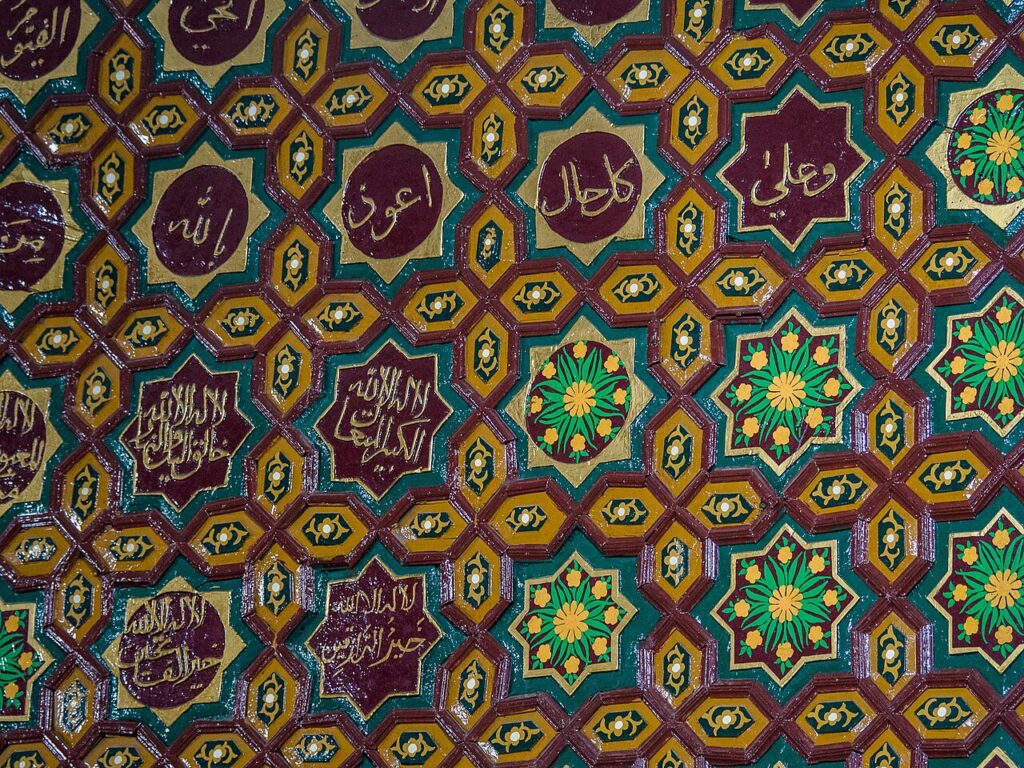
A place of reverence
Hardly a foreign visitor came to Srinagar in the 1800s without scribbling a paragraph on it, and the early photographers loved it. Lawrence went further and asked Kashmiris to rank their holy places. In sanctity, the answers put it second, after Hazratbal. He called it “a worthy memorial of a man who in his time exerted an enormous influence over the country”. On the anniversary of the saint’s death the crowds still come.
Dates at a glance
- 1314: born at Hamadan.
- 1370s–1383: in Kashmir, under Sultan Qutb-ud-Din.
- 1384–85: dies on the road; buried at Kulob.
- About 1395: Khanqah built by his son with Sultan Sikandar’s help.
- 1730s: rebuilt after fire.
- 1823: Moorcroft describes the deodar shrine.
Sources and further reading
- Abul Fazl, The Ain-i-Akbari, Vol. II, translated by H. S. Jarrett, Calcutta, 1891.
- William Moorcroft and George Trebeck, Travels in the Himalayan Provinces of Hindustan and the Panjab, London, 1841, Vol. II.
- G. T. Vigne, Travels in Kashmir, Ladak, Iskardo, London, 1842, Vol. II.
- Walter R. Lawrence, The Valley of Kashmir, London, 1895, chapter XI.
- Mohibbul Hasan, Kashmir under the Sultans, Calcutta, 1959.
Featured image: “The City of Kashmir with the mosque of Shah Hamadan”, lithograph by J. D. Harding after Charles Hardinge, Recollections of India (1847), public domain, via Wikimedia Commons. Mausoleum at Kulob, by Said-Ul-Auliya, Wikimedia Commons, CC BY-SA 3.0. The Khanqah-e-Moula, by SerCrappucino, Wikimedia Commons, CC BY-SA 4.0. Painted walls, by Mike Prince, Wikimedia Commons, CC BY 2.0.
You May Also Like
Lal Ded (Lalleshwari): The Life and Sayings of Kashmir’s First Poet

Sufism in Kashmir: Origins, Orders and Saints