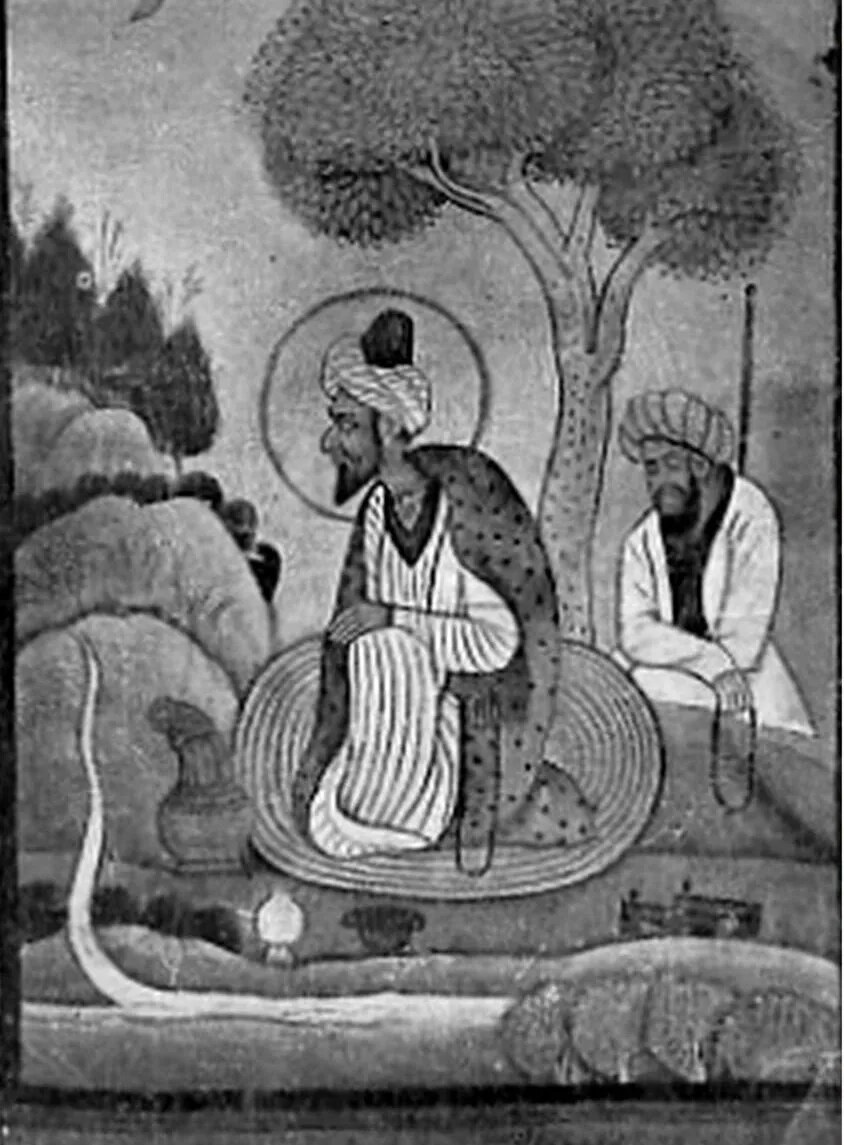
Sheikh Nooruddin (Nund Reshi) and the Rishis of Kashmir
Lal Ded is the mother of Kashmiri poetry, people like to say. Then Sheikh Nooruddin is its favourite son. Muslims call him Sheikh-ul-Alam, or Alamdar-e-Kashmir, the standard-bearer. Hindus know him as Nund Reshi, sometimes Sahajanand. He founded the Rishis, the most homegrown of all Kashmir’s religious orders, and you still hear his lines quoted in the bazaar the way people quote proverbs. His disciples’ shrines sit on hilltops right across the valley. His own, at Charar-i-Sharif, draws crowds every week of the year.
A child who wouldn’t feed
He was born, tradition says, in 1377 at Kaimoh near Kulgam. His father was Salar Sanz, his mother Sadra Moji. The famous story is about his first days. The baby would not take his mother’s milk. Then Lal Ded, the wandering mystic, turned up at the door, and he fed from her. Six centuries later Kashmiris still tell it. It ties the two saints together for good.
As a boy he was hopeless at earning a living, or so the stories go. They put him with a weaver; he left. They tried him with a trader; he left that too, sickened by the cheating he saw. Before long he gave up the world altogether. Years of fasting and prayer followed, a lot of them in a cave near Kaimoh. Pilgrims are still shown it.
Teaching in Kashmiri
When he came out he took to the road, village to village. And he preached in Kashmiri. Not Persian, not Arabic: the language people actually spoke at home. What did he say? Roughly this. The world won’t last. You will die. Tame yourself. Earn honestly, be kind to every creature, keep God’s name on your tongue. He ate very little and no meat, and he told his followers not to hurt living things.
J. Hinton Knowles, a missionary in 1880s Srinagar who wrote down proverbs, recorded one tale from those years. Nooruddin stops for the night at a village mosque whose keeper has a great name for holiness. Angels visit him after dark, the villagers believe, and so every day they bring him six dishes of food “to feed the angels with”. The keeper tries to scare the guest off with talk of a monster. Nooruddin stays put, lies down, and watches through half-shut eyes while his host eats all six dishes. Next morning, rosary in hand, the man finds his visitor leaving with a parting remark that Kashmiris still use: Talisui katas wasih muslah. “The skin will come off from the warm sheep.” Frauds get found out.
The shruks
His verses are called shruk, from Sanskrit shloka. Short poems. They are about how little the world is worth, about reining in the self, about death and the reckoning, about loving God. For generations nobody wrote them down; they lived in people’s mouths, like Lal Ded’s sayings. The main early collections come from the seventeenth century, above all the Nurnama of Baba Nasib-ud-Din Ghazi, a Persian life of the saint with his verses in it. Plenty are still in everyday use.
One line has outgrown the rest. It turns up on conservation posters and roadside signboards:
Ann poshi teli, yeli wan poshi.
Sheikh Nooruddin (our translation)
Food will be plentiful only as long as the forests flourish.
Others are darker. Knowles printed this one as “a saying of Shekh Nur-ud-din”, a world gone upside down:
Alagadih budan tah malagadih wotalan; Wetha hukhan; hénar grazan.
J. Hinton Knowles, A Dictionary of Kashmiri Proverbs and Sayings (1885)
“The great man will sink; the base man will rise; the river will dry up; the sewer will roar.”
Wetha is the Jhelum. People compare him with Kabir, or with the Persian Sufis, and fair enough. But the stuff of his poems is all Kashmir: paddy, forest, river, the potter at his wheel, the weaver, winter cold, hungry people.
Who were the Rishis?
His followers came to be called Rishis. Yes, the word is the old Indian one for a sage, but these were Muslim ascetics. Their own tradition looked back to Uwais al-Qarani, the Yemeni who loved the Prophet without ever meeting him. G. T. Vigne, passing through in the 1830s, was told that the Rishis “do not eat meat, and originally were wanderers in the jungul, living upon wild herbs, particularly one called Wopulhak”. That is the same bitter mountain plant that turns up in the old story of the temple at Naranag, a thousand years before.
Two hundred years after Nooruddin they impressed the Mughal court. Abul Fazl wrote about them in the Ain-i-Akbari, and almost everyone who has written on Kashmir since has quoted him:
“The most respectable people of this country are the Rishis, who, although they do not suffer themselves to be fettered by traditions, are doubtless true worshippers of God. They revile not any other sect, and ask nothing of any one; they plant the roads with fruit trees to furnish the traveller with refreshments; they abstain from flesh, and have no intercourse with the other sex. There are near two thousand of this sect in Kashmir.”
Abul Fazl, Ain-i-Akbari, as quoted by Walter Lawrence (1895)
The historian Mohammad Ishaq Khan went further. In his view the Rishis are a big part of why Islam took hold in Kashmir at all: they put the new faith into words and ideals that villagers already knew and trusted. Plain living, service, harming nothing. Kashmiris of every faith respected that.
Ninety-nine disciples, and their hills
Walter Lawrence spent the early 1890s settling the land revenue village by village. He noticed that “most of the best-known shrines may be traced back to the national saint, Shekh Nur Din. He and his ninety-nine followers, Khalifas, established themselves throughout the valley.” He named the best known:
- Baba Shukr-ud-Din, on the hill of Watlab above the Wular.
- Baba Hanaf-ud-Din, on a lone hill under the Tosh Maidan range.
- Baba Zain-ud-Din at Aishmuqam, whose shrine “stands like a castle on a mountain spur that looks over the Liddar valley”.
- Baba Lutf-ud-Din, on Pushkar hill.
- Baba Nasr-ud-Din, buried near his master at Charar.
- Baba Bam-ud-Din, at Bamzu.
- Baba Payam-ud-Din, Baba Reshi, a disciple of Zain-ud-Din, below Gulmarg.
The men who kept these shrines were still called Rishis, Lawrence says, “though they do not lead the ascetic and celibate life of their famous predecessor”. Their pull on people, he reckoned, was “far greater than that exercised by Mullahs in the mosque”. They were “associated with legends of self-denial and good works”, nice places to meet at fair-time, nearly always shaded by “noble ‘brotherhoods of venerable trees’, of chenars, elms, and the Kabuli poplar”, with “always some spring of water for the thirsty”. Anyone who has sat at Baba Reshi on a hot afternoon will know what he meant.
Charar-i-Sharif
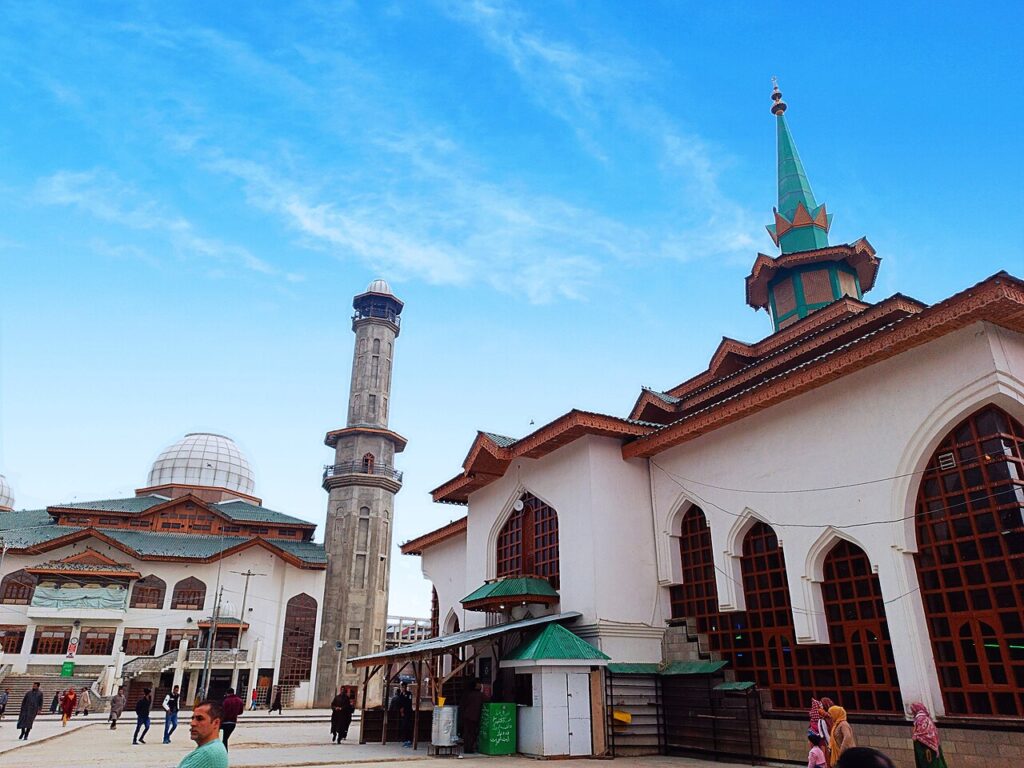
Nooruddin died in 1438. They buried him at Charar-i-Sharif (Tsrar, locally), in the hills south-west of Srinagar, and the story goes that Sultan Zain-ul-Abidin walked in the funeral. The shrine became the heart of the countryside’s faith. Every ruler paid his respects; an Afghan governor in the early 1800s even put the saint’s name on his coins.
In bad years the whole valley turned to Charar. Lawrence describes how, “when scarcity is imminent, where calamities such as earthquake, cholera, and drought occur, thousands gather there and sit silent on the hills around, confessing their sins and begging for pardon”. Knowles mentions “a great mela there in his honour” every October. The old wooden shrine burned down in 1995 and has been rebuilt. His urs still fills the town.
Why he still matters
Go anywhere in Kashmir and his name turns up. Schoolchildren learn his verses. Shrine singers recite them. Conservationists borrowed his line about forests. And the kind of believer he held up (honest, hard-working, gentle with every living thing) is still, for many Kashmiris, what a good person looks like. He and Lal Ded stand together at the very start of Kashmiri literature. And the picture of an old mystic woman feeding a newborn saint is one Kashmiris have never tired of.
Sources and further reading
- Baba Nasib-ud-Din Ghazi, Nurnama (Persian, seventeenth century).
- Abul Fazl, Ain-i-Akbari (about 1598), account of Kashmir.
- G. T. Vigne, Travels in Kashmir, Ladak, Iskardo, London, 1842, Vol. II.
- J. Hinton Knowles, A Dictionary of Kashmiri Proverbs and Sayings, Bombay, 1885.
- Walter R. Lawrence, The Valley of Kashmir, London, 1895, chapter XI.
- Mohammad Ishaq Khan, Kashmir’s Transition to Islam: The Role of Muslim Rishis, New Delhi, 1994.
Featured image: Sheikh Nooruddin (Nund Reshi), from a seventeenth-century Kashmiri manuscript painting, public domain, via Wikimedia Commons. Charar-i-Sharif, by Gowhar Nabi Wani, Wikimedia Commons, CC BY-SA 4.0, resized.
You May Also Like

Sufism in Kashmir: Origins, Orders and Saints
Lal Ded (Lalleshwari): The Life and Sayings of Kashmir’s First Poet