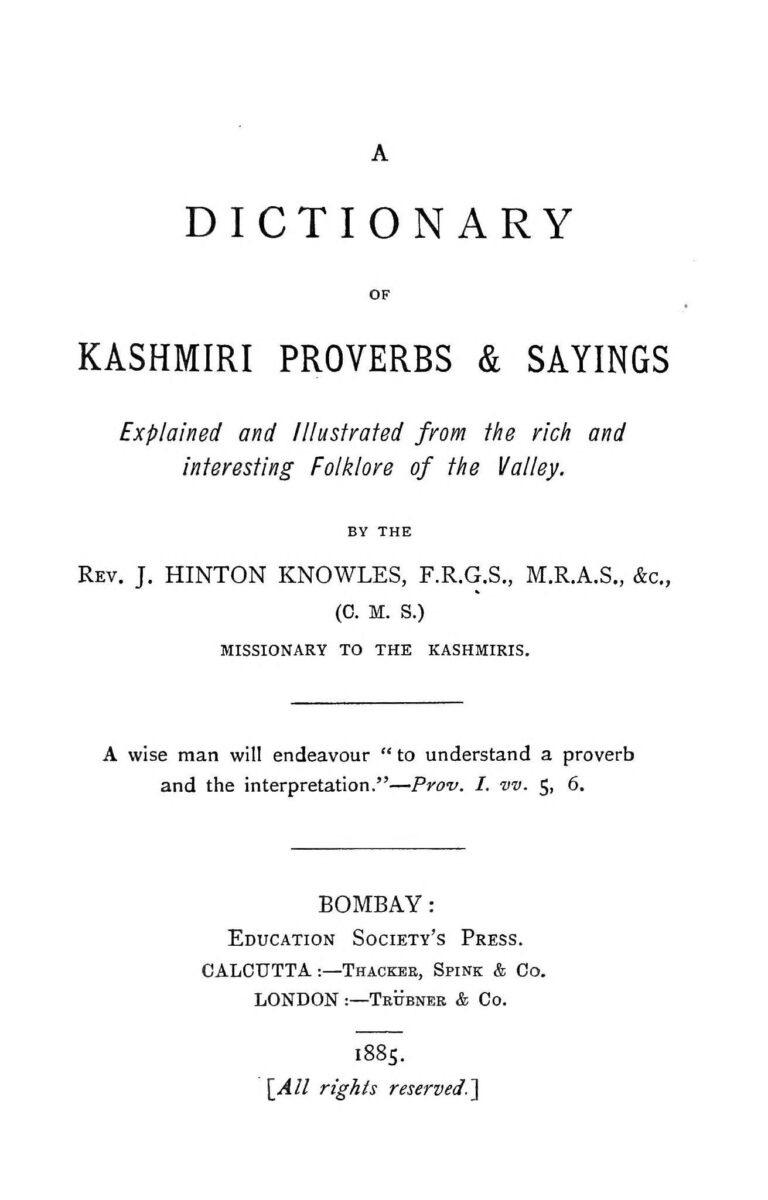
A Dictionary of Kashmiri Proverbs and Sayings by Rev. J. Hinton Knowles
Knowles, a missionary in 1880s Srinagar, couldn't hear a proverb without scribbling it down. Here they are, Kashmiri and English side by side, with his notes on when you'd say them. Open it at any page and you'll lose an hour.
If the book does not appear here (some phones can’t show PDFs inside a page), use Open full screen or Download PDF.
About this book
Missionaries are supposed to talk. The Rev. J. Hinton Knowles, posted to Srinagar in the 1880s, seems to have done rather more listening. Boatmen, shopkeepers, pandits, grandmothers. Whenever someone came out with a saying, he wrote it down, with the Kashmiri, a word-for-word English version, and then an explanation of what it actually meant and when you’d use it. In 1885 he put them all together, in alphabetical order, in this dictionary.
The explanations are the treasure. Take Al Kashmir murdah-pasand, “The Kashmiri people are fond of the dead”. Knowles explains that not speaking ill of the dead was one of the things he most admired in Kashmiris. Or the gloomy prophecy he credits to Sheikh Nur-ud-din: “The great man will sink; the base man will rise; the river will dry up; the sewer will roar”, a picture of a world gone wrong. Some entries turn into little stories. Nur-ud-din catching a fake holy man eating the food meant for the angels, for instance, or a song by “a very holy fakir woman” named Habbah Khotan who crossed the river on a lion.
Plenty of the proverbs are earthy, funny, or rude about neighbours, in-laws and officials. Many are still heard today, slightly changed. For anyone who speaks Kashmiri it’s a delight to browse. For anyone who doesn’t, it’s one of the best windows we have into how ordinary people in the valley talked and thought a hundred and forty years ago.

You May Also Like

Beyond the Pir Panjal: Life and Missionary Enterprise in Kashmir by Ernest F. Neve

The Happy Valley: Sketches of Kashmir and the Kashmiris by W. Wakefield