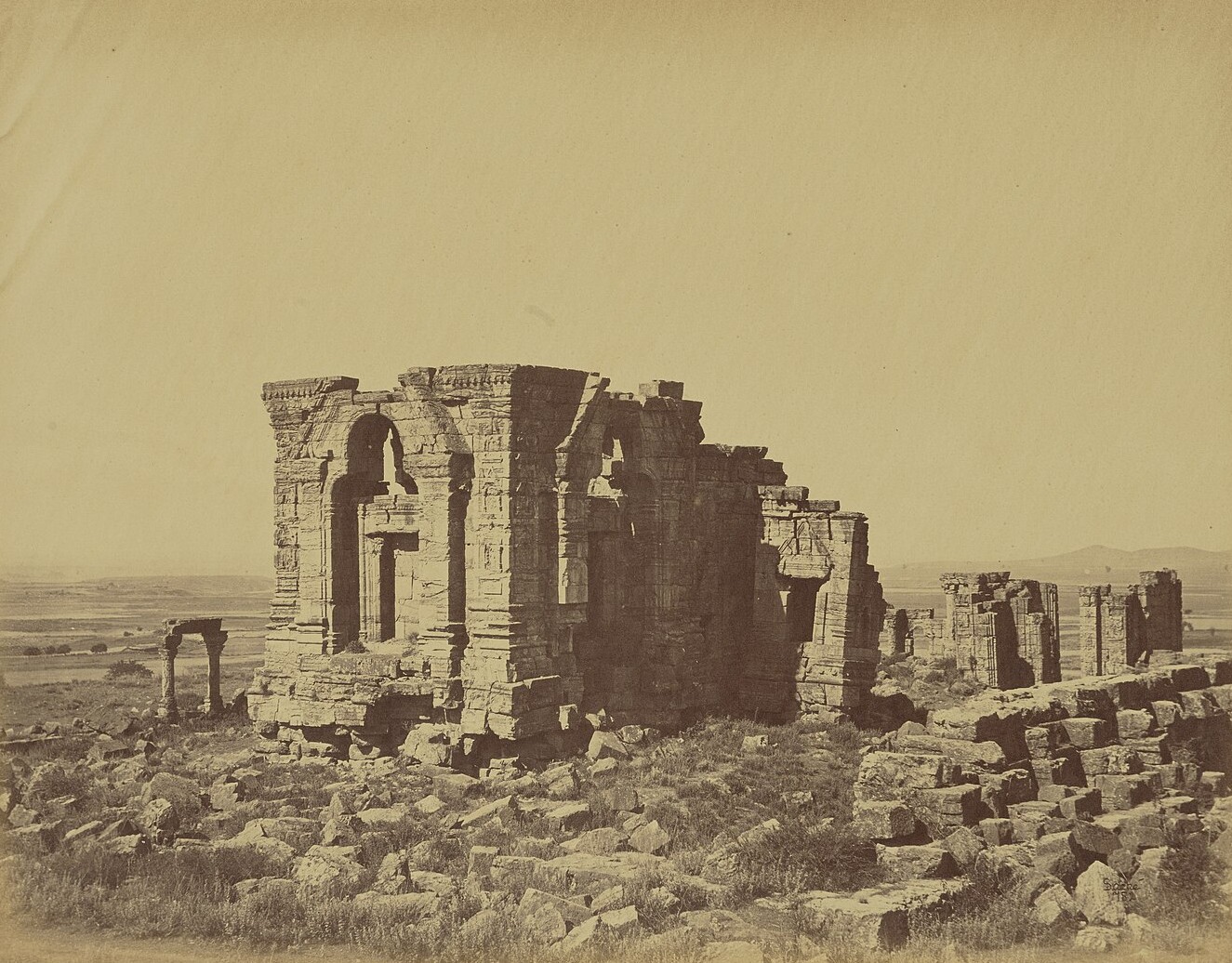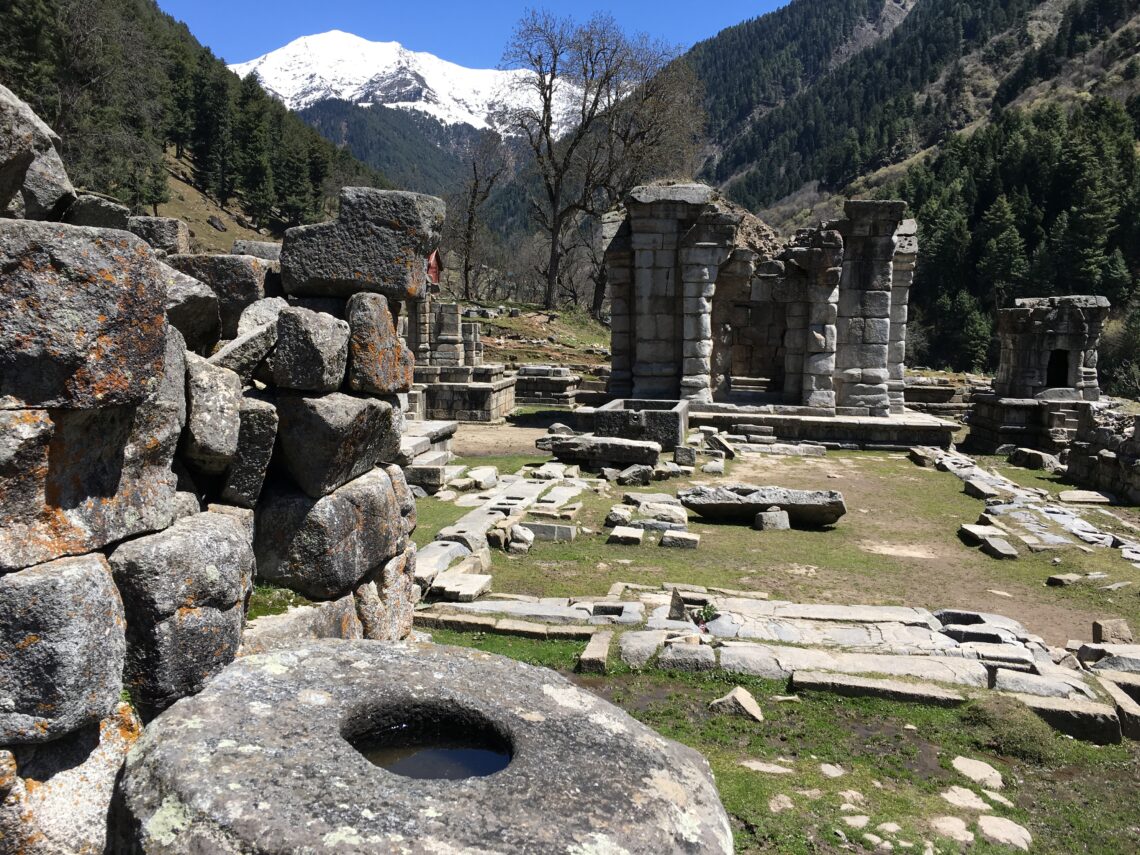
The Temples of Naranag: Bhutesha and Jyeshtesha below Mount Haramukh
Above the town of Kangan in the Sind valley, a side valley climbs north towards the snows of Mount Haramukh. At its head, among pine and deodar forest at about 2,200 metres, lie the ruins of two groups of stone temples, a spring of clear water, and the remains of an ancient pilgrims’ rest-house. This is Naranag. To Kalhana, who wrote the Rajatarangini, Kashmir’s great chronicle of kings, in 1148–49, it was the holy site of Shiva Bhutesha, “the lord of beings”, and of the ancient Linga of Jyeshtesha beside it. Kings came here to worship and to give gifts for more than a thousand years. Kalhana’s own father came every year.
What makes Naranag special is that we can read about it and then go and stand in it. Kalhana tells us which kings built here and which kings paid. He describes a man being beheaded beside the temples. He lists the raids. Then, in 1891, Aurel Stein (the man who put the Rajatarangini into English) walked up this valley with the Sanskrit in his pocket and started matching stones to verses. We are going to try the same.
One place, many names
Part of the difficulty in reading about Naranag is that it has gone by many names. The village at the mouth of the side valley is Wangath (written Wangat or Vangath by older writers), which Sanskrit texts call Vasishthashrama, the hermitage of the sage Vasishtha. The stream that runs past the temples is the Kanknai, Kalhana’s Kanakavahini, “the river that carries gold”. The mountain spur above the ruins is still called Buth’ser, the Kashmiri form of Bhuteshvara, the old name of the shrine. Kalhana himself usually calls the whole sacred landscape around Haramukh Nandikshetra, “the field of Nandin”, after Shiva’s faithful attendant. The spring beside the eastern temples, which gives the modern place its name, Naran Nag, is the Sodara spring of the chronicle.
The two temple groups also have local names. In the nineteenth century the western group was known as Rajdainbal and the eastern group as Nagbal, and the British surveyors who first described them called the whole site simply “the temples near Wangat”.
Shiva Bhutesha and the sacred mountain
On a clear day you can see Haramukh from Srinagar, a big white wall along the north, over 5,000 metres. Old Kashmir put Shiva up there. Under the glaciers sit two lakes. Gangabal, the higher one, counted as the source of Kashmir’s own Ganga. Nundkol, just below, is the old Nandisaras or Kalodaka, where Shiva and his bull Nandin were said to live together. How did Shiva end up down at Naranag as Bhutesha? The Nilamata Purana, oldest of the valley’s sacred-geography books, tells that story. Later pilgrim manuals (the Nandikshetra-mahatmya, the Haramukutaganga-mahatmya) put his seat on the ridge right above the ruins.
Next door, so to speak, was Jyeshtesha, also called Jyeshtharudra. Who set it up? The sage Vasishtha, according to the Nilamata, and that is where Wangath gets its old name. Kalhana adds that this was not a carved image but a natural stone, a svayambhu or “self-born” Linga, of the kind still worshipped at several holy places in Kashmir.
What Kalhana tells us
Bhutesha appears in the Rajatarangini from its earliest legends to Kalhana’s own day. The passages below are quoted from Stein’s translation of 1900, with Kalhana’s book and verse numbers. The words in square brackets are Stein’s own additions.
Ashoka and Jalauka
Kalhana begins with the legendary kings. He tells that Ashoka, troubled by foreign invaders, prayed to Bhutesha for a son:
“As the country was overrun by Mlecchas, the pious [king] obtained from [S’iva] Bhutesa, whom he had pleased by his austerities, a son in order to exterminate them.”
Rajatarangini, I. 107
That son was Jalauka, whom Kalhana describes as a devoted worshipper at Nandikshetra, and who is said to have built the first stone temple here:
“This king erected a stone temple at Nandiksetra for [S’iva] Bhutesa, and offered [to the god] a sacrifice of precious stones together with [other] treasures.”
Rajatarangini, I. 148
These early reigns belong to tradition rather than dated history, and nothing now standing at Naranag can be as old as Ashoka’s time. But the stories show that by the twelfth century Bhutesha was believed to be one of the most ancient shrines in Kashmir. Kalhana also records that a later legendary king, Narendraditya I, “consecrated shrines to [S’iva] Bhutesvara, and founded a permanent endowment [for the feeding of Brahmans]” (I. 347).
Lalitaditya’s gift
With Lalitaditya Muktapida, the great conqueror and builder of the eighth century who also raised the sun temple at Martand, we reach firmer ground. Kalhana tells that he took one crore with him when he set out on his campaigns, and on his return made an offering eleven times as large as an act of atonement:
“Having taken one crore when he proceeded for the conquest of the world, he presented on his return eleven crores to the [shrine of S’iva] Bhutesa as an expiatory offering. The lord of the earth erected there a lofty temple of stone for [S’iva] Jyestharudra, and made a grant of land and villages.”
Rajatarangini, IV. 189–190
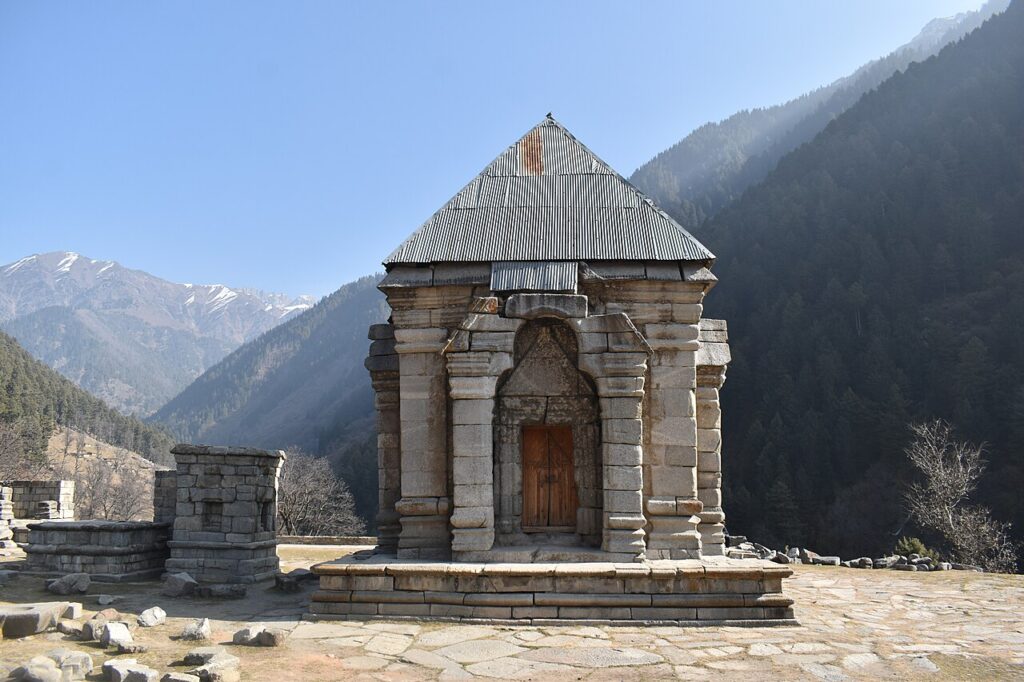
Stein believed that this “lofty temple of stone” is the large central temple of the western group, the best preserved building at Naranag today.
Avantivarman and the silver conduit
In the ninth century King Avantivarman (855–883), founder of Avantipora, gave a costly fitting to the shrine:
“This king had at the [shrines of] Tripuresvara, Bhutesa and Vijayesa, three pedestals made with silver conduits for the bathing water.”
Rajatarangini, V. 46
In a Kashmiri temple the Linga or image stood on a carved stone pedestal, and the water poured over it in daily worship ran off through a channel cut into the pedestal’s surface, ending in a carved spout. Stein noted that many such pedestals could still be seen among the ruins at Naranag. Avantivarman’s had a channel lined with silver.
The bitter offering
The most vivid story Kalhana tells of Bhutesha also belongs to Avantivarman’s reign (V. 48–60). The king came to worship and noticed that the priests had placed before the god, as their offering, nothing but a wild, bitter-tasting vegetable, utpalashaka. When he asked why, they explained that a powerful landholder of the Lahara district (the Sind valley), a man named Dhanva who enjoyed the protection of the minister Shura, had seized the villages that supported the shrine, “and thus we [can] offer to Bhutesa only this oblation.”
The king said nothing. He left the worship pretending to be taken ill with colic, so that no one would think he had heard. His minister Shura understood. He went to the temple of Bhairava, which stood “close to Bhutesa”, sent messenger after messenger to summon Dhanva, and when the landholder at last arrived with his armed followers and refused to bow, had him beheaded on the spot “in front of [the image of] Bhairava”, and the body thrown into “the tank close by”.
The plant still grows here. When Stein examined the ruins in August 1891, he found it “growing plentifully in the midst of the luxuriant forest vegetation in which the temples were then embedded”. Kashmiri villagers still gather its leaves, which lose their bitterness with repeated boiling, and old tradition held that it was the food of the sages who lived in the forest.
Plunder, fire and restoration
Wealth made Bhutesha a target. In the eleventh century, under Samgramaraja, an official named Bhadreshvara “plundered the treasury and what else [belonged to the shrines] of Bhutesvara and other gods” (VII. 106). In the reign of King Uccala (1101–1111) a fire destroyed the township that had grown up around the temples, and the king rebuilt it: “The whole town at Nandiksetra which had been burned during his reign by a sudden conflagration was built anew by him finer than it was before” (VIII. 77). Stein noticed signs of later repairs in inferior materials in the western group and thought they might be Uccala’s work.
In Kalhana’s own lifetime, during the civil wars of King Jayasimha’s reign, raiders crossed the mountains and plundered the shrine (VIII. 2756). Stein worked out their likely route: over the passes around Haramukh and down the pilgrims’ path from the Gangabal lake, so that they would take the priests completely by surprise. The last mention of the site in the chronicle is peaceful. Sumanas, a minister’s brother, “built a Matha at Bhutesvara”, a rest-house for pilgrims and holy men, “and offered to the Pitrs”, the spirits of the ancestors, “the water of the Kanakavahini” (VIII. 3356).
Kalhana’s father
Kalhana knew this place well, and for a personal reason. His father Canpaka, who served at the court of King Harsha (1089–1101), was a devoted pilgrim to Nandikshetra:
“Canpaka spent every year seven days at Nandiksetra and turned there to pious use the wealth he had acquired during the whole time [intervening between his visits].”
Rajatarangini, VII. 954
Stein thought it very likely that the young Kalhana went with his father on these annual journeys, which would explain the close knowledge of the site that shows throughout the chronicle.
How Stein matched the ruins to the chronicle
The ruins at Naranag had been described in the 1860s by Bishop Cowie and by Major H. H. Cole of the Archaeological Survey, but neither connected them with Kalhana. Stein visited in August 1891 and made the connection, and his reasoning is a small piece of detective work.
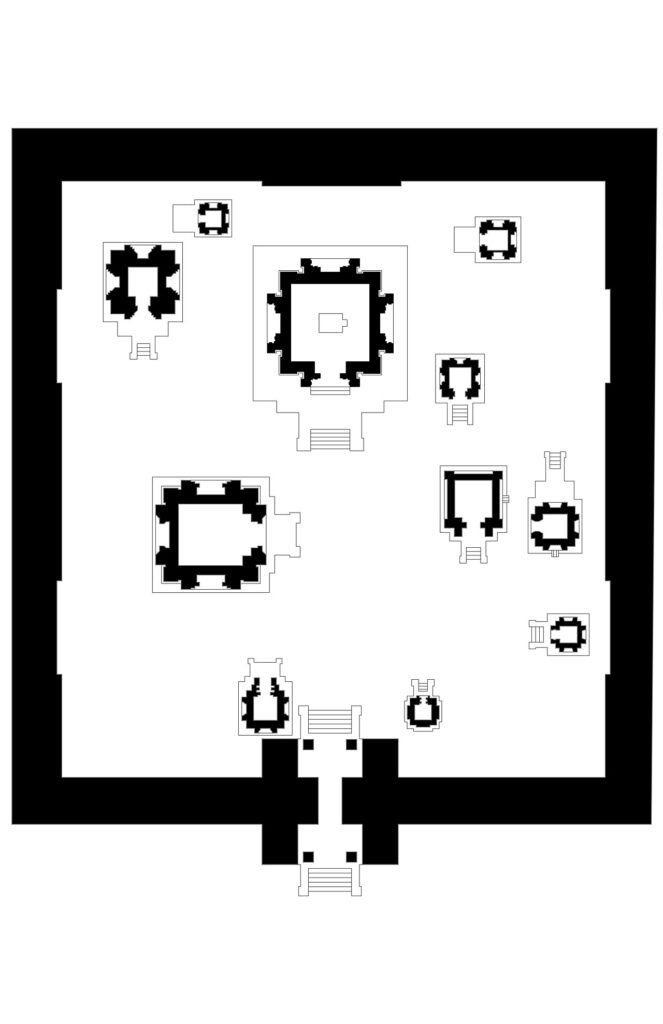
He started from the story of Dhanva. The landholder’s body was thrown into “the tank close by” the temple of Bhairava, and the only pool anywhere near the ruins is the basin of the Naran Nag spring, just beyond the north-east corner of the eastern enclosure. About twenty yards west of it, outside both temple groups, stand the remains of a small isolated temple. Shrines of Bhairava, whose worship involved blood sacrifice, were usually kept apart from those of other gods, so Stein identified this lonely ruin as the Bhairava temple of the story. Since Kalhana places Bhairava “close to Bhutesa”, the large central temple of the eastern group, the only building of imposing size within it, should be the shrine of Bhutesha. The western group must then belong to Jyeshtesha, and its central temple to Lalitaditya. Bishop Cowie had found the base of a huge Linga at the south-west corner of the western enclosure, which Stein suggested might once have held the emblem of Jyeshtesha itself.
Stein’s identifications have been followed by most later writers, though he himself presented them as probable rather than certain.
The temples today
The two groups stand about 200 yards apart, each inside its own rectangular stone enclosure, with the remains of a third structure between them. Together they contain some seventeen temples of different sizes and ages. All are built in the distinctive style of early medieval Kashmir: square shrines of large dressed stone blocks, with a projecting porch on each side, steep pyramidal roofs, and doorways framed by trefoil (three-lobed) arches set under tall triangular pediments and carried on heavy pilasters. It is the same architectural language as at Martand, Avantipora and Pandrethan, adapted to a mountain site where heavy snow lies for months.
Cole, who published photographs of the temples in his Illustrations of Ancient Buildings in Kashmir (1869), described the western group, Rajdainbal, as “six buildings, all more or less ruined, and the remains of an enclosing wall”. Its largest temple “measures 24 feet square, and has a projection on each of its four sides”, and he found it better preserved than anything in the eastern group:
“The dome and roof are of masonry, and both maintain their original vaulted and pyramidal forms. A large quantity of stones, of huge dimensions, lie heaped in the enclosure … A tall fir and other trees have grown on the pyramidal roof of the principal Temple, and it was probably by their expansion that the outer stone facing became displaced.”
H. H. Cole, Illustrations of Ancient Buildings in Kashmir, 1869
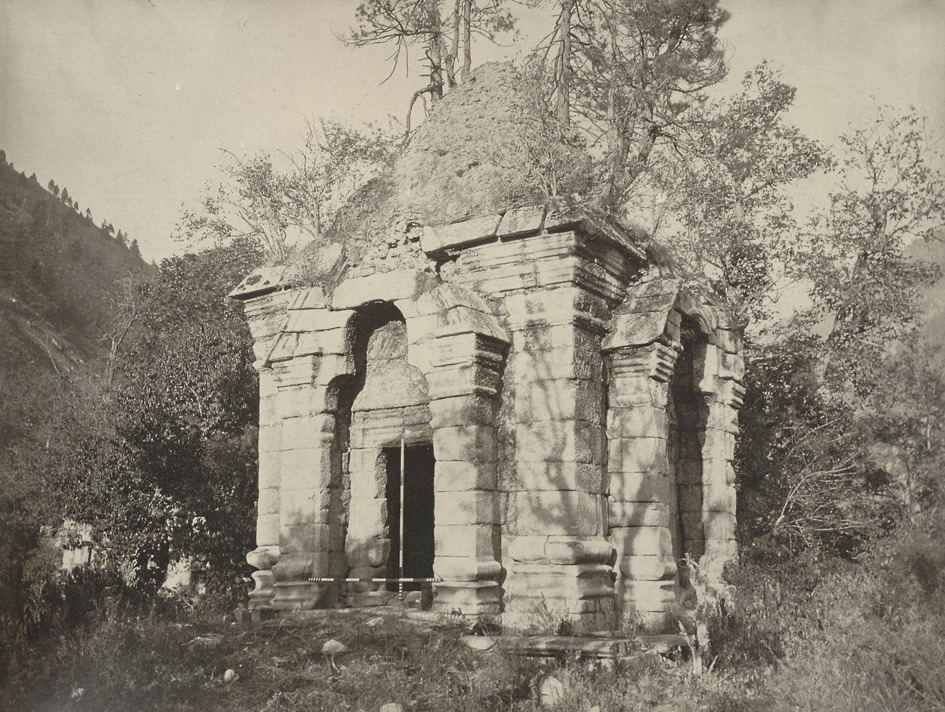
Duck inside and look up: a rough dome of rubble, oddly crude above such carefully cut walls. The carving round the doors and niches has mostly weathered away. Someone has since put a tin roof over the top to keep the snow off. Not pretty, but it helps.
The eastern group, Stein’s Bhutesha, is larger but more ruined. Its enclosure wall is pierced by a gateway, and within it a large central temple is surrounded by a crowd of smaller shrines, some no bigger than a cupboard, probably given by pilgrims and patrons over several centuries. The central temple has lost its roof, and its great stones lie scattered around the platform. Between the two groups are the remains of a long pillared building on a raised platform, with stone water tanks nearby, most likely the kind of matha or pilgrims’ hall that Kalhana says Sumanas built here.
The spring of Naran Nag
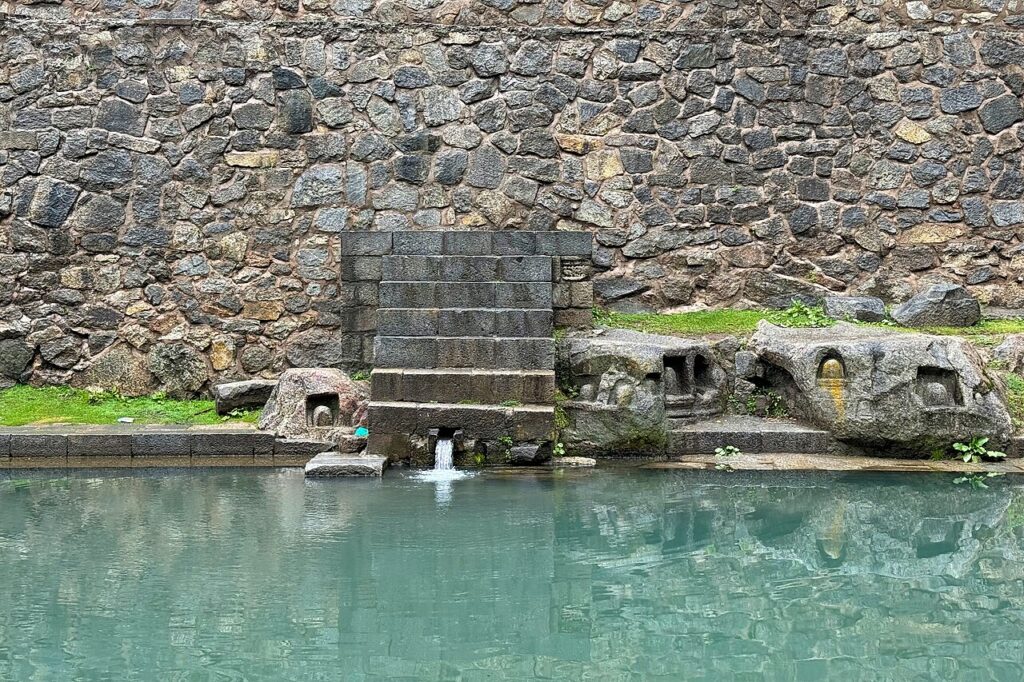
Every Kashmiri holy place has its spring, and at Naranag the spring has outlived the temples’ name. Beyond the north-east corner of the eastern enclosure, clear water rises into a stone-lined basin, walled with ancient slabs. Carved stones set around it hold small reliefs of Lingas. Kalhana called it the Sodara spring. Kalhana tells that Jalauka bathed there every day. One day, busy in Srinagar and unable to reach “the far-off Sodara spring”, the king saw water “suddenly breaking forth” from a dry spot, “alike to Sodara in colour, taste, and other respects” (I. 125–126). In Stein’s day the spring was the last stage of the Haramukh pilgrimage, where pilgrims bathed on their way home from the lakes.
The road to Gangabal
Naranag has always been a place of passage. In Stein’s time the great Haramukh-Ganga pilgrimage took place every year in the month of Bhadrapada (August–September) and was attended by thousands of pilgrims, who carried the ashes and bones of relatives who had died during the year to be placed in the waters of Gangabal. Pilgrims went up by one route, over the high ridge of Bharatagiri, and came down by another, past the temples of Bhutesha and the Sodara spring. Even then, Stein noted, the temples themselves had “long ceased to be places of worship”, although the pilgrims’ path still led past them.
People still make the Gangabal yatra. These days they share the path with trekkers in bright jackets, since Naranag to the lakes has become one of Kashmir’s favourite hikes.
A short timeline
- Legendary period: Ashoka obtains his son Jalauka from Bhutesha; Jalauka builds the first stone temple (I. 107, 148). Narendraditya I endows the shrine (I. 347).
- 8th century: Lalitaditya Muktapida gives eleven crores to Bhutesha and builds a “lofty temple of stone” for Jyeshtharudra (IV. 189–190).
- 855–883: Avantivarman gives a pedestal with a silver conduit (V. 46). The story of Dhanva and the bitter offering (V. 48–60).
- 11th century: the shrine’s treasury is plundered under Samgramaraja (VII. 106).
- 1101–1111: fire destroys the temple town; Uccala rebuilds it “finer than it was before” (VIII. 77, 110).
- Early 12th century: Kalhana’s father Canpaka visits for seven days every year (VII. 954).
- Reign of Jayasimha (1128–1155): raiders from the mountains plunder the shrine (VIII. 2756). Sumanas builds a pilgrims’ rest-house (VIII. 3356).
- 1148–49: Kalhana completes the Rajatarangini.
- 1860s: Bishop Cowie and H. H. Cole describe the ruins; John Burke photographs them.
- August 1891: Aurel Stein visits and identifies the ruins with Bhutesha and Jyeshtesha.
- Today: protected by the Archaeological Survey of India as the “Group of Ancient Temples, Naranag”.
Visiting Naranag
It’s roughly 50 km from Srinagar. Take the Sind valley road via Ganderbal to Kangan, turn off up the side valley past Wangath, and keep going until the tarmac gives out at Naranag village; the temples are a few minutes’ walk up the slope. Easily done in a day. Go in late spring if you can, before the grass gets long and while the peaks are still white, and you’ll see the stones properly. In summer it’s all meadow, and trekkers heading up to Gangabal.
And be gentle with the place. Twelve hundred winters these stones have taken. The carved bits lying around in the grass belong to the monument too, so please leave them where they are, and keep off the walls.
Sources and further reading
- M. A. Stein (translator), Kalhana’s Rajatarangini: A Chronicle of the Kings of Kashmir, 2 vols., Archibald Constable, Westminster, 1900. Quotations are from Vol. I (Books I–VII) and Vol. II (Book VIII), especially Stein’s notes on I. 107, I. 113, I. 148, IV. 190 and V. 46–59, and the memoir on ancient geography in Vol. II, § 57.
- H. H. Cole, Illustrations of Ancient Buildings in Kashmir, India Museum, London, 1869.
- W. G. Cowie, “Notes on some of the temples of Kashmir, especially those not described by General A. Cunningham”, Journal of the Asiatic Society of Bengal, vol. 35, part 1, 1866.
- Anand Koul, Archaeological Remains in Kashmir, Lahore, 1935.
- Ram Chandra Kak, Ancient Monuments of Kashmir, The India Society, London, 1933.
Featured photograph: the temples at Naranag, Kashmir Pages. Western group temple, 1868, by John Burke, from H. H. Cole’s survey, public domain, via Wikimedia Commons. Western group temple today, by Basavaraj K. Korkar, Wikimedia Commons, licensed CC BY-SA 4.0. Plan of the eastern group, by Ms Sarah Welch, Wikimedia Commons, CC0. Naran Nag spring, by UnpetitproleX, Wikimedia Commons, licensed CC BY-SA 4.0. All images resized.
You May Also Like
Travellers in Kashmir: From Bernier to Younghusband