Kalhana’s Rajatarangini: A Reader’s Guide to the River of Kings
Few places in the world have a history written as early, or as vividly, as Kashmir. In 1148 a poet named Kalhana sat down to write the story of the kings of his homeland in Sanskrit verse, and finished it a year or so later. His Rajatarangini, the “River of Kings”, is the first true work of history in Sanskrit, and almost nine centuries on it is still where the history of Kashmir begins. This guide explains who Kalhana was, how he worked, what his eight books contain, and how to start reading him, with passages quoted from Aurel Stein’s translation of 1900, which is free to read in our Library.
Who was Kalhana?
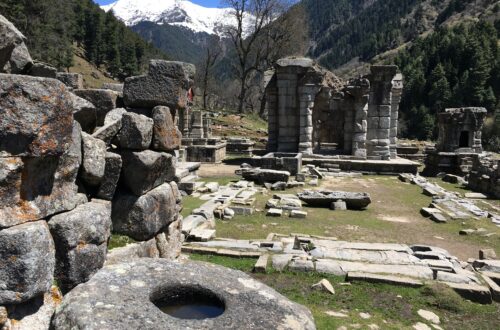
Kalhana was the son of Canpaka, who served at the court of King Harsha of Kashmir (1089–1101). He grew up close to the court and its politics, lived through the violent struggles that followed Harsha’s fall, and wrote in the reign of King Jayasimha. His account of his own times has the immediacy of an eyewitness: much of what he tells of Harsha’s last days, Stein believed, came from the only servant of his father’s household who survived the king’s flight. He was a Brahman and a devotee of Shiva, but, as Stein noticed, he wrote with unusual warmth of the Buddhist monasteries and stupas founded by Kashmir’s kings. His father went every year on pilgrimage to the shrines below Mount Haramukh, including the temples at Naranag, which Kalhana describes with a local’s knowledge.
A historian’s method
Kalhana was unusual for his age in caring about evidence and fairness. Immediately after the conventional opening in praise of poetry, he sets out what amounts to a historian’s creed:
“That noble-minded [poet] is alone worthy of praise whose word, like that of a judge, keeps free from love or hatred in relating the facts of the past.”
Rajatarangini, I. 7 (translated by M. A. Stein)
He then names his sources, and criticises them. The older chronicles, he says, “have become fragmentary” since a writer named Suvrata condensed them into an easily memorised poem, which “does not show dexterity … as it is rendered troublesome by misplaced learning”. The poet Kshemendra’s list of kings contained “not a single part … free from mistakes”. To correct them he went to the documents:
“Eleven works of former scholars containing the chronicles of the kings, I have inspected, as well as the [Purana containing the] opinions of the sage Nila. By looking at the inscriptions recording the consecration of temples and grants by former kings, at the laudatory inscriptions and at written works, the trouble arising from many errors has been overcome.”
Rajatarangini, I. 14–15
Inscriptions, land grants, coins and temple records: Kalhana used much the same evidence a modern historian would. He was not free of the beliefs of his age, and his early books mix history with legend and miracle, but on his own times he is a remarkably honest witness.
Kalhana’s Kashmir
Before he begins his history, Kalhana describes his land with open pride. It is a country where “there is not a space as large as a grain of sesamum without a Tirtha” (a sacred bathing place), where the sun, “out of respect, as it were, … does not burn fiercely”, and where
“Learning, lofty houses, saffron, icy water and grapes: things that even in heaven are difficult to find, are common there.”
Rajatarangini, I. 42
Most famously of all, he writes that Kashmir “may be conquered by the force of spiritual merits, but not by forces of soldiers” (I. 39), a line that Kashmiris have quoted ever since.
What the River of Kings contains
The work runs to nearly 8,000 verses, divided into eight books, each called a taranga, a “wave”. Roughly, the story moves from legend to history to the author’s own day:
- Book I: the creation of the valley from a great lake, and the early, largely legendary kings, among them Ashoka and his son Jalauka.
- Books II and III: further early dynasties, their chronology still uncertain, including the story of Pravarasena, founder of the city that became Srinagar.
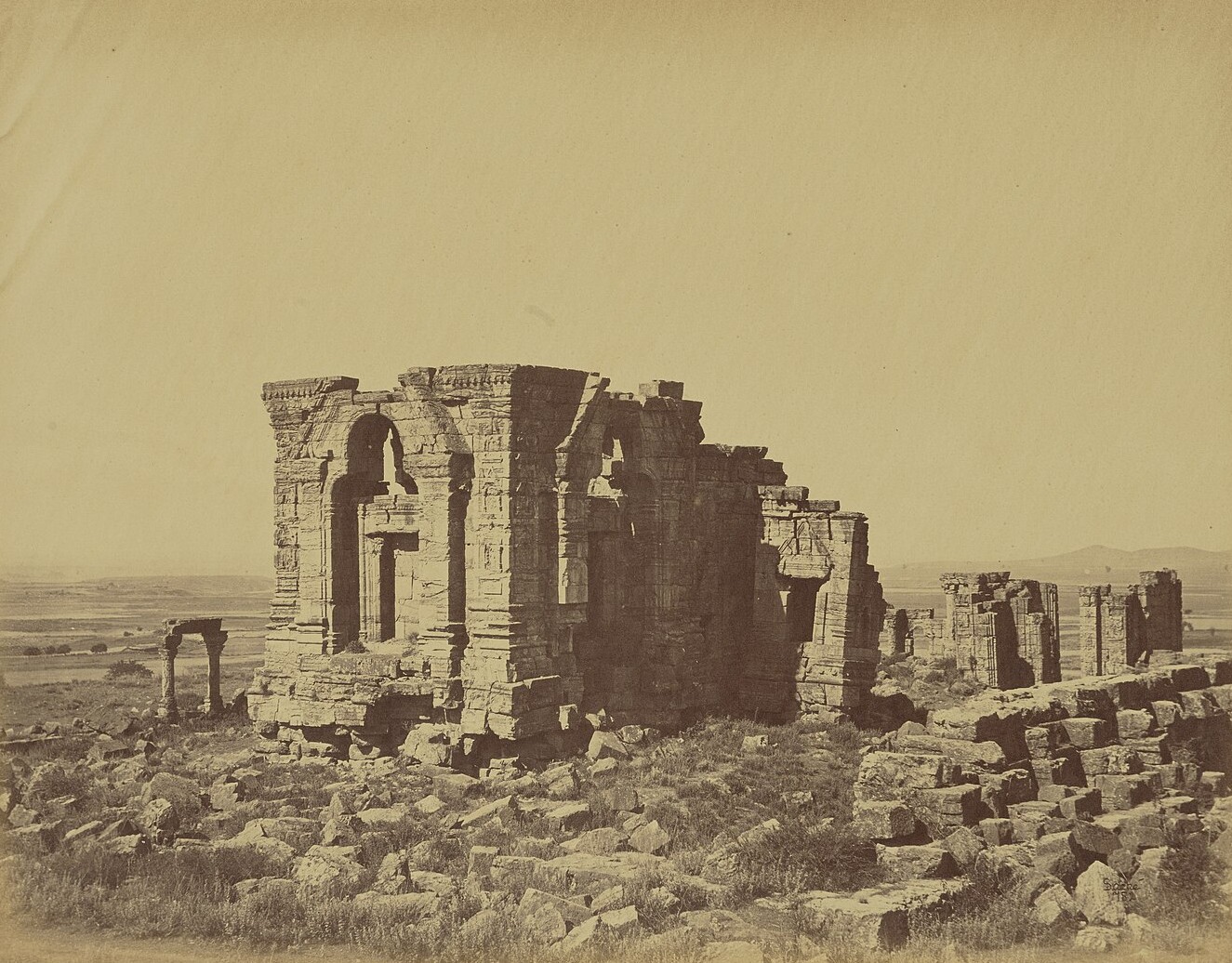
- Book IV: the Karkota dynasty, above all Lalitaditya Muktapida, the eighth-century conqueror who built the great sun temple at Martand and endowed shrines across the valley.
- Book V: Avantivarman (855–883), founder of Avantipora, and his engineer Suyya, who tamed the rivers of the valley.
- Book VI: the age of Queen Didda, who dominated Kashmir for half a century at the end of the tenth century.
- Books VII and VIII: the eleventh and twelfth centuries, Kalhana’s own world, told in great detail. Book VIII alone is longer than the first six books together.
A story from the chronicle: Suyya and the gold in the river
One of the best-loved passages tells how Suyya, a foundling of humble birth, drained the flooded valley in the reign of Avantivarman. Floods had ruined the harvests and the people were starving. Suyya went about saying he had the knowledge to fix it, and the courtiers called him mad. The king, curious, gave him the treasury. Suyya took boats loaded with pots of coins, dropped one into the flood at a drowned village, and then, at the narrow gorge below Baramulla where fallen rocks had choked the Jhelum, “threw with both hands money (dinnara) into the water”. In Stein’s translation:
“… the famine-stricken villagers then searched for the money, dragged out the rocks from the river, and [thus] cleared the [bed of the] Vitasta.”
Rajatarangini, V. 89
Suyya then dammed the river for seven days, cleared its bed, built stone walls against falling rocks, and redirected the confluence of the rivers so that the water drained away. New land rose from the floods, villages were founded on it, and the price of rice fell. The town of Sopore, Suyyapura, still bears his name. Stein, who walked the gorge himself, found that the place Kalhana names lies at a rocky spur just where the first serious rapid of the river begins, exactly where clearing the bed would lower the water across the valley.
The chronicle continued
Kalhana started a tradition. Jonaraja carried the story on to the fifteenth century and the reign of Sultan Zain-ul-Abidin; his pupil Srivara continued it; and Prajyabhatta and Shuka took it down to the Mughal annexation of Kashmir in 1586. Zain-ul-Abidin had the Rajatarangini translated into Persian, and the Mughal historian Badauni was later ordered by Akbar to complete a new Persian version, reading stories from it to the emperor at night. In the seventeenth century Haidar Malik drew on it for his Persian history of Kashmir, which the French traveller Bernier set out to translate. Through these versions Kalhana’s chronicle shaped the way Kashmir’s past was told for centuries.
Aurel Stein and the manuscripts
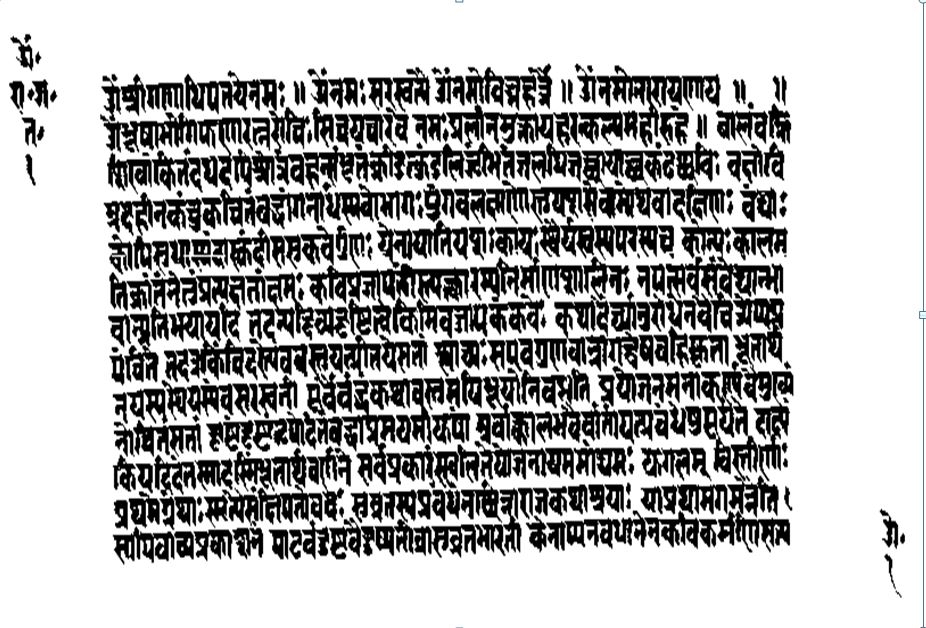
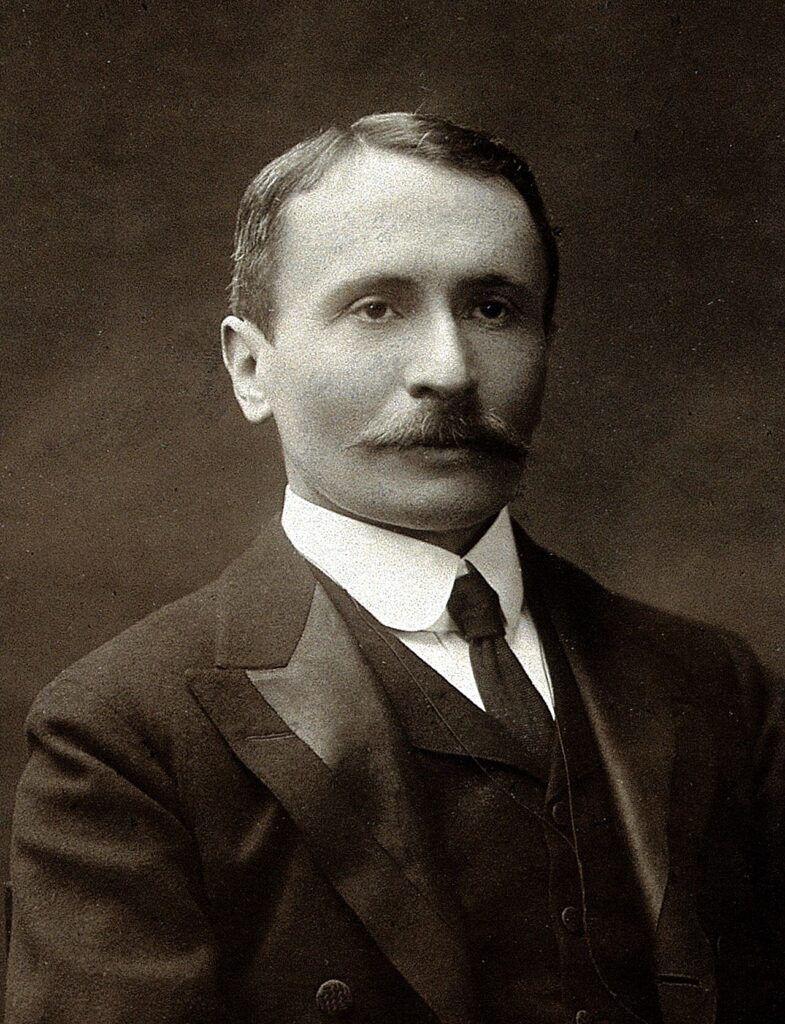
The first European translation was Anthony Troyer’s French version (1840–1852), based on faulty manuscripts. The English one everybody uses is Aurel Stein’s. He was Hungarian, oddly enough, and at the time ran the Oriental College in Lahore, but summer after summer through the 1880s and 90s he was up in Kashmir. Kashmiri Pandits helped him, Pandit Govind Kaul more than anyone, and between them they tracked down the one manuscript all the others had been copied from, a codex written in the seventeenth century in the Sharada script by the Kashmiri scholar Rajanaka Ratnakantha, and published a critical edition of the Sanskrit text in 1892.
Then he did something no translator had done: he walked the valley, summer after summer, with Kalhana’s text in hand, identifying the places the chronicle names. His notes and his long “Memoir on the Ancient Geography of Kashmir” turned the Rajatarangini into a map. His translation, with introduction, notes and memoir, appeared in two volumes in 1900. Stein went on to become one of the great explorers of Central Asia, but he kept a camp on the meadow of Mohand Marg, above the Sind valley, for many summers.
How to read it
Kalhana’s verse is dense and his cast of characters enormous, so it helps to have a plan. We suggest:
- Start with Stein’s introduction (Vol. I), which explains Kalhana’s life, sources and chronology.
- Read Book I, verses 1–50, for Kalhana’s method and his description of Kashmir.
- Then Books IV to VI, for Lalitaditya, Avantivarman and Suyya, and Queen Didda.
- Finish with Book VIII (Vol. II), some of the most gripping political narrative in any language.
- Keep the Memoir at hand (Vol. II), to find the places on the map. Many of Stein’s notes read like small essays.
Read it in the Library
- Kalhana’s Rajatarangini, a Chronicle of the Kings of Kashmir, Vol. I, translated by M. A. Stein, 1900: introduction and Books I–VII.
- Vol. II, which has Book VIII plus Stein’s memoir on old Kashmiri geography (worth it for the maps alone).
- Lawrence’s Valley of Kashmir (1895), if you want Kalhana boiled down into a few readable chapters.
Sources and further reading
- M. A. Stein (tr.), Kalhana’s Rajatarangini: A Chronicle of the Kings of Kasmir, 2 vols, Archibald Constable, Westminster, 1900.
- Ranjit Sitaram Pandit (tr.), River of Kings (Rajatarangini), Indian Press, Allahabad, 1935.
- A. Troyer (tr.), Radjatarangini, histoire des rois du Kachmir, Paris, 1840–1852.
Featured photo: the ruins of the Martand sun temple, built by King Lalitaditya in the eighth century, photographed by John Edward Saché in 1873, J. Paul Getty Museum, CC0, via Wikimedia Commons. Manuscript folio, Shri Ranbir Research Institute, Jammu, public domain, via Wikimedia Commons. Sir Aurel Stein, photographed by Thompson, The Grosvenor Studios, Wellcome Collection, Wikimedia Commons, CC BY 4.0.
You May Also Like
The Temples of Naranag: Bhutesha and Jyeshtesha below Mount Haramukh