O Soul at Peace: Surat al-Fajr in an Illuminated Qur’an of 1874
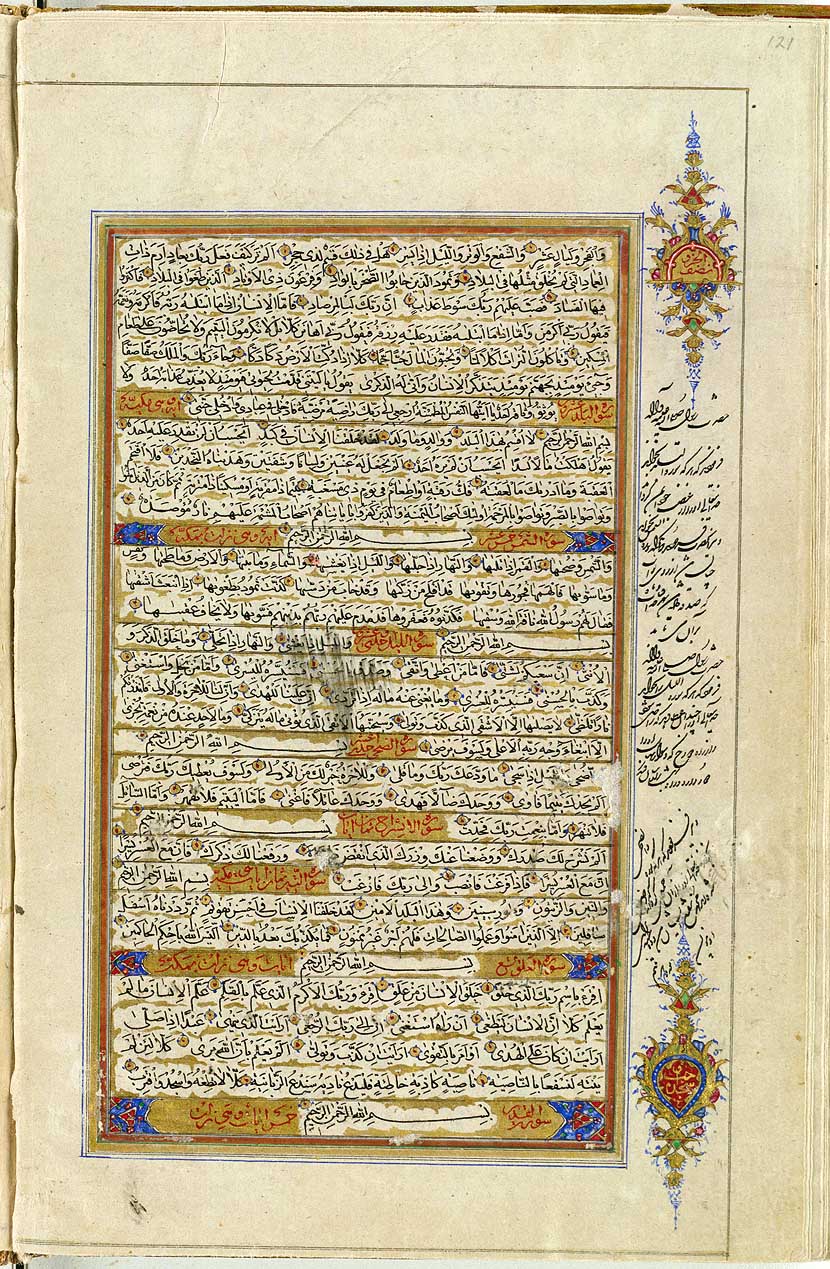
Ask people for their favourite lines in the Qur’an and the end of Surat al-Fajr, “The Dawn”, comes up a lot. The verses talk to the soul as its journey closes. Sufis read them as a map of the last stretch of the inner road. Here they are on a page of an illuminated Qur’an copied in 1874, and the scribe got the entire surah into seven lines of small naskh.
| Text | Qur’an, Surat al-Fajr (89), the whole surah, ending with verses 27–30 |
| Form | A page from a manuscript Qur’an, ink, colours and gold on paper |
| Script | Naskh, written on gold “cloud bands”; surah headings in decorative script |
| Date | 1874 |
| Decoration | Gold verse markers, illuminated surah headings, ruled borders and marginal medallions |
The verses
يَا أَيَّتُهَا النَّفْسُ الْمُطْمَئِنَّةُ ارْجِعِي إِلَىٰ رَبِّكِ رَاضِيَةً مَرْضِيَّةً فَادْخُلِي فِي عِبَادِي وَادْخُلِي جَنَّتِي
Yā ayyatuha n-nafsu l-muṭmaʾinna. Irjiʿī ilā rabbiki rāḍiyatan marḍiyya. Fa-dkhulī fī ʿibādī. Wa-dkhulī jannatī.
“O soul at peace, return to your Lord, well pleased and well pleasing. Enter among My servants, and enter My Garden.”
Reading the page
Start at the top right. Wa-l-fajr, wa-layālin ʿashr: “By the dawn, and the ten nights”. Thirty verses follow, squeezed into those first seven lines, every one closed off with a tiny gold rosette. The four about the soul at peace are on line seven, pressed up against the gold heading of the next surah, al-Balad, “The City”. Then on it goes, one short surah after another. Al-Balad, al-Shams, al-Layl, al-Duha, al-Sharh, al-Tin, al-ʿAlaq.
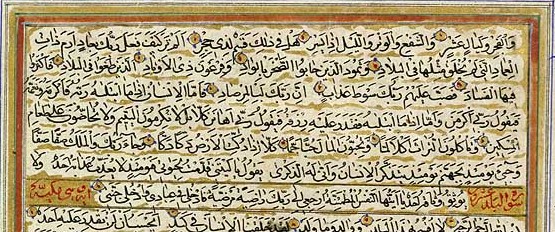
The writing’s in naskh. Round, clear, the hand you’ll meet in most Qur’ans. Get up close and every line has a little gold “cloud band” behind it, outlined in ink as thin as a hair, so the words seem to float. Titles get something showier, in boxes of gold and red and blue. Painted medallions out in the margins, too, and notes in a smaller hand. Those notes look like Persian to us. If so, the book was probably made, or at least read, somewhere Persian was spoken.
The soul at peace
For the Sufis these verses name the top rungs of the self, the nafs. A soul at peace (al-nafs al-muṭmaʾinna) has stopped fighting God. It’s well pleased (rāḍiya), content with whatever its Lord sends. And it’s well pleasing (marḍiyya): God is content with it, too.
How does anyone get there? Sufi teachers describe a climb in stages, and each stage takes its name from a verse. At the bottom is the commanding self (al-nafs al-ammāra), the everyday ego, pushed about by appetite, temper and habit. Its verse is from Surat Yusuf: “The soul surely commands to evil” (12:53). Next, the blaming self (al-nafs al-lawwāma). This one has woken up just enough to scold itself. “And I swear by the self-reproaching soul,” says Surat al-Qiyama (75:2).
Third comes the inspired self (al-nafs al-mulhama), which starts catching glimpses of something higher. Its name comes from “and inspired it with its wickedness and its righteousness” (Surat al-Shams 91:8), and that verse is right here, a few lines down this same page. Then, at last, the soul at peace, and after it the well-pleased and well-pleasing soul. Those are the stations of our verses (Surat al-Fajr 89:27–28).
Plenty of later teachers put one more step on top, the complete self (al-nafs al-kāmila). You won’t find that phrase in the Qur’an. It’s their word for a soul that has gone through all the others. Kashmir has its own voices for the same longing for a soul at rest: listen to the sayings of Lal Ded, or the verses of Sheikh Nooruddin.
Images: page from a manuscript Qur’an of 1874, with Surat al-Fajr and the surahs that follow it, and a detail of the same page. Public domain, via Wikimedia Commons.
You May Also Like
A Secret of God in the Calligrapher’s Hand: An Ottoman Qit’a of 1785