Travellers in Kashmir: From Bernier to Younghusband
For four centuries, outsiders have tried to put Kashmir into words. Mughal emperors, French physicians, British surveyors, missionaries, soldiers and adventurous Victorian women crossed the mountain passes and wrote about what they found. Their books are uneven: some are full of the prejudices of empire, others of real affection and careful observation. Read together, they form an extraordinary record of the valley, its people and its changes. Many of them are free to read in the Kashmir Pages Library.
The early travellers
1665: François Bernier
The French physician accompanied the emperor Aurangzeb to Kashmir and wrote the first detailed European description of the valley, its gardens, lakes and people, in his Travels in the Mogul Empire. Nearly every later traveller quoted him.
1783: George Forster
An East India Company servant who travelled overland from Bengal towards England in disguise, passing through Kashmir under Afghan rule. His account is one of the few from that troubled period.
1823: William Moorcroft
The Company’s veterinary surgeon, searching for horses and trade routes into Central Asia, spent months in Ladakh and Kashmir and recorded agriculture, trade and the shawl industry in close detail. Read Travels in the Himalayan Provinces, Vol. I.
1835–1838: Baron Charles von Hügel and G. T. Vigne
Two very different travellers reached the valley under Sikh rule within months of each other: the Austrian naturalist Hügel, who went on to Ranjit Singh’s court, and the English artist Vigne, who drew the temples and gardens and went on to Ladakh and Skardu. Read Hügel’s Travels in Kashmir and the Panjab and Vigne’s Travels in Kashmir, Ladak, Iskardo.
The Victorian valley
1863: William Henry Knight
A young Englishman who walked through Kashmir and into Ladakh and wrote a lively, opinionated journal. Read Diary of a Pedestrian in Cashmere and Thibet.
1862–1872: Frederic Drew
A geologist in the service of the Maharaja, who travelled nearly every part of the state and for a time governed Ladakh. His survey of its land and peoples is still cited. Read The Northern Barrier of India.
1870s: W. Wakefield and Mrs J. C. Murray Aynsley
Two books of the same year, 1879: a doctor’s sketches of Srinagar and the Kashmiris, and a lady’s letters home from a long tour of India, Kashmir and Ladakh. Read The Happy Valley and Our Visit to Hindostan, Kashmir, and Ladakh.
1889–1895: Walter Lawrence
Not a traveller but a settlement officer, who went from village to village to assess the land and listened to the cultivators. His book is the great nineteenth-century account of Kashmir. Read The Valley of Kashmir.
1891: E. F. Knight
A journalist who travelled through Ladakh and Baltistan to Gilgit and found himself reporting the British campaign in Hunza and Nagar. Read Where Three Empires Meet.
The twentieth century
1901–1908: Marion Doughty, Margaret Cotter Morison and P. Pirie
Three very different books from the early 1900s: a woman’s journey on foot through the side valleys, another woman’s summer spent largely on her own, and a portrait of the valley’s rivers and quiet places. Read Afoot Through the Kashmir Valleys, A Lonely Summer in Kashmir and Kashmir: The Land of Streams and Solitudes.
1909: Sir Francis Younghusband
The explorer who led the British mission to Tibet in 1904, and then served as British Resident in Kashmir, wrote a celebrated book on its scenery, history and ruins, illustrated with colour paintings. Read Kashmir.
1915–1922: Ernest Neve, Scott O’Connor and Tyndale Biscoe
A mission doctor’s life among patients and mountains, a writer’s portrait of the valley in all its seasons, and the founder of Srinagar’s famous mission school on the people he spent his life among. Read Beyond the Pir Panjal, The Charm of Kashmir and Kashmir in Sunlight & Shade.
Reading them today
These books were written by outsiders, mostly for readers in Britain, and they often say as much about their authors as about Kashmir. But they also preserve things found nowhere else: descriptions of buildings now lost, prices and wages, crafts and customs, the condition of the peasantry, and the look of Srinagar before the motor road. Read them critically, alongside Kashmir’s own writers, from Kalhana to Lal Ded, and they become an invaluable window on the past.
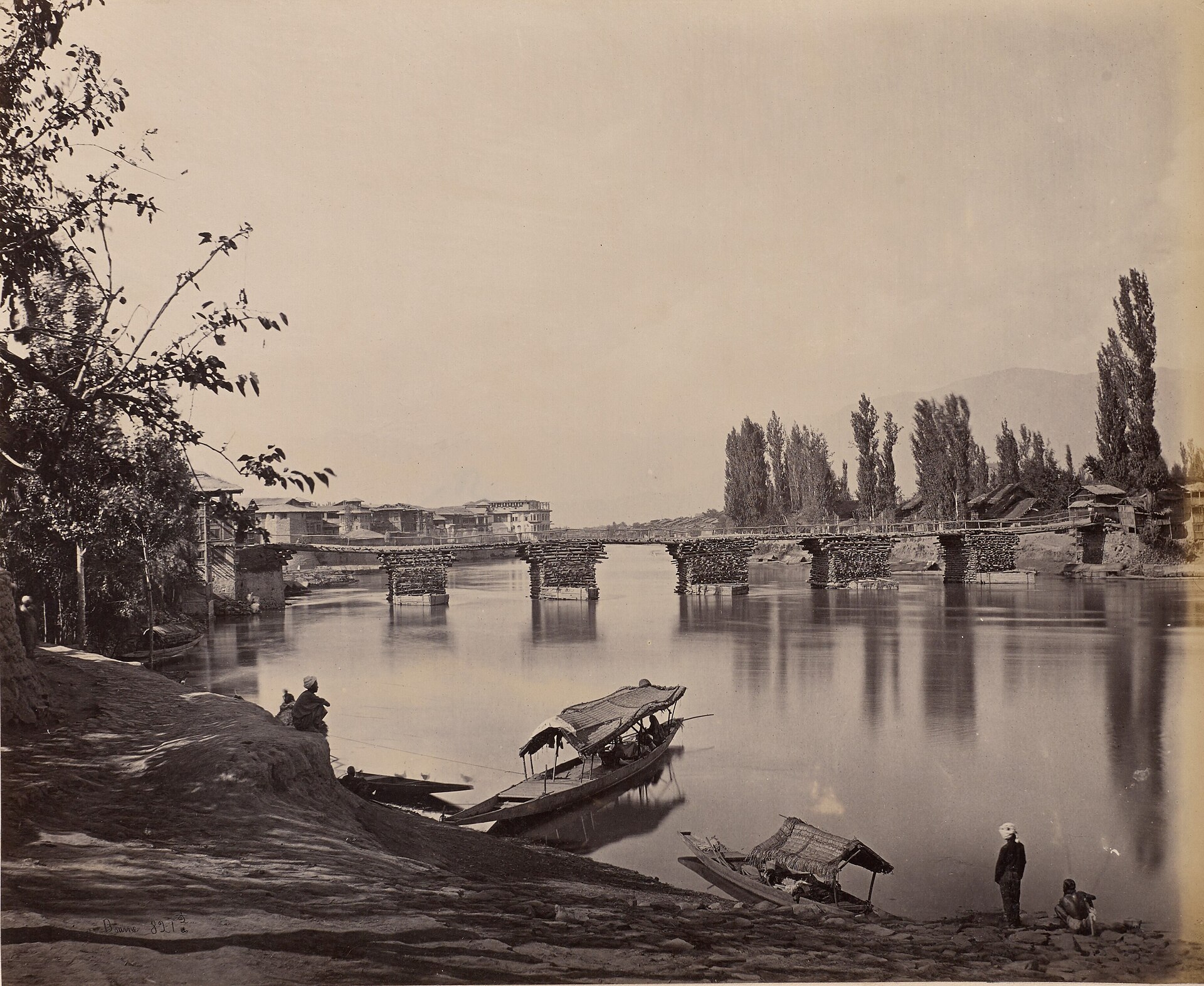
Featured photo: the Jhelum at Srinagar, photographed by Samuel Bourne in 1864. Public domain, via Wikimedia Commons.
You May Also Like
Kalhana’s Rajatarangini: A Reader’s Guide to the River of Kings