Kashmiri Papier-mâché: The Art of Kar-i-Qalamdani
In the bazaars of Srinagar, and in museums from London to Los Angeles, you will find small boxes, bowls and trays glowing with flowers, birds and gold. They are made of nothing more precious than paper. Kashmiri papier-mâché, known in the valley as kar-i-qalamdani, “pen-case work”, is one of Kashmir’s most recognisable crafts. It is also one of the best documented: travellers and officials who watched the painters at work in the nineteenth century left detailed descriptions of the materials, the methods and the patterns, and of the changes that came with foreign buyers. This article draws on those accounts.
The pen case
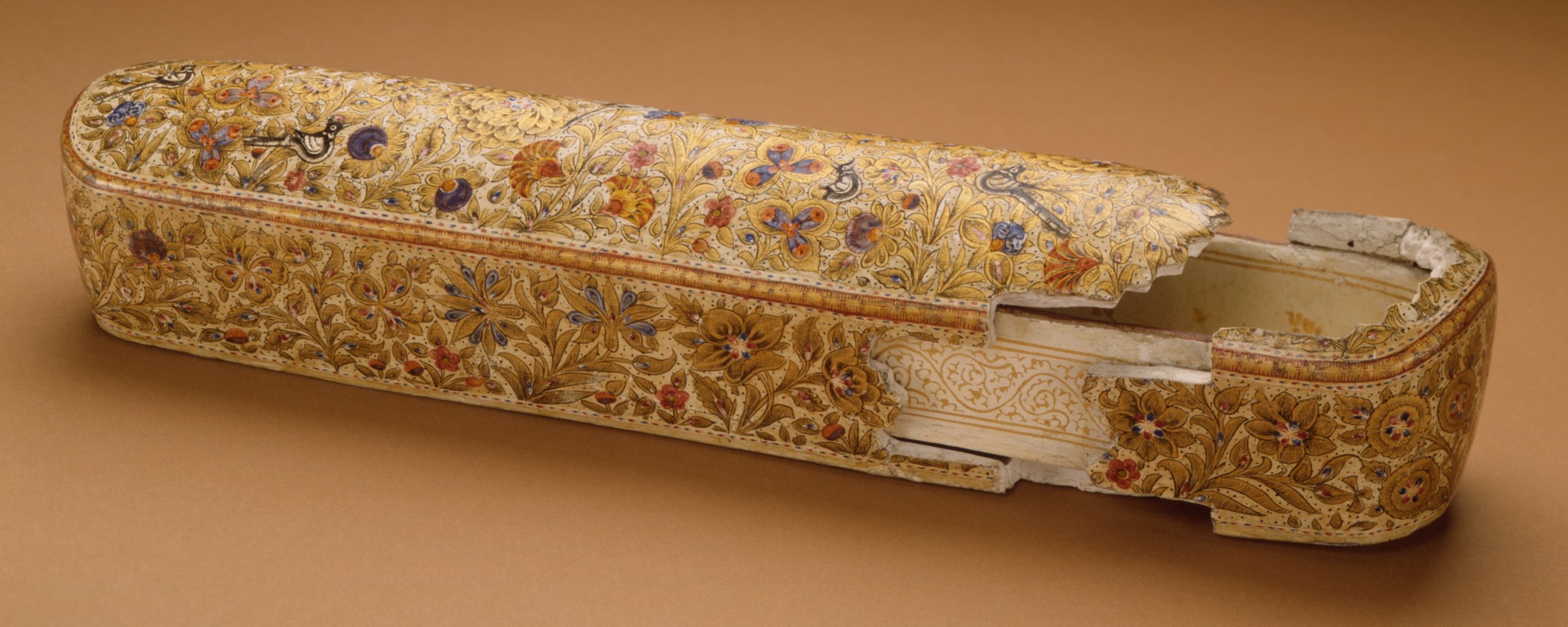
In the Persian-speaking world every scholar, secretary and scribe carried a qalamdan, a long, narrow box for reed pens, with a small compartment for ink. In Iran these were often made of lacquered papier-mâché, and Kashmir developed its own version of the art. William Moorcroft, who lived in Srinagar in 1822–23, described the Kashmiri pen cases in detail:
“A branch of manufacture for which Kashmir has long been celebrated, is that of ornamented pen-cases made of paper. They are of several varieties, classed under two heads — Masnadi, or royal, and Farsi, or Persian: — the former are articles of table-furniture, more or less bulky; the latter are portable. They are usually long, shallow boxes, rounded at the ends, with a sliding convex cover … Part of the interior is separated to hold an inkstand. They are remarkable for the variety and elegance of the patterns with which they are painted, most generally of flowers, for the brilliancy of their colours, and the beauty of the varnish.”
William Moorcroft, Travels in the Himalayan Provinces, Vol. II (1841)
The pen case gave the whole craft its name. Long after Kashmiri painters had moved on to tea-caddies, trays and tables, the work was still called kar-i-qalamdani, or sometimes kar-i-munaqqash, “painted work”. The painters themselves were the naqqash.
Kashmiri tradition connects the arrival of the craft, like several others, with the Persian and Central Asian artisans who came to the valley in the fourteenth and fifteenth centuries, in the time of Mir Sayyid Ali Hamadani and of Sultan Zain-ul-Abidin. The oldest surviving pieces are much later, mostly from the late eighteenth and nineteenth centuries, but by Moorcroft’s time the pen cases had “long been celebrated”.
Written paper and Kashmiri paper
Kashmir was famous for its paper, which was made “in considerable quantity, from old cloth of the san-hemp, and from cotton rags”, and was prized across northern India for manuscripts. The pen cases, Moorcroft noted, were “most commonly made of paper, which has been written upon, but sometimes of light wood”. In other words, old letters, accounts and worn-out manuscripts were soaked and reused as the raw material of the craft. Some fragments of writing can still be seen in the cores of broken old pieces.
Making the form: sakhtsazi
The work falls into two stages, often done by different families. The first, now called sakhtsazi, is making the object itself. George Watt, who organised the great Delhi exhibition of Indian art in 1902–03 and examined the Kashmiri work closely, explained that true Kashmiri papier-mâché differed from European:
“The paper is never exactly reduced to a pulp. It is simply softened and pasted together, layer upon layer, within a mould until by repeated slow drying and replacing within the mould while additions are made the article attains the correct shape and desired thickness. While moist it is wrapped round with a thin muslin rag and covered with a layer of a dressing material said to be plaster-of-paris (or gach). The article is next smoothed and rubbed down till it is given the required uniform surface to allow of the ground colour (samin) being imparted.”
George Watt, Indian Art at Delhi, 1903
Today the process is much the same. Soaked paper, sometimes mixed with rice-straw or cloth fibre and a glue, is laid over a wooden or clay mould and left to dry, often for days. The form is cut from the mould, joined, rubbed smooth with a stone and covered with layers of a fine base coat before it passes to the painter.
Painting: naqashi
The second stage, naqashi, is the painting, and it is here that the real art lies. Moorcroft lists the painters’ materials, gathered from across Asia: cochineal or the native kirm insect for red, “ultra-marine from Yarkand, white-lead from Russia, as well as verdigris from Surat, and possibly from Britain”. The ground was commonly metallic, of gold or tin. The brushes were made “of the hair of the shawl-wool goat, and the pencils from the hairs in the fur of the cat”.
He describes two kinds of painting, flat and raised. For raised work the painter built up the ornament with white lead mixed with glue, laid on in dots that were left to dry, trimmed with a knife, coated with glue and then coloured, so that “birds and butterflies” stood out in low relief among the flowers. Raised gold work of this kind is still one of the marks of fine Kashmiri pieces.
Unlike European papier-mâché, which was usually painted on a black ground, the Kashmiri painters worked on a light one. Watt found the ground of the best old work “pure white”, painted over in water colours. Every line was drawn freehand. Walter Lawrence, writing in the 1890s, admired the painters’ skill: their “designs are very intricate, and the drawing is all freehand, for the workmen do not possess mathematical instruments. The skill shown by the naqqash in sketching and designing is remarkable.”
The varnish
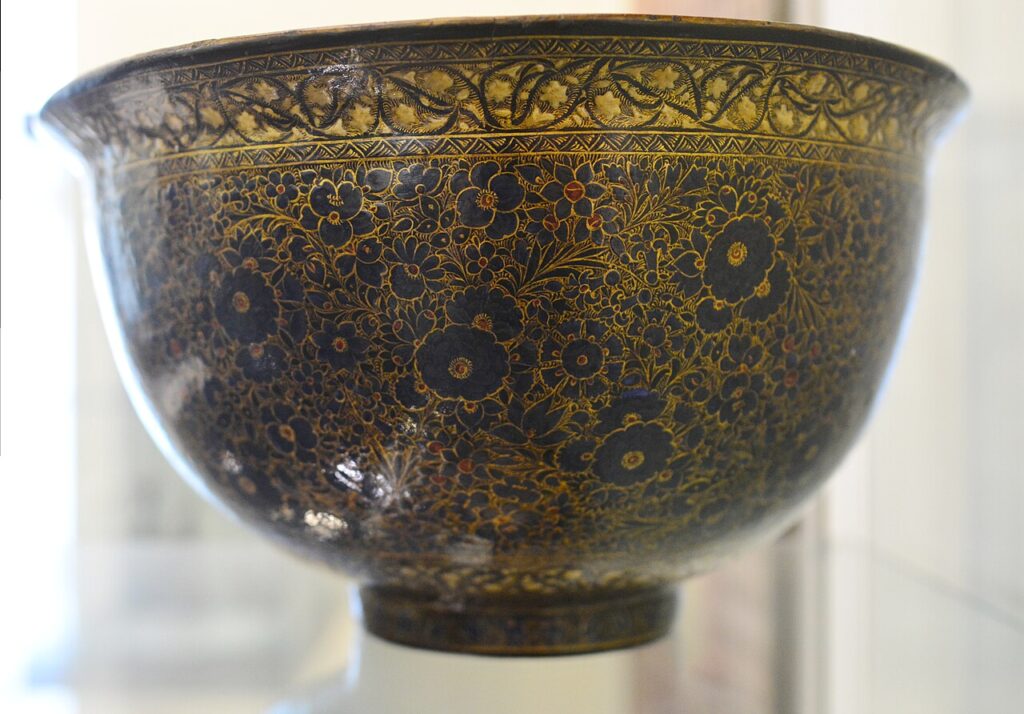
The final coat of clear varnish protects the painting and gives Kashmiri work its warm glow. Moorcroft says varnishes were made from the resin of aloe or storax, “but the best is that of the Kahruba, which is usually regarded as amber, but is by some said to be copal”. Fifty years later B. H. Baden-Powell, describing the work shown at the Punjab Exhibition of 1864, recorded a varnish “made by boiling the clearest copal (sundras) in pure turpentine”, which had to be “perfectly transparent, or it would spoil the appearance of the painting”. Watt confirms the same recipe, “copal (sundras) dissolved in turpentine, not boiled in oil”. The varnish, Baden-Powell’s jury noted, could darken with age, which is why many old pieces now look richer and browner than they did when new.
The patterns
Kashmiri papier-mâché shares its language of ornament with the shawl. Baden-Powell noted that “flowers, and the curved designs seen upon shawls, are most commonly produced”, painted chiefly in crimson, green and blue, together with “a very pretty pattern … by painting with gold paint a spreading series of minute branches and leaves on a white ground”. Watt described three classic styles in 1903:
- The shawl pattern, with the cone and floral borders of the woven shawl, in pale colours on a white ground. Watt found a fine old table in this style in the Kashmir State treasury and had it bought for the Lahore Museum.
- The rose pattern, “bunches of small red roses and birds clustered gracefully together, all over the surface”. Watt considered a small, dull-coloured old pen holder in this “minute rose pattern with birds within the twigs” to be “perhaps the best piece in the whole series”.
- The gold arabesque, fine gold scrollwork on a dull grey or dark ground.
Painters today use many of the same designs, together with others: the hazara or “thousand flowers”, an all-over pattern of tiny blossoms; gul-andar-gul, “flower within flower”; the chinar leaf; the iris; and hunting and landscape scenes. Pieces in black and gold, like the bowl above, and in white and gold remain favourites.
From pen cases to palaces
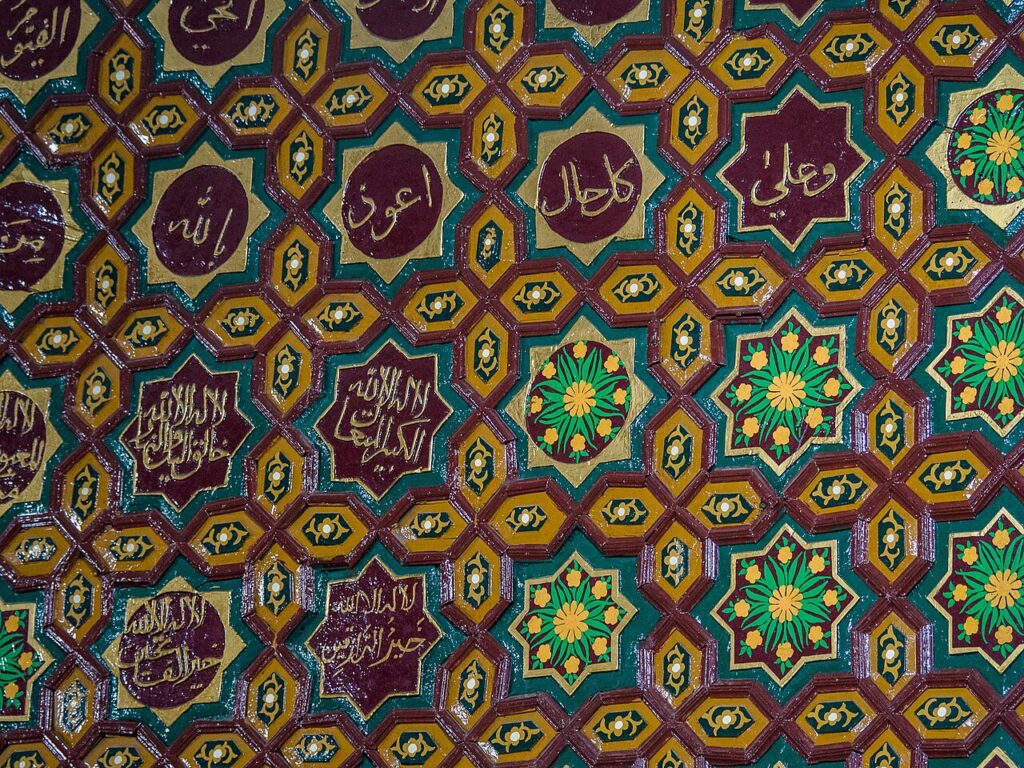
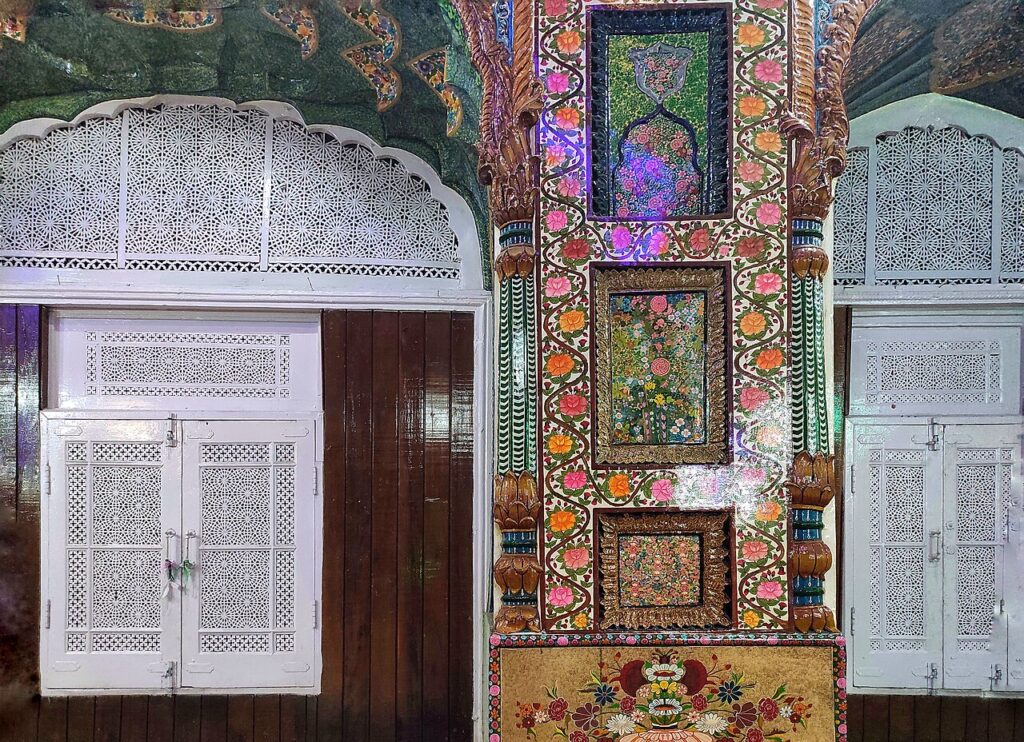
The same painting was never confined to small objects. Moorcroft saw it applied “to palankins, elephant houdas, and even to the walls and ceilings of rooms”, and Lawrence noted that “the richer classes call in the naqqash for the decoration of their ceilings and walls”. The finest surviving example is the interior of the Khanqah-e-Moula, the shrine of Shah-i-Hamadan on the Jhelum in Srinagar, whose walls and ceilings are covered with painted panels of flowers, geometric stars and calligraphy. Other shrines in Srinagar, among them the shrine of Sheikh Hamza Makhdoom on Hari Parbat, are decorated in the same way.
Foreign buyers and changing taste
In the nineteenth century the craft found a new market among European visitors. By 1872 Baden-Powell could report that “since an European demand has arisen, tea-caddies, glove-boxes, paper cases, and vases, have been made at Srinagar to order, and even articles of furniture”. The jury of the 1864 exhibition admired a large lacquered table sent by the Maharaja of Kashmir, “richly in flower work”, with a varnish “very transparent”, but noted sadly that its top had warped.
The new market was a mixed blessing. Lawrence wrote that “papier-mache has perhaps suffered more than any other industry from the taste of foreign purchasers”, and contrasted the old export trade to Afghanistan with the tourist trade of his own day:
“Ask an old artist in papier-mache to show the work which formerly went to Kabul, and he will show something very different from the miserable trash which is now sold. But the Pathans of Kabul paid the price of good work; the visitors to the valley want cheap work, and they get it.”
Walter R. Lawrence, The Valley of Kashmir (1895)
Watt, a few years later, described the same decline from a craftsman’s point of view. The most serious change, he thought, was that real papier-mâché was being replaced by painted wood, which was quicker to make. With it went whole classes of objects that could only be made from moulded paper: “The charming coffee-sets so admirably finished that the warmest coffee might be drunk with impunity from them, are no longer procurable. The many-cornered trays, too troublesome to be made of wood, have all but disappeared.” Watt was surprised that neither the palace nor the State museum in Srinagar had kept examples of the old work, and warned that if Kashmir ever wished to revive the art, “it will have to go to the Museums of Europe and America for the most desirable models”.
Not every craftsman gave way. At the Delhi exhibition Watt singled out the work of Jabbar Khan of Srinagar, whose tables, trays, vases and screens in the shawl and rose patterns were on sale. The jury gave first prize and a silver medal to the old papier-mâché table from the Kashmir State, and a silver medal to Jabbar Khan for his collection.
The craft today
Papier-mâché is still made in the workshops of old Srinagar, where families of sakhtsaz and naqqash continue to work, alongside a large trade in cheaper machine-made imitations. Kashmir papier-mâché is registered as a Geographical Indication, which protects the name for genuine hand-made work from the valley. A fine piece is still made entirely by hand: the moulding and drying may take weeks, and the painting of a single box can take many days. The best work, in the old rose and shawl patterns and in raised gold, can be compared with the museum pieces Watt so admired.
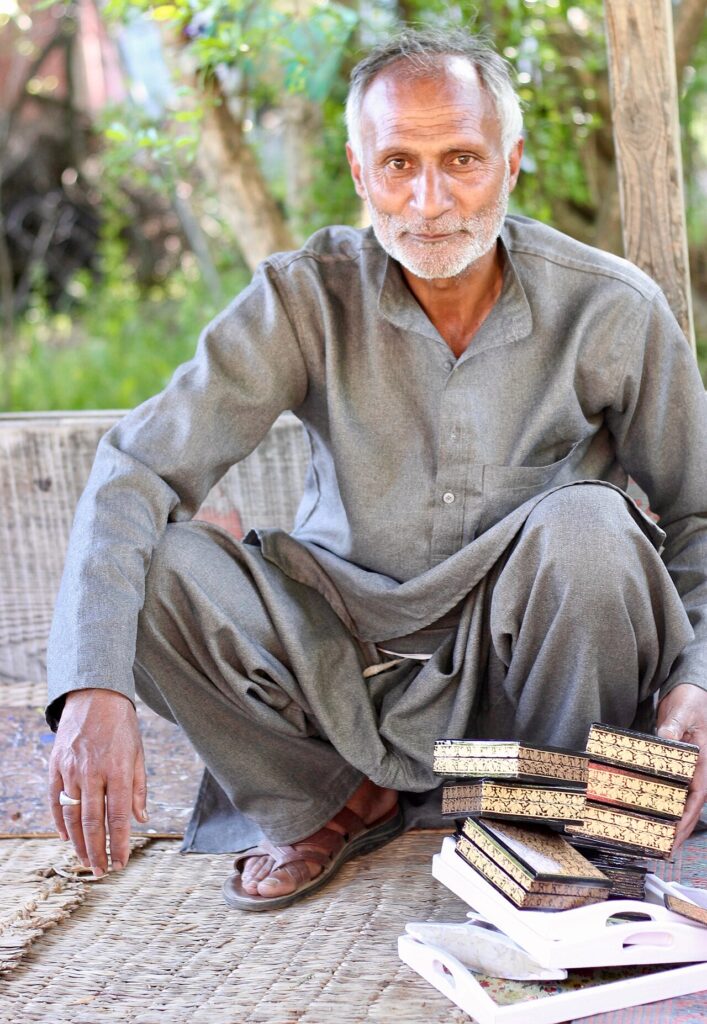
Buying a piece?
Pick it up first. Proper papier-mâché feels surprisingly light; if it’s heavy, you are probably holding painted wood. Then put your nose close to the painting. Freehand work wobbles very slightly and lives; stencils and prints don’t. Real gold has a soft glow, whereas bronze powder (the cheap substitute) goes dull and greenish with time. And open the box. A good maker finishes the inside as lovingly as the lid.
Sources and further reading
- William Moorcroft and George Trebeck, Travels in the Himalayan Provinces of Hindustan and the Panjab, ed. H. H. Wilson, John Murray, London, 1841, Vol. II, Part III, chapter 3.
- B. H. Baden-Powell, Hand-Book of the Manufactures and Arts of the Punjab, Lahore, 1872, Class XVII, “Papier Mâché and Painted Ware”.
- Walter R. Lawrence, The Valley of Kashmir, Henry Frowde, London, 1895, chapter XV.
- George Watt, Indian Art at Delhi, 1903: Being the Official Catalogue of the Delhi Exhibition, 1902–1903, Calcutta, 1903, Divisions 17 and 18.
Featured image: papier-mâché pen box (qalamdan), Srinagar, about 1800–1850, Los Angeles County Museum of Art, public domain, via Wikimedia Commons. Bowl, 19th century, Museum of Art Collections, Bucharest, by Joe Mabel, Wikimedia Commons, CC BY-SA 4.0. Walls of the Khanqah-e-Moula, by Mike Prince, Wikimedia Commons, CC BY 2.0. Shrine of Sheikh Hamza Makhdoom, by ThePoeticFrame, Wikimedia Commons, CC BY-SA 4.0. Papier-mâché artist, by Nagarjun Kandukuru, Wikimedia Commons, CC BY 2.0. Images resized.
You May Also Like
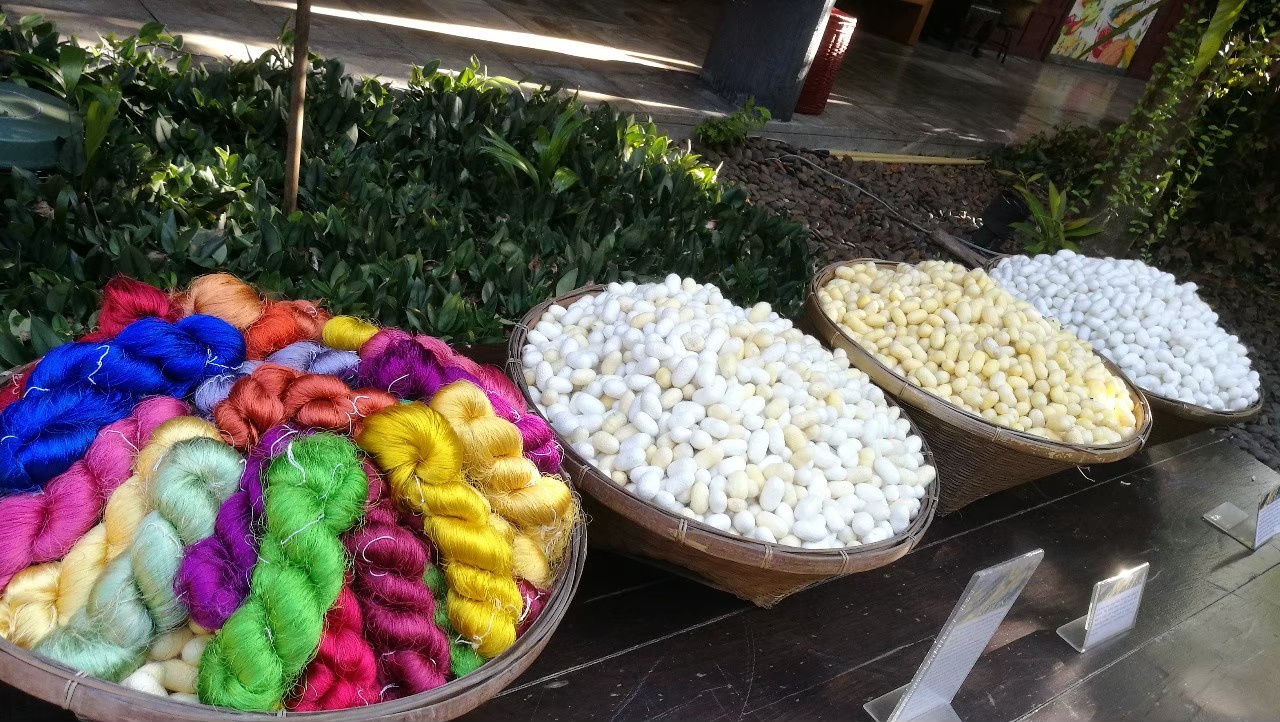
Kashmiri Silk: From Mulberry Trees to the Srinagar Silk Factory
Kashmir Woodwork: Walnut Carving, Pinjrakari and Khatamband