Kashmir Woodwork: Walnut Carving, Pinjrakari and Khatamband
Stone was for the old Hindu kings. Everything since has been wood. Mosques, shrines, the houses leaning over the Jhelum, the bridges, the houseboats: deodar and pine and fir off the hillsides, and walnut for anything that needed to look fine. Out of that came three crafts people outside Kashmir still go quiet over. Walnut cut so deep the leaves seem to lift off the panel. Pinjrakari, window lattice made of hundreds of little interlocking bits. And khatamband, ceilings of tiny geometric pieces that hold together with no nails at all. We lean here on a few writers who stood and watched the carpenters a century and more ago.
A wooden architecture
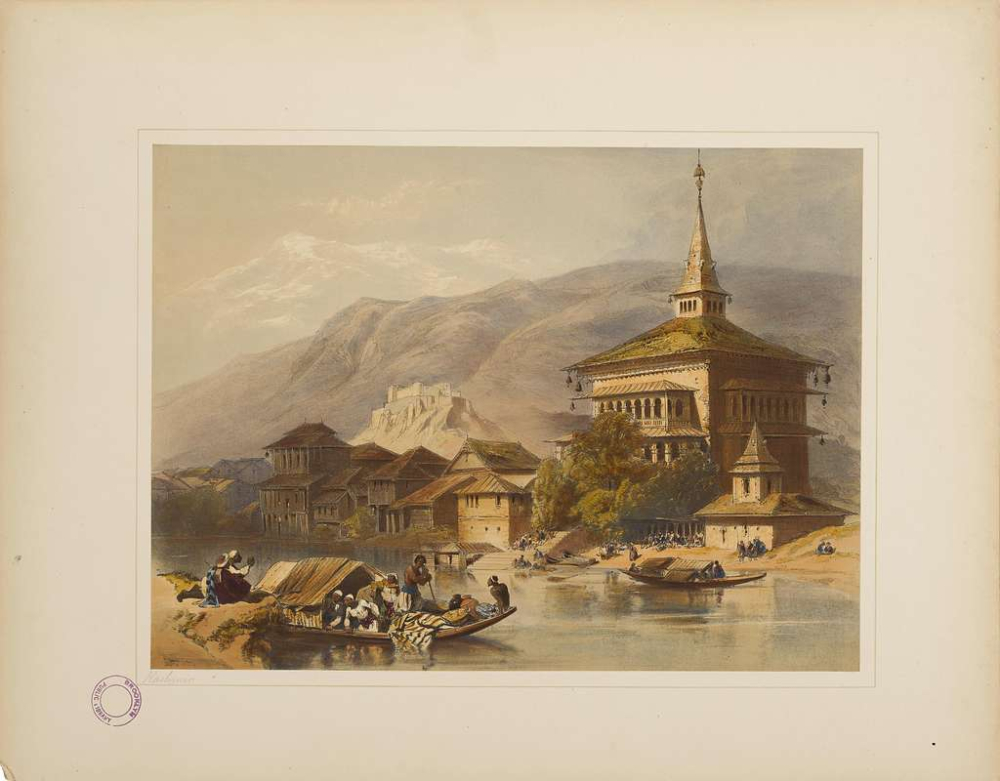
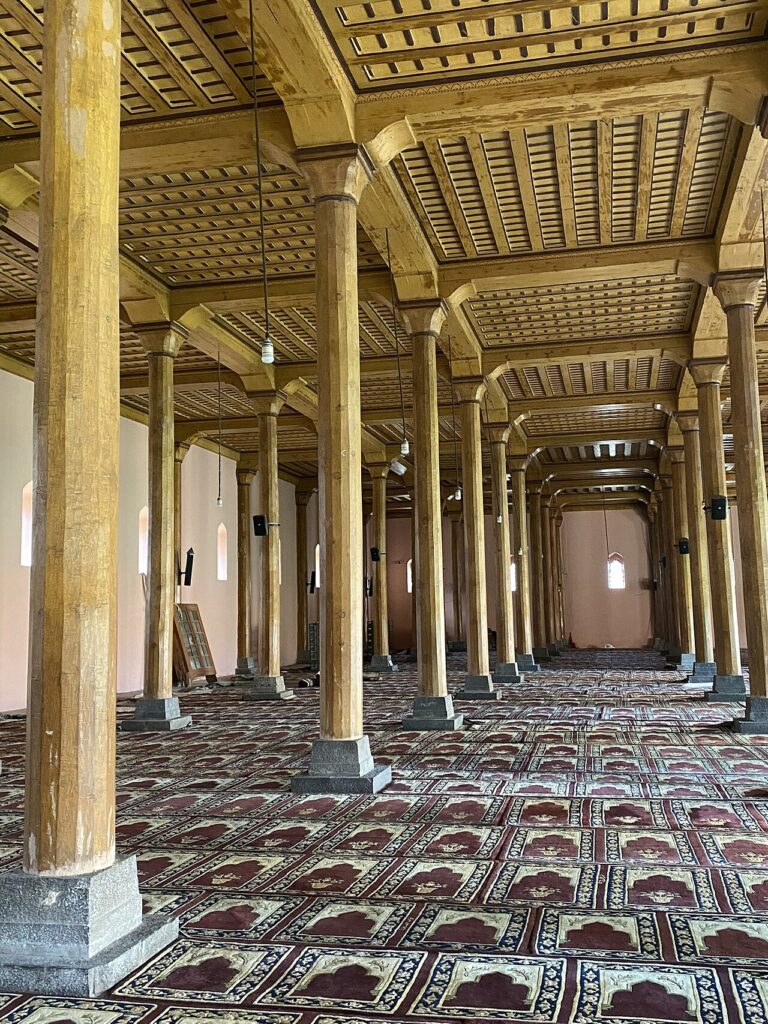
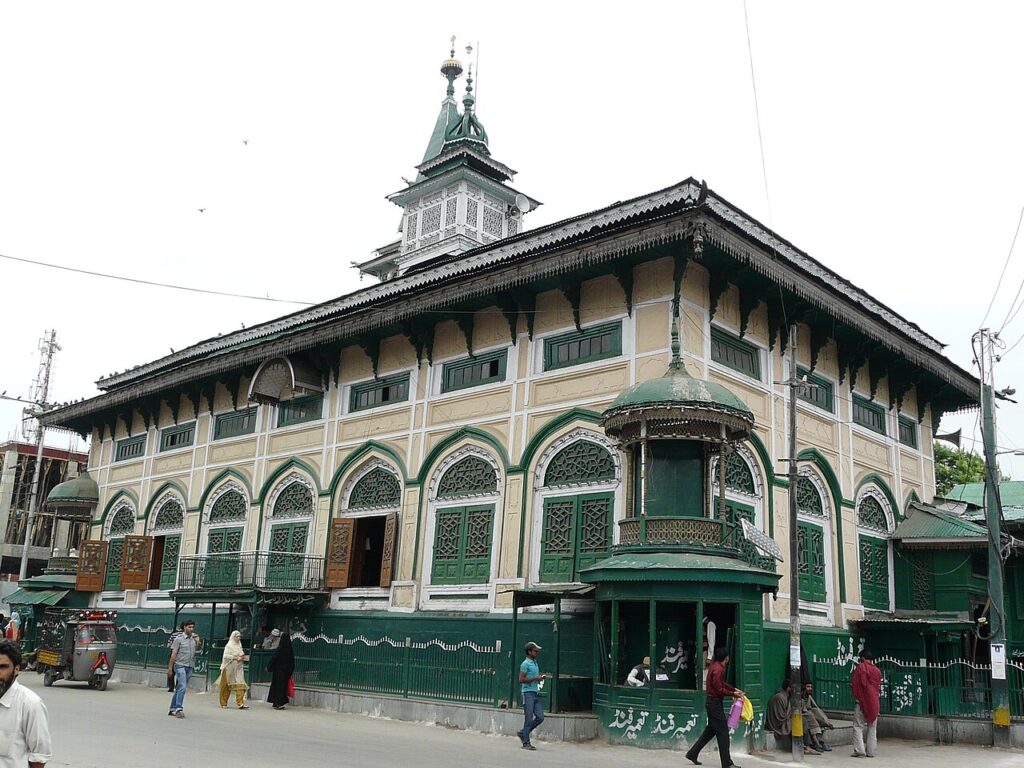
Martand and Avantipora are stone. Then the sultans arrive, the fourteenth century turns, and Kashmir starts building in timber instead. Two buildings tell the story best. The Jamia Masjid, which Sultan Sikandar began in 1394; its roof stands on a small forest of deodar columns, each one a whole tree. And the Khanqah-e-Moula on the Jhelum, Shah-i-Hamadan’s shrine. Both have the stepped pyramid roofs and the thin open spires that say “Kashmir” at a glance, and both have walls where courses of timber alternate with brick or stone.
Why wood? There was plenty of it, for one thing, and logs could simply be floated down to Srinagar. It also bends a little when the ground shakes, and Kashmir’s ground shakes. Local masons hit on two tricks for marrying timber to masonry. One they call taq, where thick brick piers get a wooden beam threaded through at each storey. The other, dhajji dewari, is more like a patchwork quilt: timber frame, rubble or brick packed into every square. Engineers have taken a keen interest in both since 2005, when such houses rode out a quake that flattened stiffer concrete ones.
The catch, of course, is fire. The Jamia Masjid has burned down and gone back up several times; what stands is mostly seventeenth century. Plenty of Srinagar shrines have the same history, rebuilt each time by carpenters who knew the old ways.
Which wood for what
Deodar, the Himalayan cedar, is the heavy lifter. It smells lovely, shrugs off rot, and went into columns, beams, bridges, boats and the chunky old lattices. Pine and fir? Soft, easy to slice thin; panelling, khatamband. Walnut belongs to the carver. Branch wood comes out honey-gold, root wood almost the colour of strong kahwa gone cold.
Walnut carving
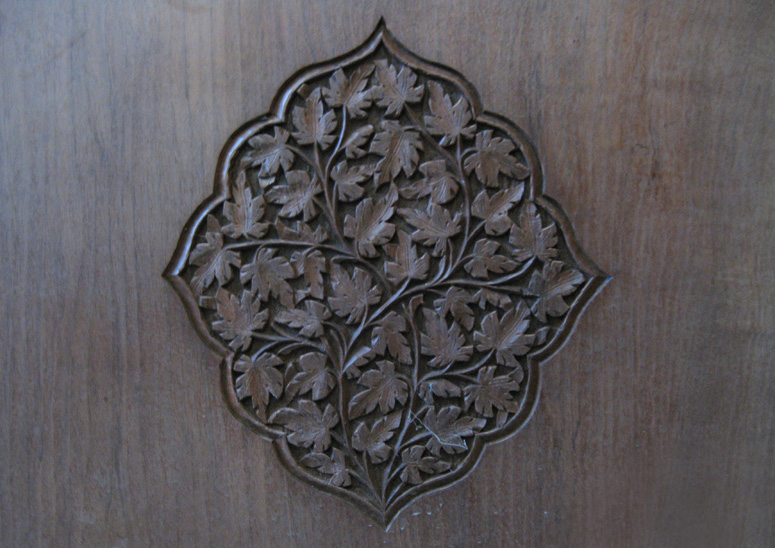
Any village has walnut trees. A carver, though, wants an old one, and he’ll pay more for the dark wood near the root. The showy style is deep undercutting, in which a chinar leaf seems to float a finger’s width off its background. Carvers also do shallower relief, flat engraved patterns and see-through jali. As for designs, they carve what grows outside: chinar, lotus and lily from the Dal, iris off the graveyards, roses, a vine heavy with grapes. Now and then a dragon creeps in, a souvenir of old trade with Central Asia and China.
Walter Lawrence, writing in the 1890s, judged that “the woodwork of Srinagar lacks the finish of the Panjab carving, but the Kashmiri carver is perhaps second to none in his skill as a designer”. He worked, Lawrence noted, “with a hammer and chisels”, and much of the roughness of his pieces came from “the difficulty of obtaining seasoned walnut-wood”. The village carpenter carried his tools in a leather apron: “a kind of half hammer, half adze (tur), and a chisel (turats)”, with which he would “execute any work which his clients may require”. Lawrence singled out the town of Bijbehara for “its excellence in wood-carving”, and admired the lattice work and carving of the village shrines, which “argues a strong artistic instinct”.
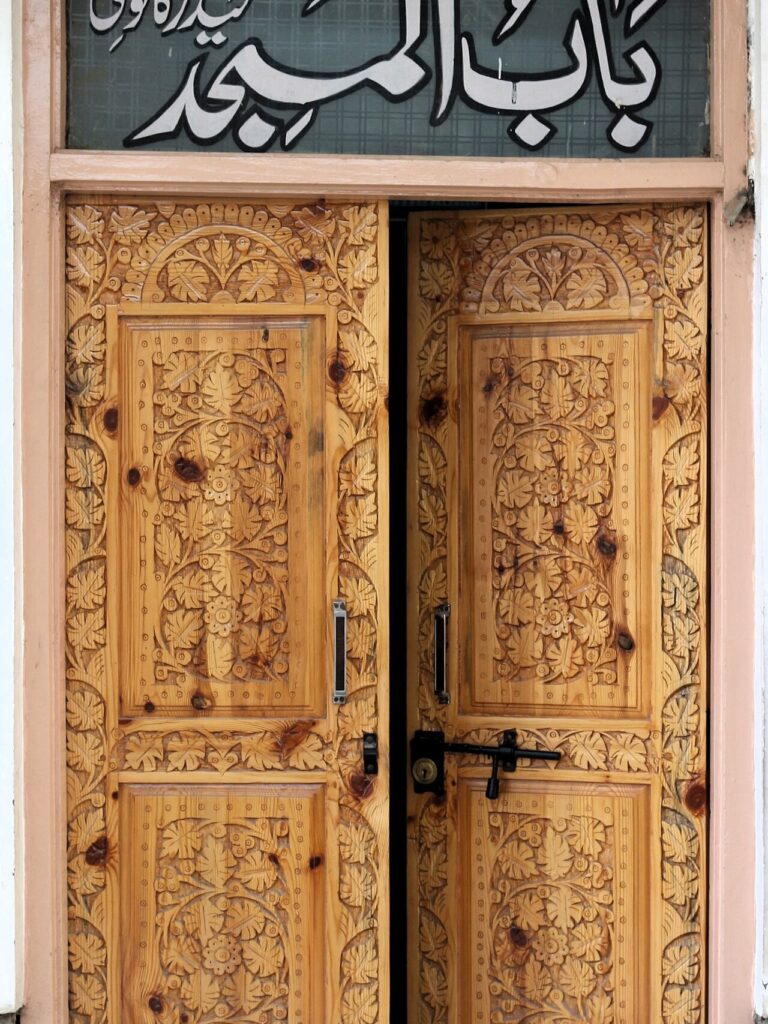
By the late 1800s the sahibs on holiday were buying carved walnut by the boatload: side tables, screens, boxes, panels. Lawrence noted a large new demand for Kashmiri copper trays “framed as tables in carved walnut-wood”, so that “the carpenter is now the close ally of the coppersmith”. Not everyone approved of the new style. George Watt, who organised the Delhi exhibition of Indian art in 1902–03, regretted what he saw as a recent change:
“In Kashmir, of former times, the characteristic feature was the bold and effective (sometimes notched or carved) pinjra-work, in deodar wood, and the graceful geometric panellings (khatamband) applied to ceilings — a speciality of Kashmir so far as India is concerned … Recently in Kashmir a most unfortunate departure has taken place into realistic carving in walnut, in which bunches of water lilies or sprays of chunar (plane) leaves are carved over the surface of tables or other articles, the one object apparently being to display a marvellous degree of under-cutting but with a corresponding loss of art feeling.”
George Watt, Indian Art at Delhi, 1903
Funny, really. The deep chinar-and-lily carving Watt sniffed at, made for tourists in his own day, is exactly what most of us now picture when someone says “Kashmiri woodwork”. Tradition is younger than it looks. The best of it is genuinely superb, and these days it carries a Geographical Indication tag. Walnut, meanwhile, has become so precious that cutting the trees down needs official permission.
Pinjrakari: the wooden lattice
Ask a Kashmiri grandmother what a pinjur is and she’ll point at the bird. Now picture a window built from a few hundred notched slivers of deodar, locked into stars, and the name makes sense. Light gets in, and the breeze. Neighbours peering across the lane don’t. Lawrence describes the city in winter, when “the lattice windows are covered with paper” to keep out the cold. The best old pinjra was made of deodar and, as Watt noted, was bold rather than minute. Its makers used a special jig to ensure that all the similar pieces of a pattern were “exactly alike and interchangeable with each other”.
Khatamband: the geometric ceiling
Lie on your back in an old Srinagar drawing room, or a shrine, or a good houseboat, and stare up. That ceiling of a thousand little wooden stars is khatamband. How on earth does it stay up? Lawrence printed an explanation of how it works by C. Tickell, the engineer in charge of the State’s public works. Kashmiri carpenters, Tickell explained, had a characteristic way of panelling walls: they cut a groove along the edges of each post and slid planks into the grooves, alternating them with small posts grooved on both sides, so that “each panel … is held in a groove on every side”. Khatamband applies the same principle to a ceiling:
“The so-called Kashmiri ceilings (khatamband) are a most ingenious extension of exactly the same principle. Thin panels of soft wood … are cut into various geometric forms, and are held together by being placed in the grooves of small double-grooved battens … The fitting of the numerous small pieces of wood forming a well-executed Kashmiri ceiling is most accurately done … there are only a certain number of different pieces forming each pattern, which have each to be repeated many hundreds of times.”
C. Tickell, quoted in Walter R. Lawrence, The Valley of Kashmir (1895)
Because the pieces are held in grooves rather than nailed or glued, a khatamband ceiling can be taken down and put up again elsewhere. Tickell found it a speciality of “a limited number of workmen in Srinagar and Islamabad” (Anantnag). Lawrence described the effect: “beautiful ceilings of perfect design, cheap and effective … in which the various shades of the pine-slips blend together in perfect harmony”. The houseboat builders of his time gave the craft “a great impetus”, and began to mix “the darker colours of the walnut-wood … with the lighter shades of the pine”. A few khatamband ceilings, he added, had already been sent to England. For the finest example in Srinagar, Lawrence recommended the shrine of Naqshband Sahib, near the Jamia Masjid.
Its cousins are the geometric ceilings of Iran and Central Asia, and Kashmiris credit its arrival, as with papier-mâché, to the craftsmen of the Sufi and Sultanate years. The craftsmen have a name for every pattern. You can still order one for your house, and plenty of new mosques and hotels do. It too has a GI tag these days.
Houseboats
Want the lot in one go? Sleep on a houseboat. They are a Victorian dodge. Foreigners couldn’t own land in the Maharaja’s Kashmir, so the British floated. The big ones on the Dal and Nigeen are proper floating houses of cedar and pine, walnut-panelled, with carved furniture, pinjra windows and khatamband overhead. Lawrence saw the boat-builders keeping the ceiling-makers in work in the 1890s, and they still do.
Where to look
The Jamia Masjid for the deodar columns, obviously. The Khanqah-e-Moula for timber-laced walls and that roof. Naqshband Sahib, which was Lawrence’s tip for ceilings. Then just walk the old city along the Jhelum and look up at the balconies and lattice windows, many sagging now. And a houseboat, for the whole thing in one place.
Sources and further reading
- Walter R. Lawrence, The Valley of Kashmir, Henry Frowde, London, 1895, chapter XV (including the note by C. Tickell).
- George Watt, Indian Art at Delhi, 1903: Being the Official Catalogue of the Delhi Exhibition, 1902–1903, Calcutta, 1903, Division 13.
- B. H. Baden-Powell, Hand-Book of the Manufactures and Arts of the Punjab, Lahore, 1872.
Featured photo: walnut wood carving with a chinar-leaf design, by Ehsan Quddusi, Wikimedia Commons, CC BY-SA 2.0. Srinagar with the mosque of Shah Hamadan, by James Duffield Harding, 1847, public domain, via Wikimedia Commons. Wooden pillars in the Jamia Masjid, by Tamjeed Ahmed, Wikimedia Commons, CC BY-SA 4.0. Carved mosque doors, Anantnag, by ThePoeticFrame, Wikimedia Commons, CC BY-SA 4.0. Dastgir Sahib, Srinagar, by Varun Shiv Kapur, Wikimedia Commons, CC BY 2.0. Images resized.
You May Also Like
Pashmina and Kani: The Shawls of Kashmir
Kashmiri Papier-mâché: The Art of Kar-i-Qalamdani