
Kashmiri Silk: From Mulberry Trees to the Srinagar Silk Factory
Every spring, in villages across the Kashmir valley, families clear a room, spread fresh mulberry leaves on trays and raise silkworms through the few weeks it takes them to spin their cocoons. It is quiet, seasonal work, yet for more than a century it supplied one of the largest silk factories of its time. This is the story of Kashmiri silk: how it is made, how a princely state turned it into an industry, and why that industry declined.
Silk is not the shawl
Kashmir’s most famous textile is not silk at all. The fine fabric that the Mughals prized and that became a fashion in Europe in the late eighteenth and nineteenth centuries was the Kashmir shawl, woven from pashm, the soft under-fleece of mountain goats brought from Ladakh and Tibet. Silk has a separate history in the valley. It is older as a household craft, but it became a major industry only in the nineteenth century. Keeping the two apart makes both stories clearer.
Sericulture in the valley
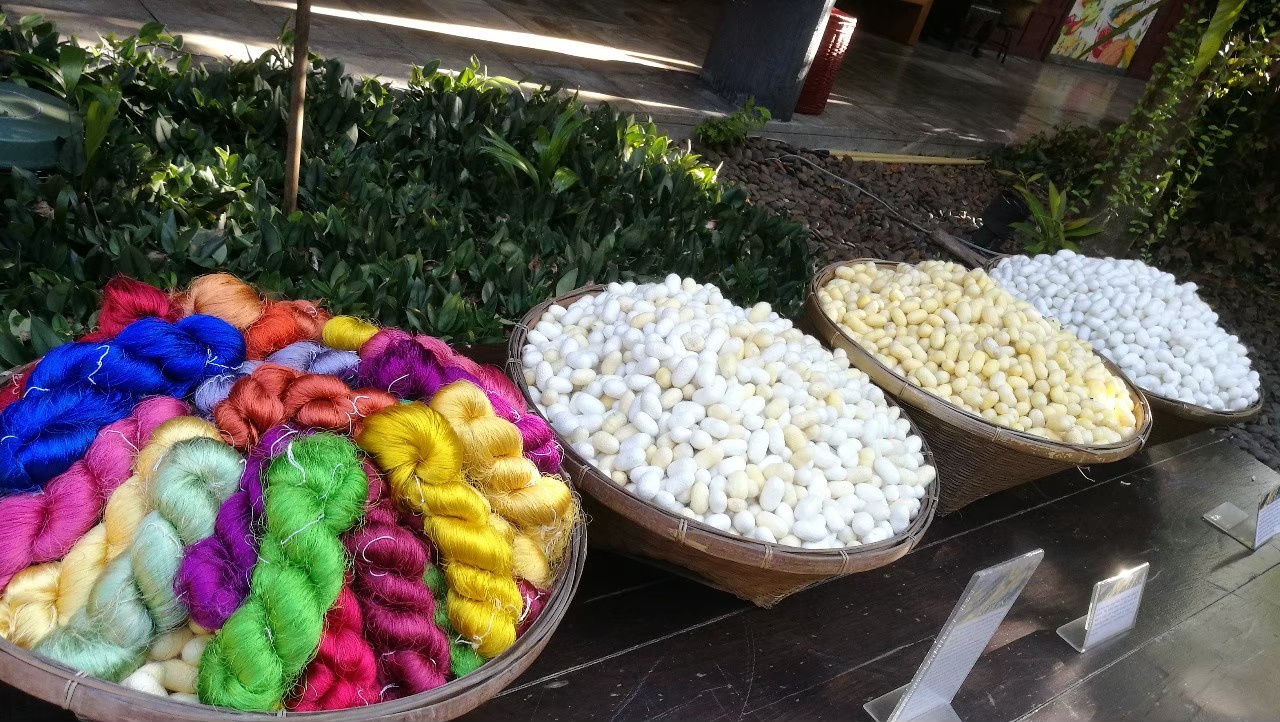
Silk comes from the cocoon of the mulberry silkworm, Bombyx mori, which feeds only on mulberry leaves. Mulberry trees grow throughout Kashmir, and the valley’s temperate climate suits the silkworm races that complete one or two generations a year (univoltine and bivoltine). These races are reared in cooler regions and produce long, even filaments of fine white silk, unlike the many-generation races of the tropical plains.
Rearing in Kashmir has always been a spring activity. Families receive silkworm eggs, hatch them as the mulberry comes into leaf, feed the growing larvae several times a day and collect the cocoons when spinning is complete. The cocoons are then sold on for reeling, where the filament is unwound into raw silk.
The Dogra state takes control
Under the Dogra Maharajas, who ruled Jammu and Kashmir from 1846, silk became a state enterprise. Sericulture was run by a government department, and the state controlled the trade. Rearers received eggs from the state and sold their cocoons back to it at prices the state fixed. Early efforts in the nineteenth century were set back by silkworm disease, and the industry was reorganised in the 1890s with the help of European experts and imported eggs.
In 1897 the state opened the Government Silk Factory in Srinagar, where cocoons from across the valley were reeled into raw silk. By the early twentieth century it was described as one of the largest silk filatures in the world, employing thousands of workers, most of them Kashmiri Muslims. Silk became one of the state’s most valuable sources of revenue.
The 1924 strike
The factory was also the scene of one of the first organised protests in modern Kashmir. In 1924 its workers went on strike over low wages and the conduct of the officials who supervised them. The state responded with force and dismissed many of the workers. The strike, and a memorandum on the grievances of Kashmiri Muslims presented to the Viceroy, Lord Reading, later that year, are often seen as early signs of the political movement that grew in the valley in the following decade.
Decline after 1947
After independence the state’s silk units continued under public ownership, but the industry gradually lost ground. Cheaper silk and synthetic fabrics competed with Kashmiri raw silk, rearers found better returns in other crops, mulberry trees were cut down, and the state silk factories struggled to stay viable. Political unrest from the 1990s deepened the decline, and many families that had reared silkworms for generations left the work.
A craft worth reviving
Sericulture has not disappeared. The government’s Department of Sericulture still distributes silkworm eggs and buys cocoons each season, and rearing remains a source of spring income for thousands of rural households. Efforts to revive the industry focus on planting mulberry, improving silkworm stocks and cocoon prices, and reeling and weaving more of the silk inside Kashmir rather than sending the raw material elsewhere.
For accounts of Kashmir in the years when its silk industry was being built, see the travellers’ books in our Library.
Further reading
- Walter R. Lawrence, The Valley of Kashmir (1895), which includes a first-hand account of sericulture in the 1890s.
- Mridu Rai, Hindu Rulers, Muslim Subjects: Islam, Rights, and the History of Kashmir (2004).
- Chitralekha Zutshi, Languages of Belonging: Islam, Regional Identity, and the Making of Kashmir (2004).
- Prem Nath Bazaz, The History of Struggle for Freedom in Kashmir (1954).
- Frank Ames, The Kashmir Shawl and Its Indo-French Influence (1986), for the separate history of the shawl.


One Comment
Dr Farooq Ahmad
They say well begun is half done, I am sure you will take it to its logical conclusion!