Pashmina and Kani: The Shawls of Kashmir
For about three hundred years, if you wanted the best shawl money could buy, it came off a loom in Srinagar. Mughal emperors draped them on favoured nobles. Persian khans and Turkish pashas fought over them. Then Paris got hold of the idea, then London, and the little bent cone in their borders ended up with an English name, “paisley”. Every one of those shawls went through an astonishing number of hands first. Herders up on the Changthang. Caravan men. Something like a hundred thousand women at their wheels. Dyers, pattern men, weavers, darners, washermen. We follow that chain here, and let the people who watched it do the talking where we can.
An imperial fabric
Who started it? Budshah, most Kashmiris will say (Zain-ul-Abidin, fifteenth century), or else the Central Asian craftsmen who trailed in after the Sufis. Lawrence heard another version in the 1890s from a Frenchman who had lived in Srinagar for years. The Mughals, he said, wore an almond-shaped jewel on the turban, the jigha, with a feather plume stuck in it. Some weaver from Andijan copied the shape into a scarf for Babur. Babur liked it. After that, every scarf and shawl had to have one.
True or not, by Akbar’s time the shawl was fit for an emperor, quite literally. His minister Abul Fazl, compiling that enormous stocktaking of the empire, the Ain-i-Akbari (done around 1598), gave shawls a chapter to themselves. Akbar, he says, “prefers and wears woollen stuffs, especially shawls”, and that among the new names Akbar invented for his clothes, the shawl became parmnarm, “supremely soft”. He also records a change in fashion that Akbar himself began:
“In former times shawls were often brought from Kashmir. People folded them up in four folds, and wore them for a very long time. Now-a-days they are generally worn without folds, and merely thrown over the shoulder. His Majesty has commenced to wear them double, which looks very well. His Majesty encourages, in every possible way, the manufacture of shawls in Kashmir.”
Abul Fazl, Ain-i-Akbari, Ain 32 (translated by H. Blochmann, 1873)
Wearing shawls “double”, sewn back to back so that no reverse side shows, gave rise to the doshala, the paired shawl that remained the standard Kashmiri product for the next three hundred years. In his account of Kashmir in the same work, Abul Fazl sums up the valley’s reputation in one line: “Woollen fabrics are made in high perfection, especially shawls which are sent as valuable gifts to every clime.”
Moorcroft’s eyewitness account
Our best witness is an unlikely one. William Moorcroft was an English horse-doctor and explorer who spent the winter of 1822–23 in Srinagar with his eyes wide open. He had an ulterior motive. He wanted Britain to grab more of the shawl trade, perhaps even make the things at home, and so, in his words, “I devoted much of my time and thoughts, whilst in Kashmir, to the acquisition of authentic information on every detail connected with the subject.” The result, published after his death in his Travels in the Himalayan Provinces (1841), follows every stage of the work from raw fleece to finished bale. Much of what follows is drawn from it.
Pashm: the wool
Not the goat’s hair, mind. Pashm is the soft fuzz hidden beneath it, grown by goats that winter on the freezing plateaus of Ladakh and western Tibet, and combed out when they moult in spring. Moorcroft knew two grades. Ordinary pashm shal came off tame goats. Asali tus, scarcer and dearer, came from wild goats, wild sheep and the like. Each year five hundred to a thousand pony-loads of it (close on 300 lb a load) came over the passes. Ladakh and western Tibet sent most, but some came from as far as Yarkand, Khotan and the Kirghiz grazing grounds, brought by Central Asian traders who swapped it for finished shawls and sold those on in Russia.
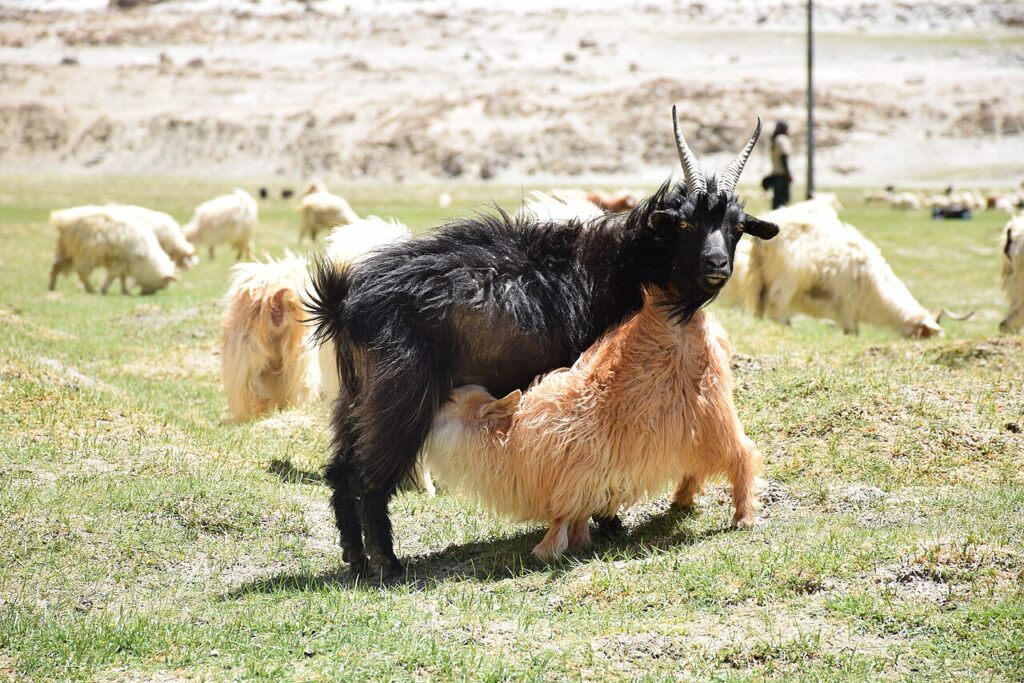
Abul Fazl had already praised tus shawls as “unrivalled for [their] lightness, warmth, and softness”. The very best, what later got called shahtoosh, is the chiru’s, the Tibetan antelope’s. You have to kill the animal to get it. Which is why, rightly, you can no longer legally buy or sell it anywhere.
A hundred thousand spinners
Raw pashm was sold to women, who cleaned and spun it at home. Moorcroft describes how much of the fleece was waste: from six sers of raw wool, only about two were fine down, the rest being coarse hair, dust and a second-grade wool called phiri, used for cheaper cloth and the sturdy woollen pattu. The down was cleaned not with soap, which “makes the wool harsh”, but by working it again and again through a paste of soaked, ground rice, a method in which the Kashmiris boasted “they were more knowing than Europeans”. It was then teased out with the fingernails into soft pads and spun on a light wheel specially built to avoid any jerk that might break the thread.
“Women begin to work at daybreak, continue with little interruption the whole day, if not taken off by other domestic affairs, and extend their labour until very late in the night, spinning by moonlight, when available, and when they cannot afford to purchase oil for a lamp.”
William Moorcroft, Travels in the Himalayan Provinces, Vol. II
Girls began to spin at ten, and Moorcroft estimated that a hundred thousand women in Kashmir were employed in spinning, about one in ten to make shawls for their own families and the rest to earn a living. Their earnings were tiny. After paying for the wool, an expert spinner kept about one and a half rupees a month for her labour. Collectors went from house to house buying yarn, announcing their arrival by ringing a bell.
Sixty-four colours
Once the weaver had decided on a pattern, the yarn was divided by colour and sent to the dyer, the rangrez, a hereditary trade. Moorcroft’s dyer claimed to give sixty-four tints, each with its own name. Crimson was gul-anar, “pomegranate flower”, the best made from cochineal brought from India, the cheaper from lac and kermes. Blues and greens came from indigo, or from colour boiled out of European broadcloth; oranges and yellows from safflower and from saffron grown in Kashmir itself. The whiter and finer the wool, the brighter the dye it would take, one reason the goat’s fine white down was preferred to sheep’s wool.
The kani loom and the talim
Now the clever part. On an ordinary loom one weft thread runs right across. Not on a kani loom. Here every colour has its own little bobbin, a kani or tuji, which goes back and forth only over its own patch and hooks into the colour next door. Moorcroft calls them needles with no eyes, of light smooth wood, the tips lightly charred so they would not splinter. On a rich pattern you might have fifteen hundred of them dangling along a single row. Four hundred on a simple one. The shawl was woven face down, the weavers working from the back, and when a row was complete the comb was “brought down upon it with a vigour and repetition, apparently very disproportionate to the delicacy of the materials”.
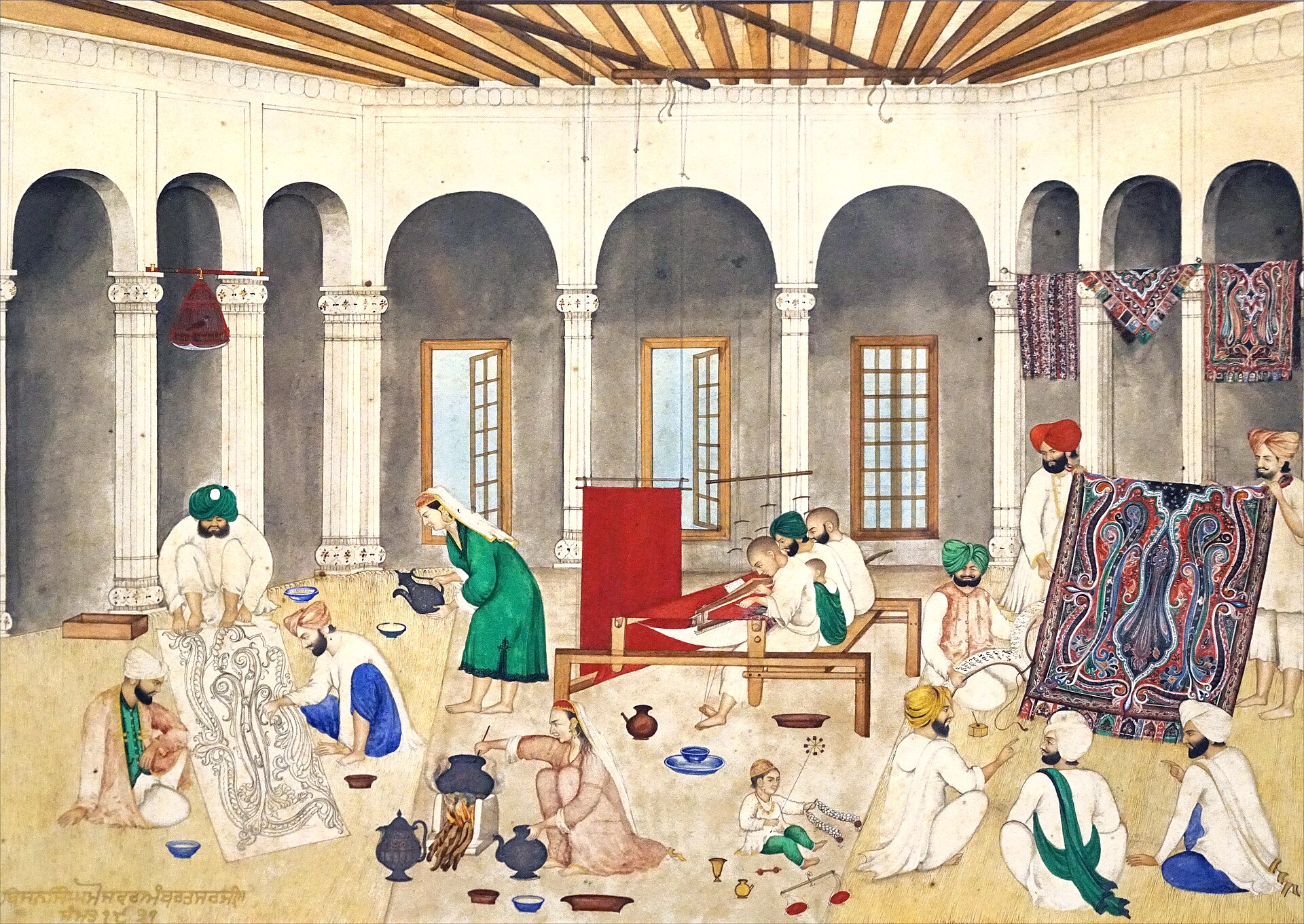
No weaver could hold such a pattern in his head. It was prepared by a team of specialists. The naqqash, or pattern-drawer, made the design in black and white. The tarah-guru studied it and called out, from the bottom of the pattern upwards, the colour of each thread and how many threads it was to run. From his dictation the talim-guru wrote the whole pattern down in a special shorthand, the talim, and gave a copy to the weavers.
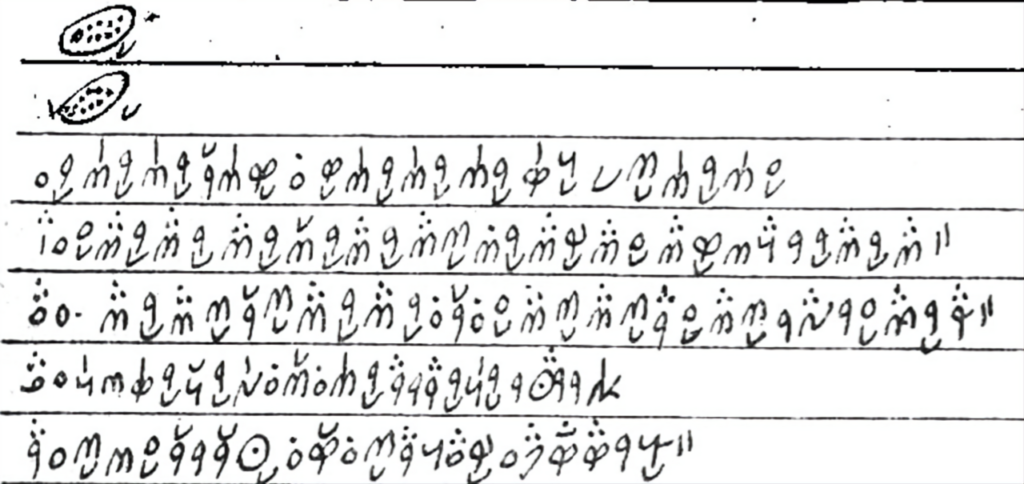
Seventy years later Lawrence watched the same system at work, by then mostly on carpets. The reader of the talim, he wrote, “calls out to the rows of sickly men and boys who sit at the loom, ‘lift five and use red,’ or ‘lift one and use green,’ but neither he nor the weavers have any idea as to what the pattern of the fabric will be.” Only the pattern-drawer knew the whole design, and “the pattern never goes into the factory”. The talim itself, Lawrence noted, “at first sight … reminds one of the notation used in music”.
The work was slow. Moorcroft reckoned that three men would spend three months on a loom-patterned shawl of ordinary design, but “a very rich pair will occupy a shop for eighteen months”. Workshops held anything from three to three hundred weavers, “generally crowded together in long low apartments”. The weavers were all men, starting at ten. Most worked for a master, the ustad, who supplied the materials and often advanced money, so that the weaver became “so deeply indebted to his employer that he may, in some sort, be considered as his bond-slave”.
Finishing the shawl
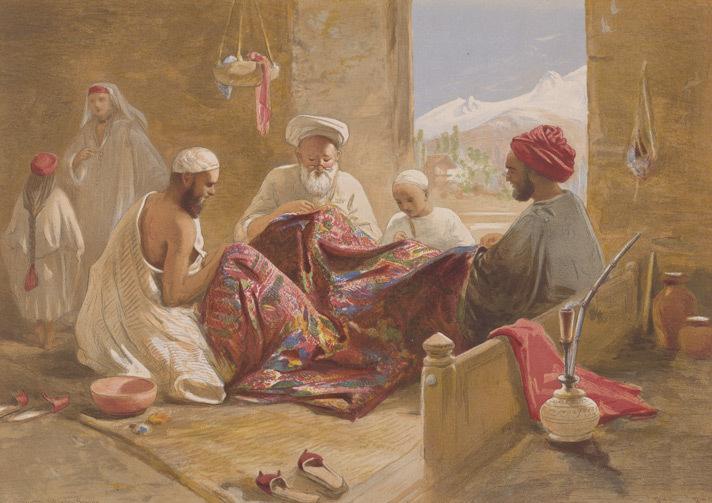
A shawl off the loom was not yet finished. Broad borders were often woven separately, on silk warps that made the colours glow, and then sewn on by the rafugar, the fine-darner, “with such nicety, that the union can scarcely be detected”. Rafugars could also join small woven pieces into a single shawl, a practice that allowed several looms to work on one design at once. The purusgar picked out stray hairs and knots with tweezers. The shawl was then taken to the collector of duties, who levied a tax of twenty-six per cent of its value and stamped and registered it.
Only after sale was the shawl washed, in clear cold water, with soap used “very cautiously to white parts alone, and never to embroidery”. Coloured ones dried in the shade. White ones went out in the sun and then got smoked over burning sulphur to whiten them further. Two days stretched tight round a split wooden roller. Shiny paper went between the folds, the pile was squashed under weights, and then came the wrapping: cloth, birch bark, waxcloth, and last of all a raw hide sewn on wet, so it shrank as it dried and gripped the bale like a drum. Nothing less would survive the passes.
The amli, or embroidered shawl
Alongside the loom-patterned shawl grew a cheaper rival, the amli, in which the whole design was embroidered with a needle on a plain woven ground. How do you get the design onto the cloth? Moorcroft watched. Trace it on thin paper first, and prick holes all along the lines with a needle. Rub the cloth glassy-smooth on a board with a lump of agate. Lay the paper on top and pat coloured powder over it, so a dotted outline comes through. Go over that with a gummy paste, embroider, then simply brush the paste off.
Lawrence found that embroidered shawls allowed “colour effects which would have been almost impossible in a woven shawl”, though they “never fetched more than 200 rupees”, against as much as 5,000 for the finest loom-woven pieces. Embroidery on pashmina, especially the fine needlework called sozni, outlived the woven shawl and remains one of Kashmir’s great crafts.
From the jigha to the paisley
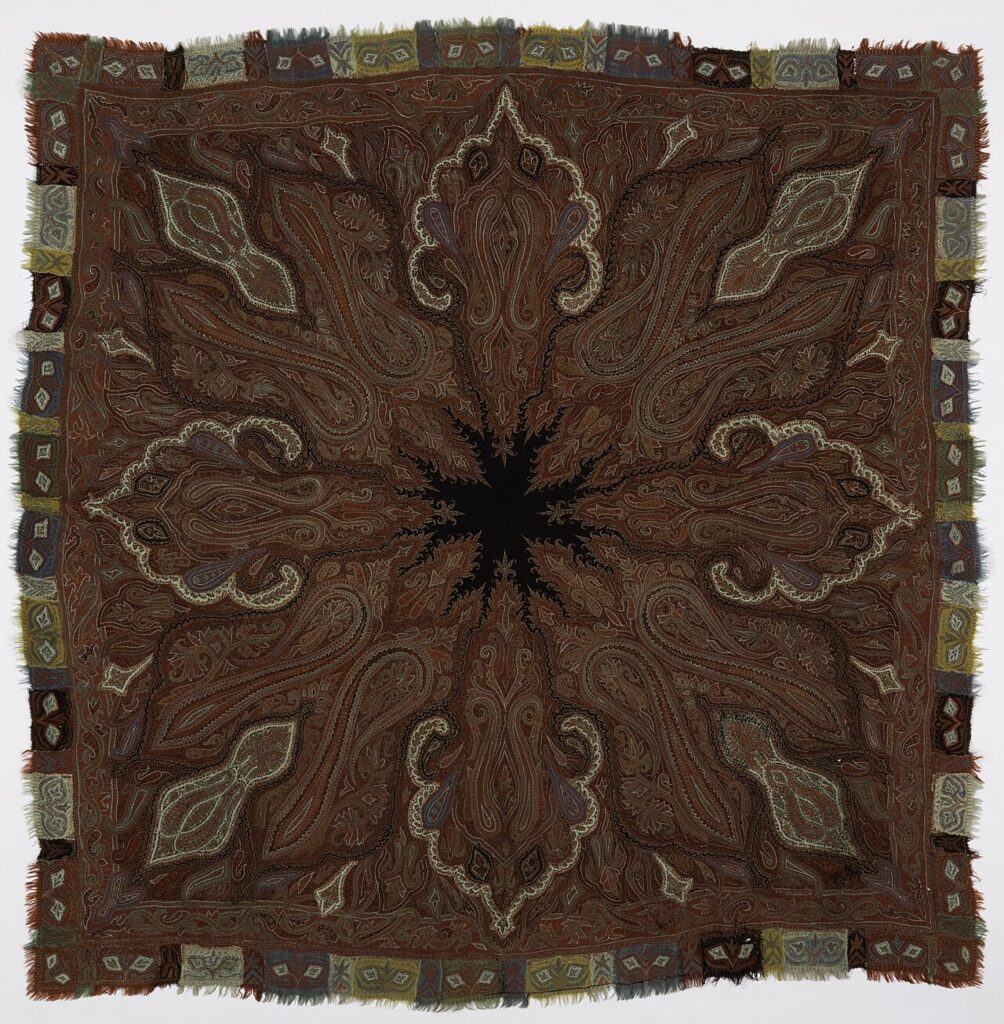
That cone, the boteh, started out modest. In seventeenth-century shawls it is just a flowering plant, fairly true to life. Give it two hundred years and it fattens, the top curls over like a breaking wave, and the inside fills up with tiny flowers. Kashmiri weavers called it buta; Lawrence’s informants still called it the jigha.
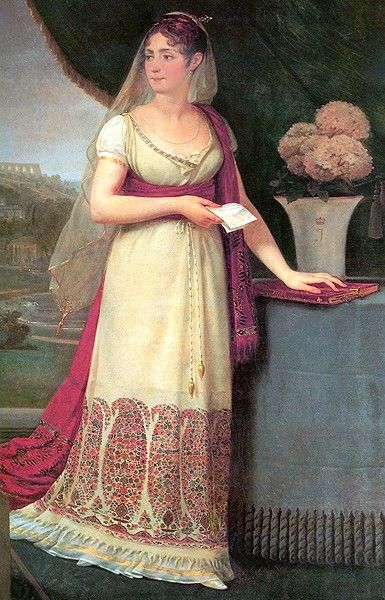
Europe discovered these shawls at the end of the eighteenth century. According to the French merchant whose account Lawrence recorded, the first to reach France were brought back from Napoleon’s Egyptian campaign as a present for Josephine, “and from that time shawls became fashionable”. Josephine owned hundreds and helped make them the essential accessory of the age. Later, General Ventura, a French officer serving Maharaja Ranjit Singh of Lahore, sent to France shawls in which the cone had grown to enormous size: the so-called “palms”, ten or eleven feet long, with plain black centres and borders filled with rows of elongated cones.
Demand was so great that European mills set out to copy the Kashmir shawl. Moorcroft himself played a part: the editor of his Travels noted that the samples of wool, patterns and information he sent home “found their way silently to persons engaged in similar manufactures, and enabled them to imitate successfully the shawls of Kashmir”. Weavers in France, in Norwich and Edinburgh, and above all in the Scottish town of Paisley produced machine-woven imitations on Jacquard looms, and the cone motif has been known in English ever since as the “paisley”. Before long Lyon was returning the favour, with French buyers sitting in Srinagar and giving the naqqash their own sketches to work from. Some mid-century shawls are an odd, rather charming mixture as a result.
Merchants and markets
Moorcroft lists the buyers who came to Kashmir: merchants “from Turkey, both in Asia and Europe, by Armenians, Persians, Afghans, Uzbeks, and by traders from Hindustan and from Chinese Turkistan”. He estimated the value of shawl goods made in Kashmir at about thirty-five lakhs of rupees a year, though trade had already fallen in his time as the old Indian courts, “in which costly shawls were formerly a principal article of attire”, lost their wealth. Business was done through the mohkim, or broker, and Moorcroft notes that “in Kashmir all commercial contracts of importance are discussed at dinner”: a merchant receiving a cargo of wool would invite the dealer and broker to a feast before the price was settled.
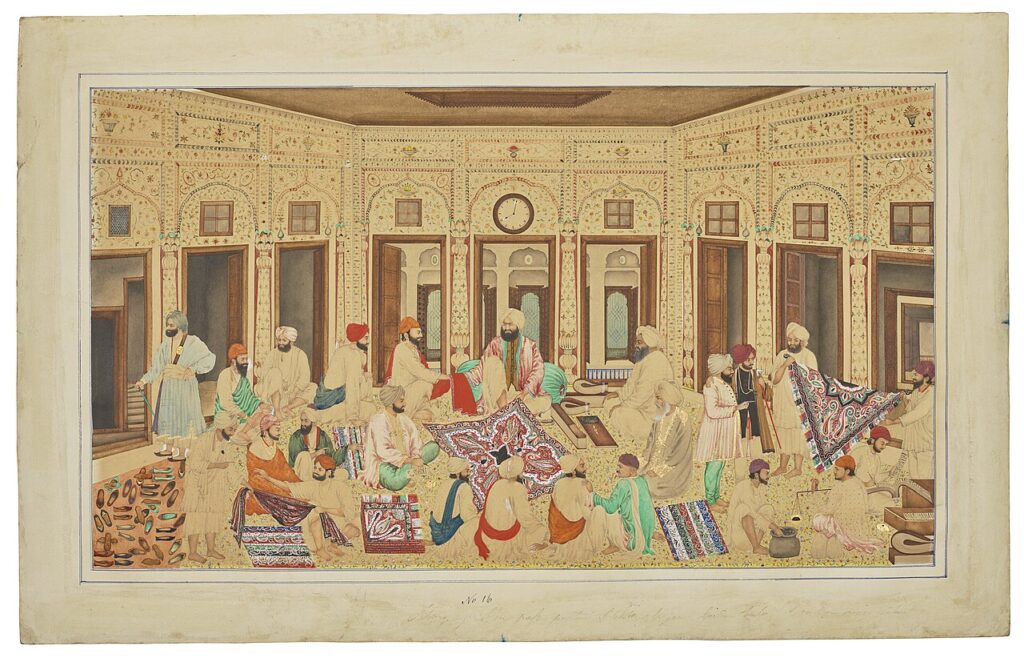
Many weavers left Kashmir in hard times, settling in Amritsar, Ludhiana, Lahore and other towns of the Punjab, where colonies of Kashmiri shawl-makers grew up. The paintings by Bishan Singh on this page, made in Amritsar in the 1860s and 1870s, show their workshops and the brokers who sold their work.
Boom and collapse
The last great age of the woven shawl came in the 1860s. Lawrence’s French informant believed that “the best shawls ever made in Kashmir were manufactured in the time of Maharaja Ranbir Singh, between the years 1865–73”. Between 1862 and 1870 exports averaged thirty-five to thirty-eight lakhs of rupees a year, and at the height of the trade twenty-five to twenty-eight thousand people worked on shawls. In those same years the new synthetic aniline dyes reached Kashmir. The French purchasing agents refused to buy shawls made with them and, Lawrence wrote, “succeeded in stamping out the abomination”.
Then the market vanished. France was the shawl’s greatest customer, and the Franco-Prussian War of 1870–71, together with a change in European fashion, ended the demand almost overnight. Lawrence was told by an eyewitness “of the intense excitement and interest with which the Kashmiri shawl-weavers watched the fate of France in that great struggle — bursting into tears and loud lamentations when the news of Germany’s victories reached them”. Any hope of recovery ended with the great famine of 1877–79, in which “none suffered more heavily … than the poor weakly shawl-weavers”. By 1893–94 the export of shawls was worth only 22,850 rupees. Lawrence called the industry “a tradition — a memory of the past”. Many surviving weavers turned to carpet-making, which used the same talim system.
The shawl today
The old shawl was never entirely lost. Pashmina spinning and weaving continued in Srinagar homes, sozni and other embroidery flourished, and in recent decades the kani loom has been revived by a small number of master weavers, some still working from talim notation. Kashmir Pashmina, Kashmir Kani shawls and Kashmir Sozani craft are now registered as Geographical Indications, and genuine pashmina is tested and certified in Srinagar. A fine kani shawl still takes many months, sometimes more than a year, to weave, just as it did in Moorcroft’s day.
Sources and further reading
- Abul Fazl, The Ain-i-Akbari, Vol. I, translated by H. Blochmann, Asiatic Society of Bengal, Calcutta, 1873 (Ain 32, “On Shawls, Stuffs, &c.”); Vol. II, translated by H. S. Jarrett, 1891.
- William Moorcroft and George Trebeck, Travels in the Himalayan Provinces of Hindustan and the Panjab, ed. H. H. Wilson, 2 vols., John Murray, London, 1841 (Vol. II, Part III, chapter 3).
- Walter R. Lawrence, The Valley of Kashmir, Henry Frowde, London, 1895 (chapter XV).
- G. W. Leitner, Linguistic Fragments … followed by an Account of Shawl-Weaving, Lahore, 1882.
- John Irwin, The Kashmir Shawl, Victoria and Albert Museum, London, 1973.
- Frank Ames, The Kashmir Shawl and its Indo-French Influence, Antique Collectors’ Club, Woodbridge, 1986.
Featured image: a shawl weavers’ workshop, painted by Bishan Singh, probably Amritsar, about 1874–75, public domain, via Wikimedia Commons. Pashmina goat and kid, Ladakh, by Rahul Ajmera, Wikimedia Commons, licensed CC BY-SA 4.0. Talim notation, from G. W. Leitner, 1882; shawl makers in Kashmir, by William Simpson, 1867; Empress Josephine, by Antoine-Jean Gros, 1808; embroidered shawl, 19th century, Cooper Hewitt, Smithsonian Design Museum; traders evaluating shawls, attributed to Bishan Singh, about 1866–67: all public domain, via Wikimedia Commons. Images resized.
You May Also Like
Kashmiri Papier-mâché: The Art of Kar-i-Qalamdani
Kashmir Woodwork: Walnut Carving, Pinjrakari and Khatamband