
A Lonely Summer in Kashmir by Margaret Cotter Morison
Left on her own in Kashmir in 1901, Margaret Cotter Morison skipped Gulmarg's tennis parties and went camping alone in the side valleys. Brave, funny and rather rare.
If the book does not appear here (some phones can’t show PDFs inside a page), use Open full screen or Download PDF.
About this book
May 1901, and Margaret Cotter Morison’s travelling companion has to leave. She is in Kashmir with no friend in the country and the whole summer in front of her. The sensible thing, everyone assumes, is to settle in Gulmarg and play tennis with the other English ladies. She doesn’t. She sticks to her original plan and heads off into the mountains and side valleys alone, with only the men she has hired.
That makes this book unusual. Most British travellers saw Kashmir from a houseboat, in company. Morison saw it from her tent, a long way from the club and the bandstand. She writes about the people who looked after her, the villages, the shepherds’ huts high up in the margs, flowers, weather, loneliness, and the odd small adventure. There’s a quiet courage in it, and a good deal of humour.
Below is how she opens the book, in her own words.
From the opening pages
The question I had to decide when at the end of May 1901, I was suddenly, through no fault of my own, thrown entirely on my own resources in Kashmir, with no friend in the land and no one with whom to travel or chum, was whether to hang around Srinagar or the hill-station of Gulmarg, and by mixing persistently with others try to forget my own loneliness, or whether to follow out my original plan of seeing something of the country, and explore alone the mountains and side-valleys as I had intended doing in the company of my friend. I had as yet seen only two sides of Kashmir life, that of the river, amid lovely scenery, on a house-boat ; and the life of the English residents in the capital, Srinagar. The river life is exquisite for a time, especially in the spring ; the trees all bursting into life, the white blossom to be seen everywhere, the river banks and fields blue with iris, the chains of snow-capped mountains on either hand which unfold their beauty slowly as the boat goes winding up the valley. After the long and tiring journey into Kashmir nothing more delightful at first can be imagined ; but after a time this lazy life is found to have its limitations ; there is not enough variety for one actively inclined, the novelty of watching the boatmen punt, tow and paddle the boat wears off, there is no other exercise to be had but to walk along the bank while the boat slowly follows behind, and every day the mountains look more alluring and seem to invite one into their fastnesses and to leave the sluggish river life. Srinagar, the capital of Kashmir and the only big town in the country, is a place full of life and picturesqueness, which captivates the visitor by its novelty and perpetually amuses him by the many quaint similarities to places seen before. With the polo-ground, tennis-courts, and smartly dressed ladies, one might think oneself in an ordinary Indian station ; at the Residency garden-parties, where croquet is played on the softest of lawns, and strawberries and cream dispensed under cool spreading trees, any one would think himself at a country house in England ; on the river above the town, where house-boats are crowded close together for over a mile, the sight recalls Henley a few days before the regatta ; a row down the town where houses and temples line the banks, where gracefully carved wooden balconies overhang the water, where men and women loiter chattering on the steps, and half the population lives in boats, brings back faint memories of Venice. But a visit to the Dhal Lake, with its willow-lined water canals and unique floating gardens, or a stiff climb up the hill, called the Takht-i-Suleiman, to obtain a panoramic view of the city, so green in spring-time, with grass growing thickly on all the roofs ; and lastly, the perpetual swarm of merchants round one’s boat thrusting themselves and their goods in a the window repeating their never ceasing cry of “Only see, lady, only see ; don’t buy, Mem-sahib ” these are suggestive of Srinagar, and only Srinagar, for their like is seen in no other part of the earth…..

You May Also Like
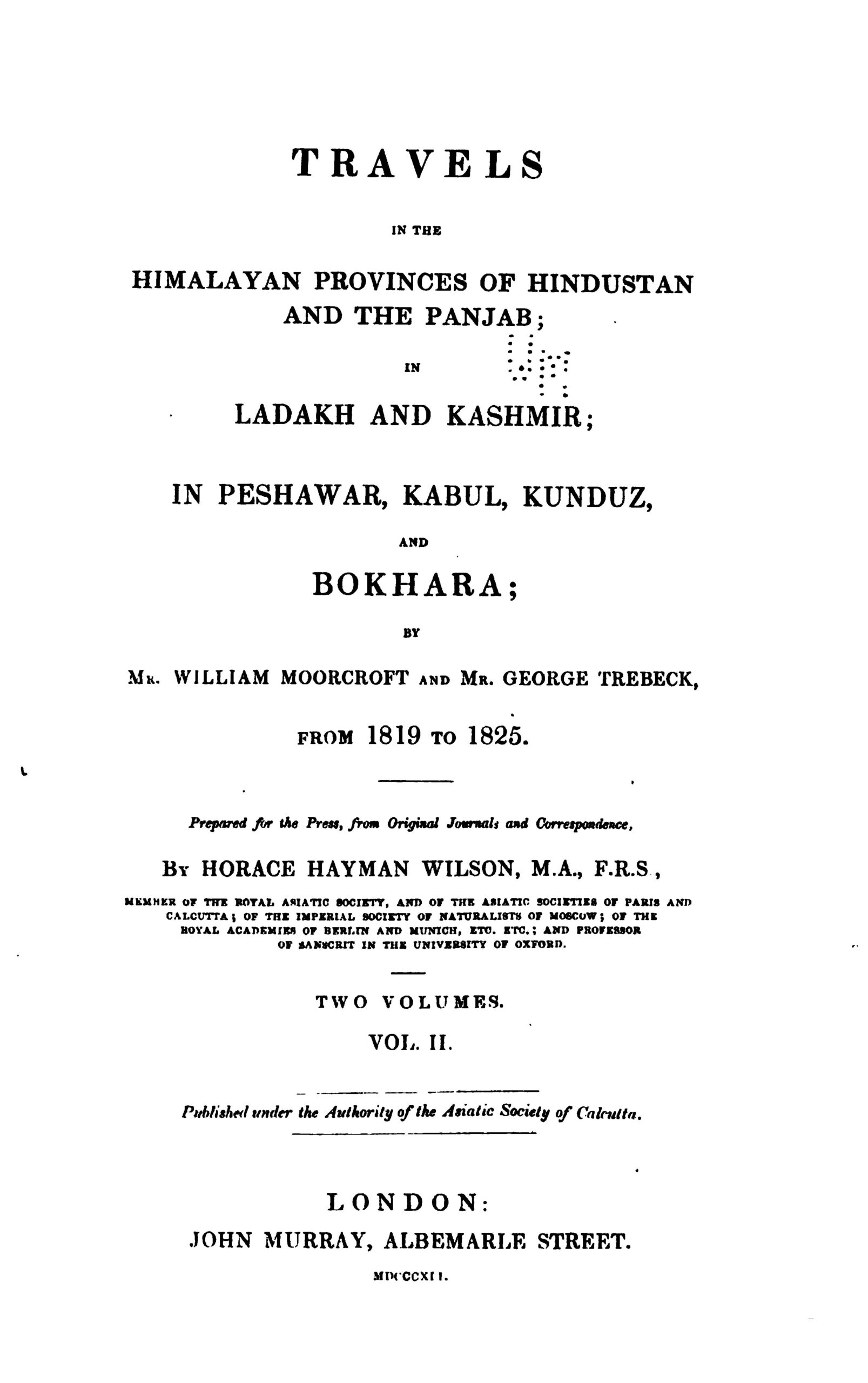
Travels in the Himalayan Provinces of Hindustan and the Panjab, Vol. II by William Moorcroft and George Trebeck

Kashmir by Sir Francis Edward Younghusband
