Kashmiri Papier-mâché: The Art of Kar-i-Qalamdani
In the bazaars of Srinagar, and in museums around the world, you will find small boxes, bowls and trays glowing with flowers, birds and gold. They are made of nothing more precious than paper. Kashmiri papier-mâché is one of the valley’s best-known crafts, and one of its most beautiful.
Kar-i-qalamdani: the pen-case work
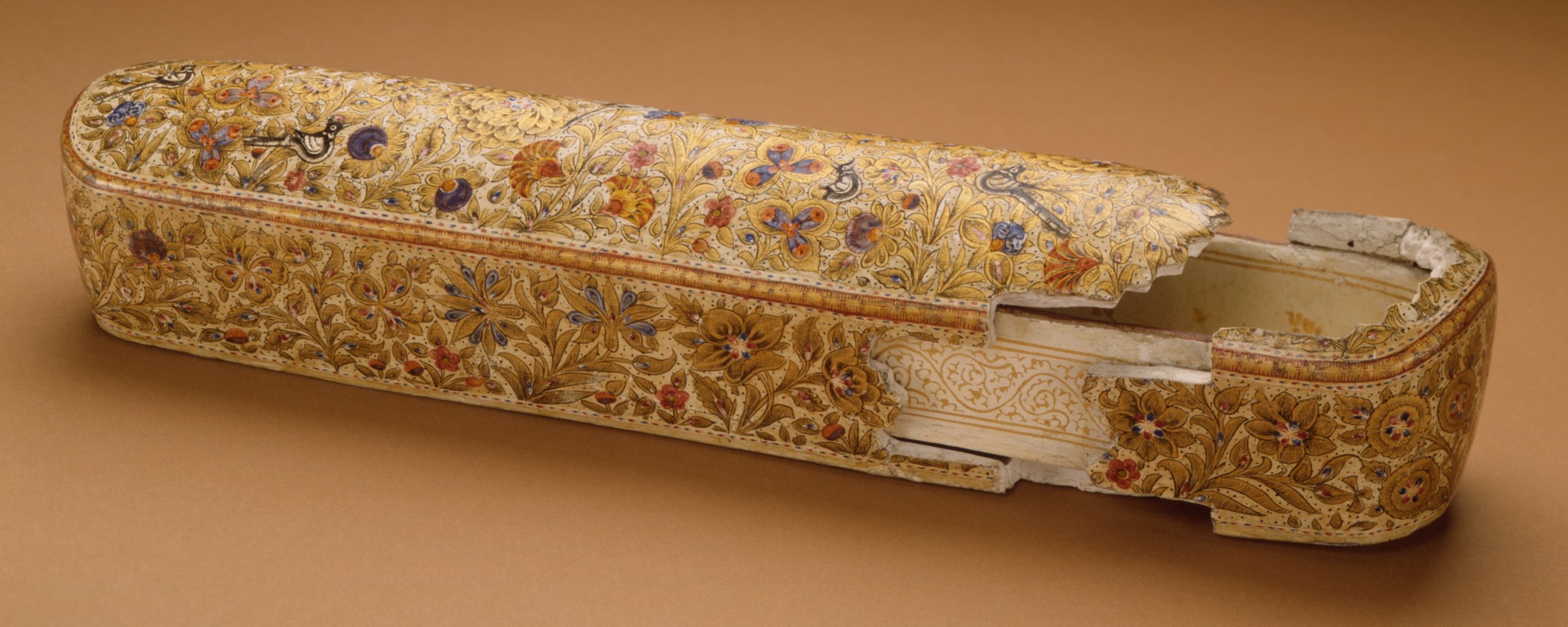
In Kashmir the craft is called kar-i-qalamdani, “pen-case work”, because pen boxes (qalamdan), like the one in the picture above, were among its most important products in the days when every scholar and scribe carried one. It is also known as kar-i-munaqqash, “painted work”. Kashmiri tradition traces the craft, like several others, to Persian and Central Asian artisans who came to the valley with the Sufis of the fourteenth century and under the patronage of the sultans who followed.
Two arts in one
Papier-mâché is made in two quite separate stages, often by different families of craftsmen.
The first is sakhtsazi, the making of the object. Waste paper is soaked until it breaks down into pulp, mixed with a glue, and pressed over a mould, or laid on in layers. When it is dry the mould is removed, and the surface is smoothed, strengthened and covered with a fine base coat.
The second is naqashi, the painting. Working freehand with fine brushes, the painter covers the surface with intricate designs: the chinar leaf, the iris, roses and other flowers, birds, and sometimes hunting scenes, often outlined or highlighted with gold. A final coat of varnish protects the work and gives it its characteristic glow.
From pen boxes to palaces
The same painting technique is used on wood as well as paper, and the finest examples are not small objects but whole interiors. The walls and ceilings of the Khanqah-e-Moula in Srinagar are covered in painted panels of this kind, and so were the rooms of many old Srinagar houses. In the nineteenth century, European visitors bought papier-mâché in great quantities, and Kashmiri craftsmen made boxes, trays, vases, lamps and even furniture for them.
Today Kashmir papier-mâché is registered as a Geographical Indication, and the craft continues in the workshops of old Srinagar, alongside cheaper mass-produced imitations. A genuine piece is made entirely by hand, and the painting alone may take many days.
Sources and further reading
- Walter R. Lawrence, The Valley of Kashmir, Henry Frowde, London, 1895.
- George Watt, Indian Art at Delhi, 1903: Being the Official Catalogue of the Delhi Exhibition, 1902–1903, Calcutta, 1903.
Featured image: papier-mâché pen box (qalamdan) with paint and gold leaf, Srinagar, about 1800–1850. Los Angeles County Museum of Art, public domain, via Wikimedia Commons.
You May Also Like
Kashmir Woodwork: Walnut Carving and Khatamband
Pashmina and Kani: The Shawls of Kashmir