Kashmir Woodwork: Walnut Carving and Khatamband
Kashmir is a land built of wood. Its old mosques and shrines, its houses, bridges and houseboats were made of deodar, pine and walnut, and its carpenters developed two crafts that are still admired today: the deep, flowing carving of walnut wood, and the geometric ceilings called khatamband.
Walnut wood carving
The walnut tree grows widely in Kashmir, and its wood is hard, close-grained and beautifully coloured, ranging from pale gold in the branches to deep brown in the root and lower trunk. Only mature trees give good carving wood, and today the felling of walnut trees in Kashmir is restricted to protect them.
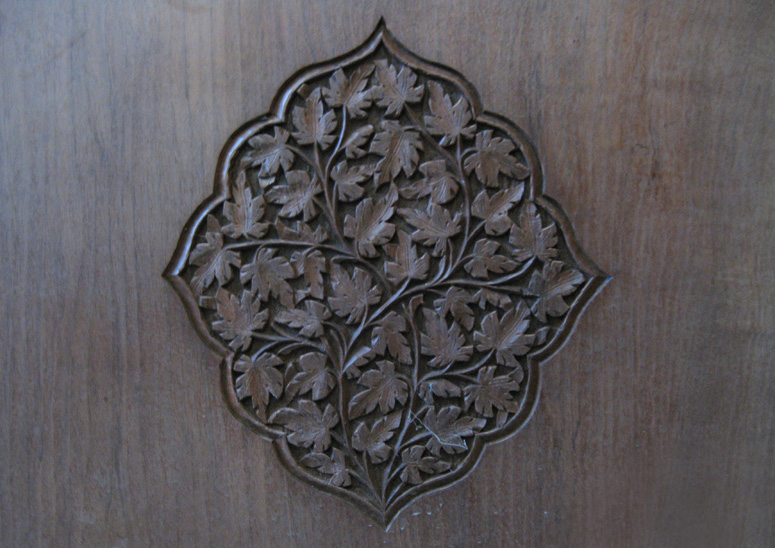
Kashmiri carvers work in several styles: deep carving and undercutting, in which leaves and flowers seem to stand free of the background; shallower relief; and open lattice work, pinjrakari, used for windows and screens. Their favourite motifs come from the valley around them: the chinar leaf, the lotus, the iris, the vine and its grapes, with occasional dragons and other designs that recall the craft’s contacts with Central Asia and China.
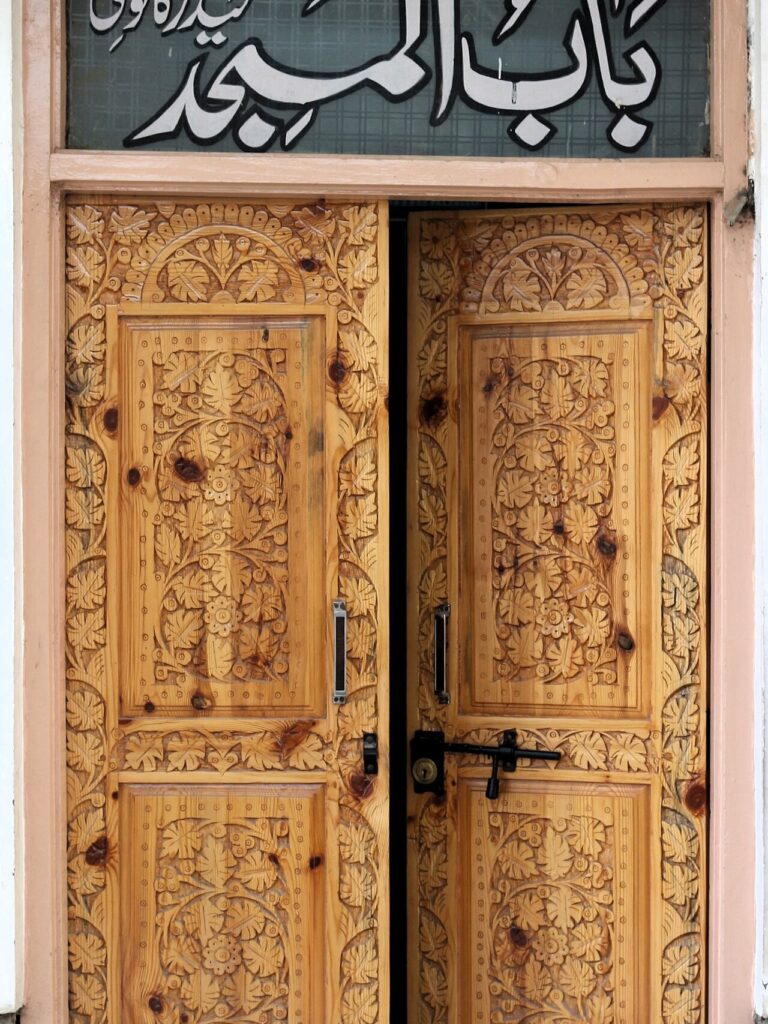
Carved walnut furniture, screens, boxes and panels became popular with European visitors in the late nineteenth century, and the panelled interiors of Srinagar’s houseboats are still showcases of the craft. Kashmir walnut wood carving is registered as a Geographical Indication.
Khatamband: the geometric ceiling
Look up in an old Kashmiri house or shrine and you may see a ceiling made of hundreds of small pieces of wood, cut into precise geometric shapes and fitted together into stars, hexagons and interlocking patterns. This is khatamband. The pieces, usually of pine or deodar, are slotted into grooved frames rather than fixed with nails, so that a whole ceiling can be taken down and put up again elsewhere.
Khatamband is related to the geometric woodwork of Persia and Central Asia, and Kashmiri tradition associates its arrival, like that of papier-mâché, with the craftsmen who came to the valley in the age of the Sufis and sultans. Each pattern has its own name among the craftsmen. Khatamband ceilings are still made for homes, mosques and hotels, and the craft is registered as a Geographical Indication.
Sources and further reading
- Walter R. Lawrence, The Valley of Kashmir, Henry Frowde, London, 1895.
- George Watt, Indian Art at Delhi, 1903, Calcutta, 1903.
Featured photo: walnut wood carving with a chinar-leaf design, by Ehsan Quddusi, Wikimedia Commons, licensed CC BY-SA 2.0. Carved mosque doors, Anantnag, by ThePoeticFrame, Wikimedia Commons, licensed CC BY-SA 4.0.
You May Also Like
Pashmina and Kani: The Shawls of Kashmir
Kashmiri Papier-mâché: The Art of Kar-i-Qalamdani