Habba Khatoon: The Nightingale of Kashmir
Of all the voices of old Kashmir, none is sung more often than hers. At weddings, in kitchens and on the radio, Kashmiris still sing songs of longing attributed to Habba Khatoon, the village girl who became a queen and lost her king, remembered as the Nightingale of Kashmir.
Zoon of Chandhar
According to tradition she was born in the sixteenth century as Zoon, “the moon”, in the village of Chandhar near Pampore, among the saffron fields south-east of Srinagar. Her family were peasants, but she is said to have learnt to read and to have had a gift for verse from childhood. She was married young into a peasant family, and the marriage was unhappy; some of the songs attributed to her are the complaints of a young bride mistreated by her in-laws.
Warivyan saeth vaaraeh chhas no, chaare kar myaene maalinyo ho.
A song attributed to Habba Khatoon (our translation)
I am not at ease in my in-laws’ house; O my parents, find some remedy for me.
A queen of the Chaks
The story Kashmiris love best tells how Prince Yusuf Shah Chak, out hunting, heard her singing and was captivated. Her first marriage was dissolved, she married the prince, and as his wife she took the name Habba Khatoon. Yusuf Shah became Sultan of Kashmir in 1579.
His reign was short and troubled. In 1586, facing the armies of the Mughal emperor Akbar, Yusuf Shah went to negotiate and was detained. He was sent into exile far away in Bihar, where he died in 1592, and Kashmir passed under Mughal rule. Habba Khatoon never saw him again. Tradition says she spent the rest of her life wandering and singing of separation, and the mountain in Gurez now called Habba Khatoon is said to be one of the places she roamed.
The lol: songs of longing
Lal Ded and Sheikh Nooruddin wrote verses of the spirit; Habba Khatoon is remembered as the first great poet of human love in Kashmiri. She is credited with making popular the lol, a short lyric of love and longing, sung rather than recited, with a refrain that returns at the end of each verse. Her songs speak of waiting, of a lover who does not come, of flowers, springs and the changing seasons of the valley, in a simple and intensely personal Kashmiri.
Her songs have been sung for more than four hundred years and are still part of the repertoire of Kashmiri folk singers and of many a wedding.
History and legend
Remarkably, the Persian chronicles of the Chak period do not mention her, and her story reached writing only much later, through oral tradition and the songs themselves. Some scholars have therefore questioned parts of it, and others have argued about which songs are truly hers. What is not in doubt is her place in Kashmiri memory: whatever the details of her life, the songs that carry her name are among the best-loved poetry in the language.
Sources and further reading
- Braj B. Kachru, Kashmiri Literature, A History of Indian Literature, Otto Harrassowitz, Wiesbaden, 1981.
- Mohibbul Hasan, Kashmir under the Sultans, Iran Society, Calcutta, 1959, for Yusuf Shah Chak and the end of the Sultanate.
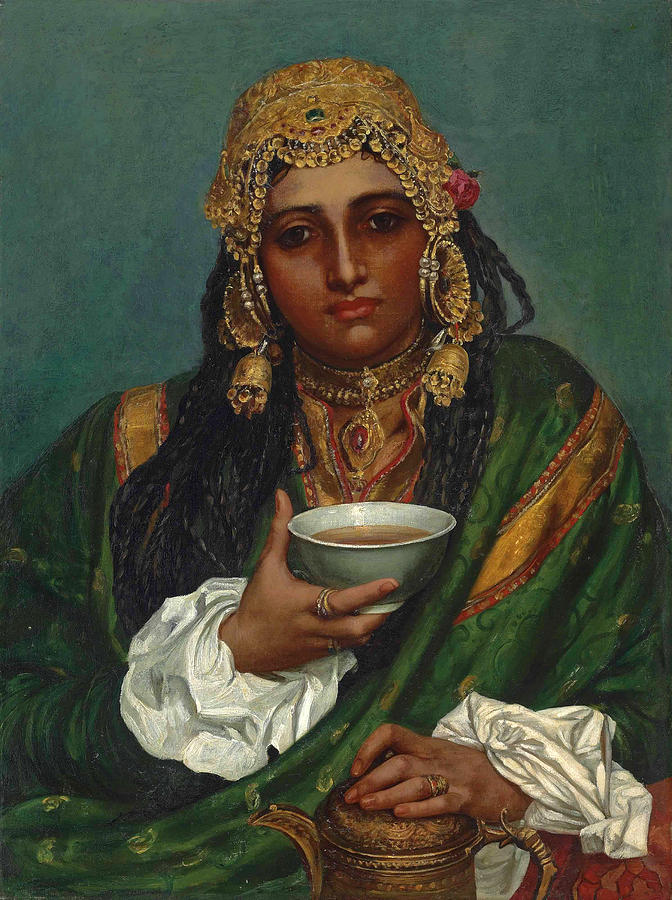
Featured image: portrait of a Kashmiri woman by Valentine Cameron Prinsep (about 1880), often reproduced as an imagined portrait of Habba Khatoon; no true likeness of her survives. CC0, via Wikimedia Commons.
You May Also Like

Chalo Mante Hain Ki Hum He Galat Thay by Ayaz Rasool Nazki
Lal Ded (Lalleshwari): The Life and Sayings of Kashmir’s First Poet
