
Kalhana’s Rajatarangini: A Reader’s Guide to the River of Kings
Few places in the world have a history written as early, or as vividly, as Kashmir. In 1148, a poet named Kalhana sat down to write the story of the kings of his homeland in Sanskrit verse. He finished it a year or so later. His Rajatarangini, the “River of Kings”, is the first true work of history in Sanskrit, and almost nine centuries on it is still where the history of Kashmir begins.
Who was Kalhana?
Kalhana was the son of Champaka, a minister of King Harsha of Kashmir, who ruled at the end of the eleventh century. He grew up close to the court and to its politics, and he lived through the violent struggles that followed Harsha’s fall. He wrote in the reign of King Jayasimha, and his account of his own times has the immediacy of an eyewitness.
He was unusual for his age in caring about evidence. He tells us he consulted eleven earlier histories, most of them now lost, as well as the Nilamata Purana, temple inscriptions, land grants and coins, and he states that a historian should be free from love and hate, like a judge.
What the River of Kings contains
The work runs to about 7,800 verses, divided into eight books, each called a taranga, a “wave”. Roughly, the story moves from legend to history to the author’s own day:
- Book I: the creation of the valley from a great lake, and the early, largely legendary kings.
- Books II and III: further early dynasties, their histories still uncertain.
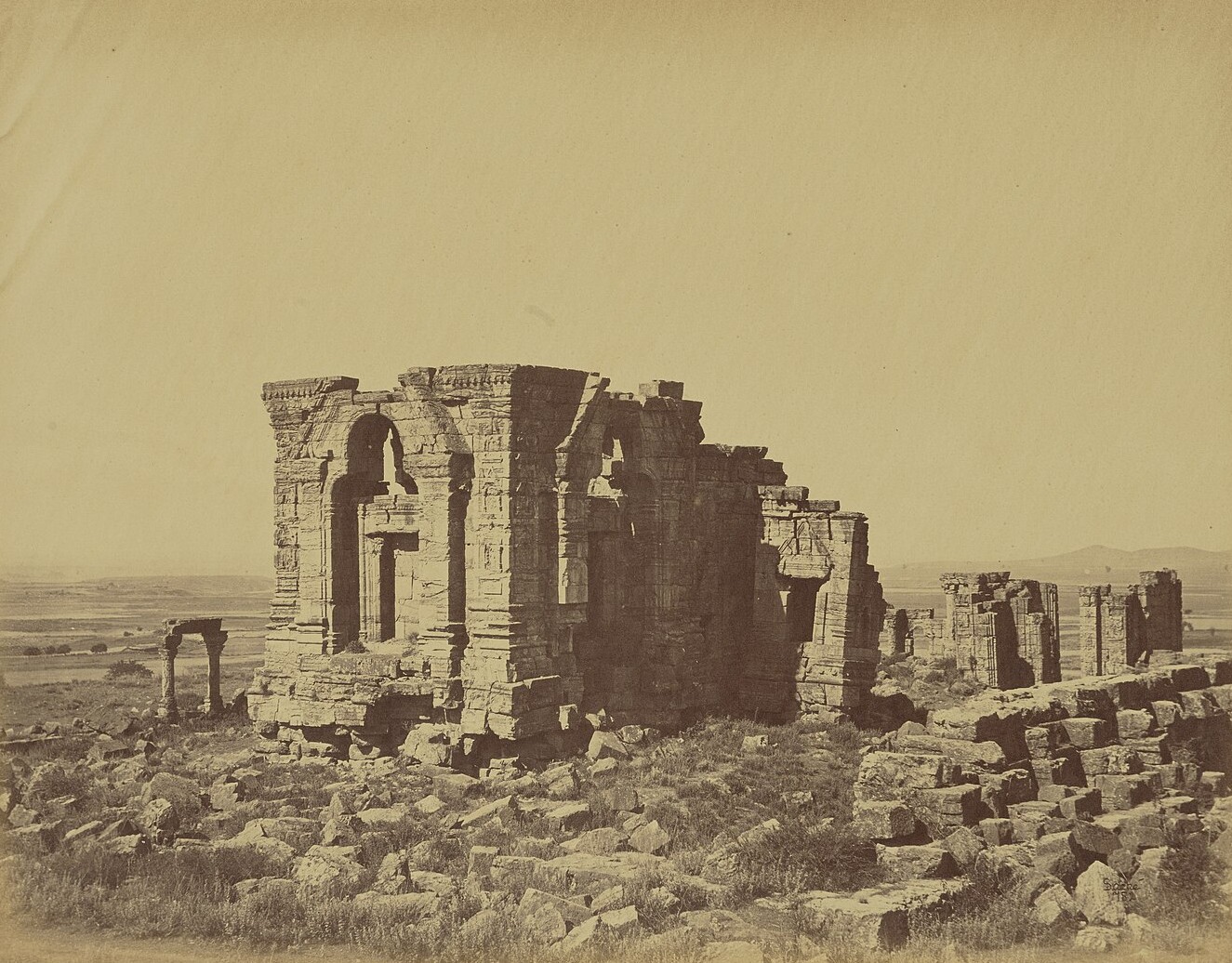
- Book IV: the Karkota dynasty, including Lalitaditya Muktapida, the eighth-century conqueror who built the great sun temple at Martand, shown above.
- Book V: Avantivarman and his engineer Suyya, who drained and regulated the rivers of the valley; the town of Sopore still bears his name.
- Book VI: the age of Queen Didda, who ruled Kashmir for decades at the end of the tenth century.
- Books VII and VIII: the eleventh and twelfth centuries, Kalhana’s own world, told in great detail. Book VIII alone is longer than the first six books together.
The chronicle continued
Kalhana started a tradition. Jonaraja carried the story on to the fifteenth century and the reign of Sultan Zain-ul-Abidin; his pupil Srivara continued it; and Prajyabhatta and Shuka took it down to the Mughal annexation of Kashmir in 1586. Together these later chronicles are sometimes printed with Kalhana’s as one long River of Kings.
Reading it today
The first European translation was Anthony Troyer’s French version (1840–1852). The great English translation is that of Aurel Stein, published in 1900, who spent years tracking down the best manuscripts and walking the valley to identify the places Kalhana names. Ranjit Sitaram Pandit’s translation, River of Kings (1935), is a more literary version.
For a first reading, we suggest Stein’s introduction, which explains Kalhana’s world, then Books IV to VI for the great kings and Queen Didda, and then Book VIII for some of the most gripping political narrative in any language. Both volumes of Stein’s translation are free to read in our Library:
- Kalhana’s Rajatarangini, a Chronicle of the Kings of Kashmir, Vol. I, translated by M. A. Stein, 1900, and Vol. II, with Book VIII, the notes and the Memoir on the Ancient Geography of Kashmir.
- The Valley of Kashmir by Walter Lawrence (1895), whose history chapters draw on Kalhana.
- The Northern Barrier of India by Frederic Drew (1877), for the land Kalhana describes.
Sources and further reading
- M. A. Stein (tr.), Kalhana’s Rajatarangini: A Chronicle of the Kings of Kasmir, 2 vols, Archibald Constable, Westminster, 1900.
- Ranjit Sitaram Pandit (tr.), River of Kings (Rajatarangini), Indian Press, Allahabad, 1935.
- A. Troyer (tr.), Radjatarangini, histoire des rois du Kachmir, Paris, 1840–1852.
Featured photo: the ruins of the Martand sun temple, built by King Lalitaditya in the eighth century, photographed by John Edward Saché in 1873. J. Paul Getty Museum, CC0, via Wikimedia Commons.
You May Also Like