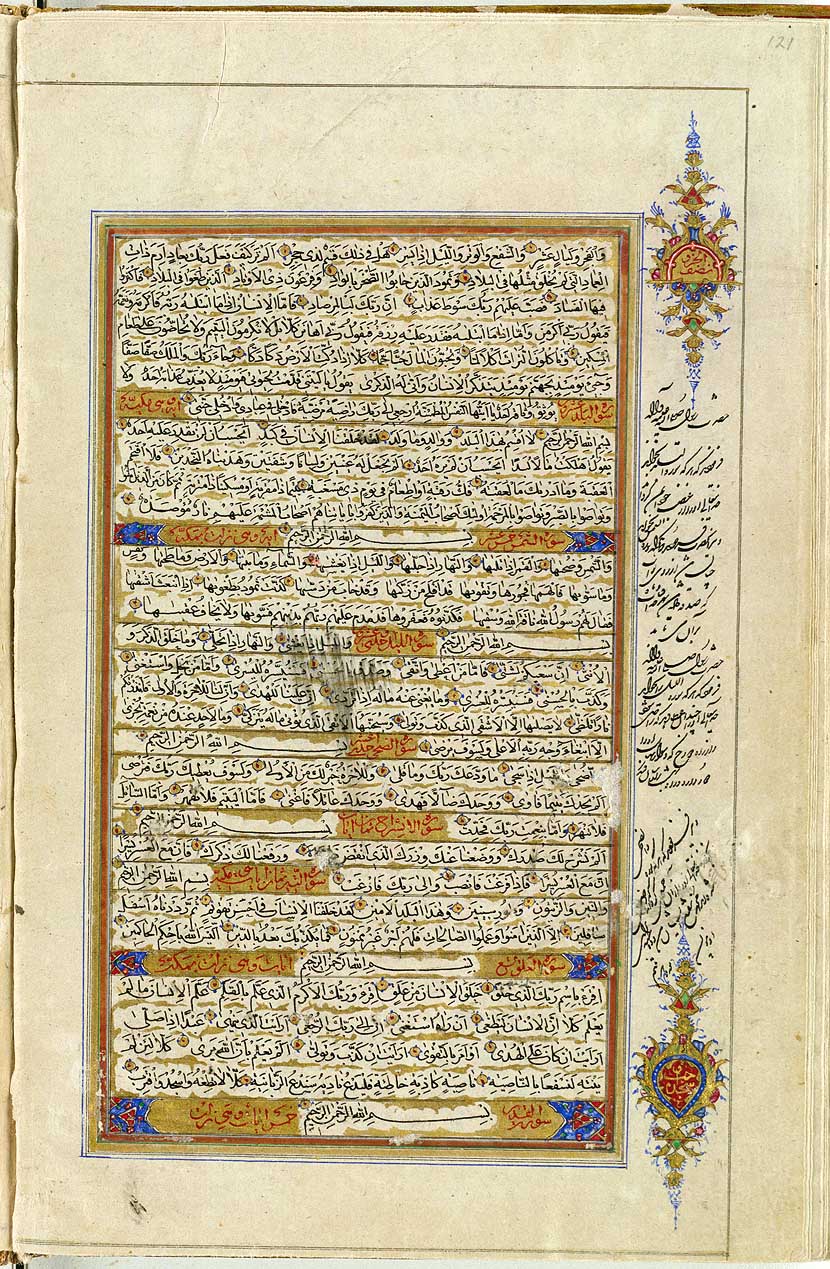
O Soul at Peace: Surat al-Fajr in an Illuminated Qur’an of 1874
Some of the most beloved verses of the Qur’an come at the end of Surat al-Fajr, “The Dawn”. They speak to the soul at the end of its journey, and for Sufis they describe the last stages of the inner path. Here we read them on a page from an illuminated Qur’an copied in 1874, where the whole surah fits into just seven lines of fine naskh.
| Text | Qur’an, Surat al-Fajr (89), the whole surah, ending with verses 27–30 |
| Form | A page from a manuscript Qur’an, ink, colours and gold on paper |
| Script | Naskh, written on gold “cloud bands”; surah headings in decorative script |
| Date | 1874 |
| Decoration | Gold verse markers, illuminated surah headings, ruled borders and marginal medallions |
The verses
يَا أَيَّتُهَا النَّفْسُ الْمُطْمَئِنَّةُ ارْجِعِي إِلَىٰ رَبِّكِ رَاضِيَةً مَرْضِيَّةً فَادْخُلِي فِي عِبَادِي وَادْخُلِي جَنَّتِي
Yā ayyatuha n-nafsu l-muṭmaʾinna. Irjiʿī ilā rabbiki rāḍiyatan marḍiyya. Fa-dkhulī fī ʿibādī. Wa-dkhulī jannatī.
“O soul at peace, return to your Lord, well pleased and well pleasing. Enter among My servants, and enter My Garden.”
Reading the page
The page opens with the first words of the surah, wa-l-fajr, wa-layālin ʿashr, “By the dawn, and the ten nights”, at the top right, and the scribe has fitted all thirty verses into the first seven lines. Each verse ends with a small gold rosette. The four verses on the soul at peace are on the seventh line, set against the gold heading of the next surah, al-Balad, “The City”. Below them, the page continues with the short surahs that follow: al-Balad, al-Shams, al-Layl, al-Duha, al-Sharh, al-Tin and al-ʿAlaq.
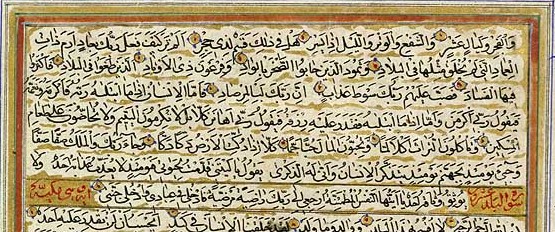
The text is written in naskh, the clear, rounded script used for most copies of the Qur’an, and each line is set on a “cloud band” of gold, outlined in fine ink, so that the words seem to float on light. The surah headings are written in a decorative script inside illuminated panels of gold, red and blue, and the outer margins carry painted medallions and notes in a smaller hand. The marginal notes appear to be in Persian, which suggests the manuscript was made or used in the Persian-speaking world.
The soul at peace
In Sufi teaching these verses name the highest stations of the self (nafs). The soul that is at peace (al-nafs al-muṭmaʾinna) no longer pulls against God. It is well pleased (rāḍiya) with whatever comes from its Lord, and it is well pleasing (marḍiyya), the soul with which God is pleased.
Sufi teachers describe the path to that peace as a series of stages, each named from the Qur’an:
- The commanding self (al-nafs al-ammāra): the ordinary ego, ruled by desire, anger and habit. “The soul surely commands to evil” (Surat Yusuf 12:53).
- The blaming self (al-nafs al-lawwāma): the self that has woken up enough to reproach itself. “And I swear by the self-reproaching soul” (Surat al-Qiyama 75:2).
- The inspired self (al-nafs al-mulhama): the self that begins to receive glimpses of something higher, named from the verse “and inspired it with its wickedness and its righteousness” (Surat al-Shams 91:8), which appears on this very page a few lines further down.
- The self at peace (al-nafs al-muṭmaʾinna), then the well-pleased (rāḍiya) and well-pleasing (marḍiyya) self: the stations of these verses (Surat al-Fajr 89:27–28).
Many later Sufi teachers add a final station, the complete self (al-nafs al-kāmila). The term is not found in the Qur’an, but it describes the soul that has passed through all the others. In Kashmir, the same longing for a soul at rest runs through the sayings of Lal Ded and the verses of Sheikh Nooruddin.
Images: page from a manuscript Qur’an of 1874, with Surat al-Fajr and the surahs that follow it, and a detail of the same page. Public domain, via Wikimedia Commons.
You May Also Like
His Are the Creation and the Command: A Jali Thuluth Panel by Abdülfettah Efendi