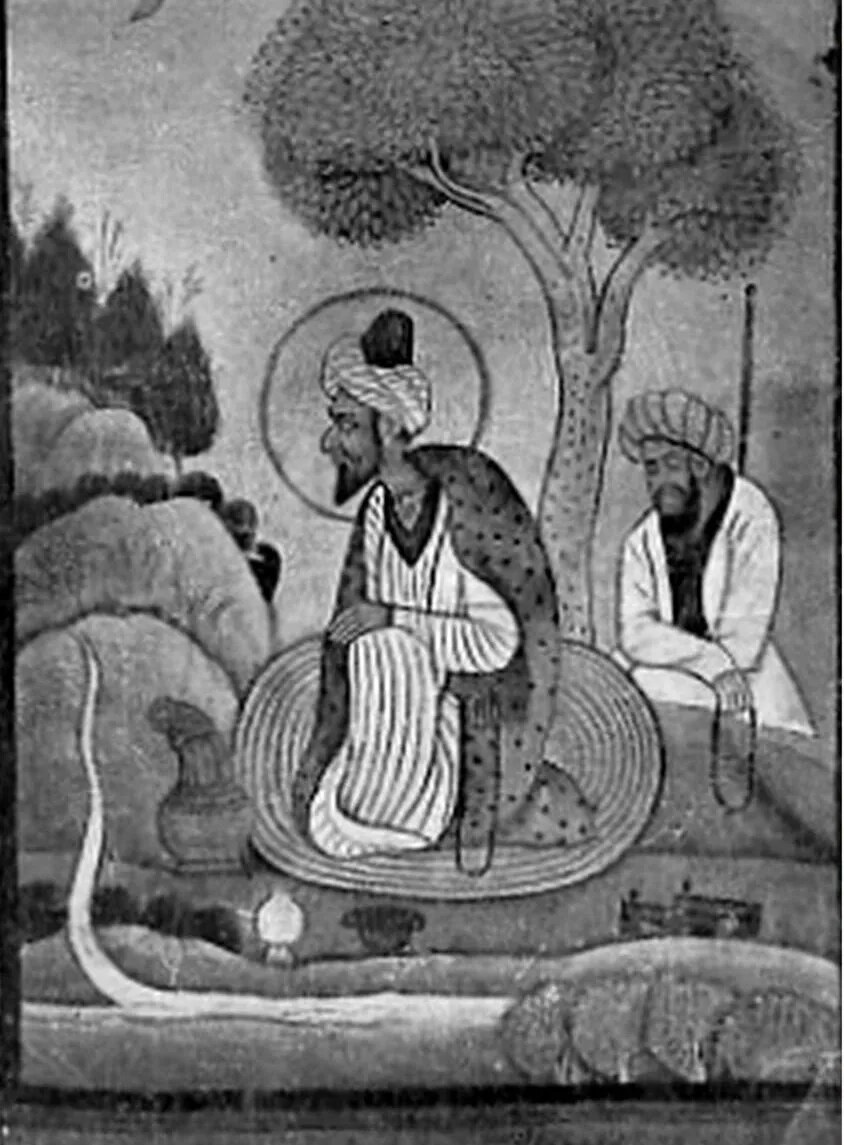
Sheikh Nooruddin (Nund Reshi) and the Rishis of Kashmir
If Lal Ded is the mother of Kashmiri poetry, Sheikh Nooruddin is its most beloved son. Known to Muslims as Sheikh-ul-Alam and Alamdar-e-Kashmir, “the standard-bearer of Kashmir”, and to Hindus as Nund Reshi or Sahajanand, he founded the Rishi order, the most Kashmiri of all the valley’s spiritual traditions. His shrine at Charar-i-Sharif is still one of the most visited places in Kashmir, and his verses are quoted as readily as proverbs.
Life
Tradition places his birth in 1377 at Kaimoh, near Kulgam in south Kashmir, to Salar Sanz and his wife Sadra Moj. A well-known legend says that the newborn child refused his mother’s milk until Lal Ded came to the house and nursed him, a story that has bound the two saints together in the Kashmiri imagination ever since.
As a young man he is said to have tried and abandoned several worldly occupations before withdrawing from the world. He spent long years in prayer and meditation, much of the time in a cave, and gathered disciples who came to be known as Rishis. He died in 1438, and was buried at Charar-i-Sharif in the hills south-west of Srinagar. According to tradition, Sultan Zain-ul-Abidin himself attended his funeral.
The Rishi order
The Rishis were Muslim ascetics with deep roots in the Kashmiri countryside. Their way of life drew on the Sufi path and on older traditions of renunciation in the valley. Many lived simply in remote places, kept long fasts, avoided eating meat and harming living creatures, and devoted themselves to service: planting trees, building paths and bridges, and feeding travellers. Nooruddin’s four chief disciples, Baba Bam-ud-Din, Baba Zain-ud-Din, Baba Latif-ud-Din and Baba Nasr-ud-Din, spread his teaching, and Rishi shrines are still found all over Kashmir.
For the historian Mohammad Ishaq Khan, the Rishis were central to the way Islam took root in Kashmir: they expressed the new faith in the language, images and ascetic ideals that ordinary Kashmiris already knew. (See Sufism in Kashmir for the wider story.)
His poetry
Nooruddin’s verses, called shruk or shrukh, are short poems in Kashmiri on the vanity of the world, the discipline of the self, death and judgement, and the love of God. Like Lal Ded’s sayings they were passed down by word of mouth before being written down, chiefly in Persian-script collections such as the Nurnama compiled in the seventeenth century by Baba Nasib-ud-Din Ghazi. Many are as alive in Kashmiri speech today as they were five hundred years ago.
The best known of all is a single line that has become a motto for the protection of Kashmir’s forests:
Ann poshi teli, yeli wan poshi.
Sheikh Nooruddin (our translation)
Food will be plentiful only as long as the forests flourish.
Charar-i-Sharif
The shrine built over his grave at Charar-i-Sharif (Tsrar) became the spiritual heart of rural Kashmir. Rulers of every kind honoured it; in the early nineteenth century an Afghan governor even struck coins in the saint’s name. The old wooden shrine was destroyed by fire in 1995, and has since been rebuilt. Each year his urs draws pilgrims from across the valley.
Read further in the Library
- Lal Ded (Lalleshwari): The Life and Sayings of Kashmir’s First Poet, on the mystic whose story is entwined with his.
- Sufism in Kashmir: Origins, Orders and Saints, on the Rishis and the other Sufi orders of the valley.
- The Valley of Kashmir by Walter Lawrence (1895), which describes the Rishi shrines and the reverence in which they were held.
- The Dhikr Book of Kashmir, prayers of remembrance as they are recited in Kashmir.
Sources and further reading
- Baba Nasib-ud-Din Ghazi, Nurnama (Persian, seventeenth century), the principal early life of the saint.
- Mohammad Ishaq Khan, Kashmir’s Transition to Islam: The Role of Muslim Rishis, Manohar, New Delhi, 1994.
- Walter R. Lawrence, The Valley of Kashmir, Henry Frowde, London, 1895.
Featured image: Sheikh Nooruddin (Nund Reshi), from a seventeenth-century Kashmiri manuscript painting. Public domain, via Wikimedia Commons.
You May Also Like
Lal Ded (Lalleshwari): The Life and Sayings of Kashmir’s First Poet
Shah-i-Hamadan and the Khanqah-e-Moula
