
Gulshan-i-Raz: The Mystic Rose Garden of Mahmud Shabistari, translated by E. H. Whinfield
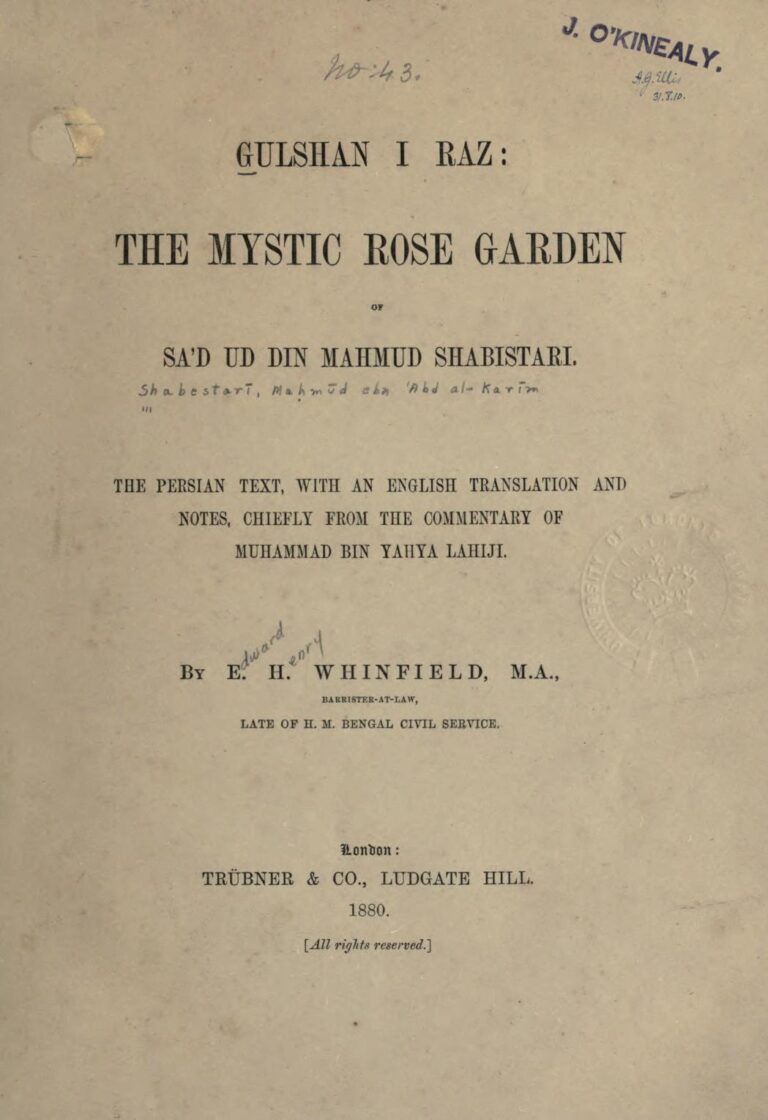
Why do Sufi poets talk about wine and taverns? Shabistari's famous answer in verse, around 1317, with Whinfield's Persian and English side by side.
If the book does not appear here (some phones can’t show PDFs inside a page), use Open full screen or Download PDF.
About this book
Around 1317 a Sufi in Herat sent a list of questions to Mahmud Shabistari, a scholar living near Tabriz. What is thought? Who am I? What does it mean to travel towards God? And why on earth do Sufi poets keep writing about wine, taverns, idols and the curls of the beloved’s hair? Shabistari answered in verse, and the answer became the Gulshan-i-Raz, “The Rose Garden of Mystery”.
It’s only about a thousand couplets, but it packs in a whole philosophy. The best-known parts are the explanations of the poetic images. The tavern is the place where the self is lost. Wine is the love that intoxicates the soul. The idol stands for love and unity. If you have ever puzzled over a Hafiz ghazal or a Sufiana song in Kashmiri, this is the key.
E. H. Whinfield, a British civil servant in India and a keen Persianist, published this edition in 1880 with the Persian text and his English translation, plus notes and extracts from a famous Persian commentary. The translation is a little old-fashioned, but clear. The poem was read and taught in Kashmir for centuries, so it sits naturally in our Library.

You May Also Like
The Charm of Kashmir by V. C. Scott O’Connor

A Lonely Summer in Kashmir by Margaret Cotter Morison
