Shah-i-Hamadan and the Khanqah-e-Moula
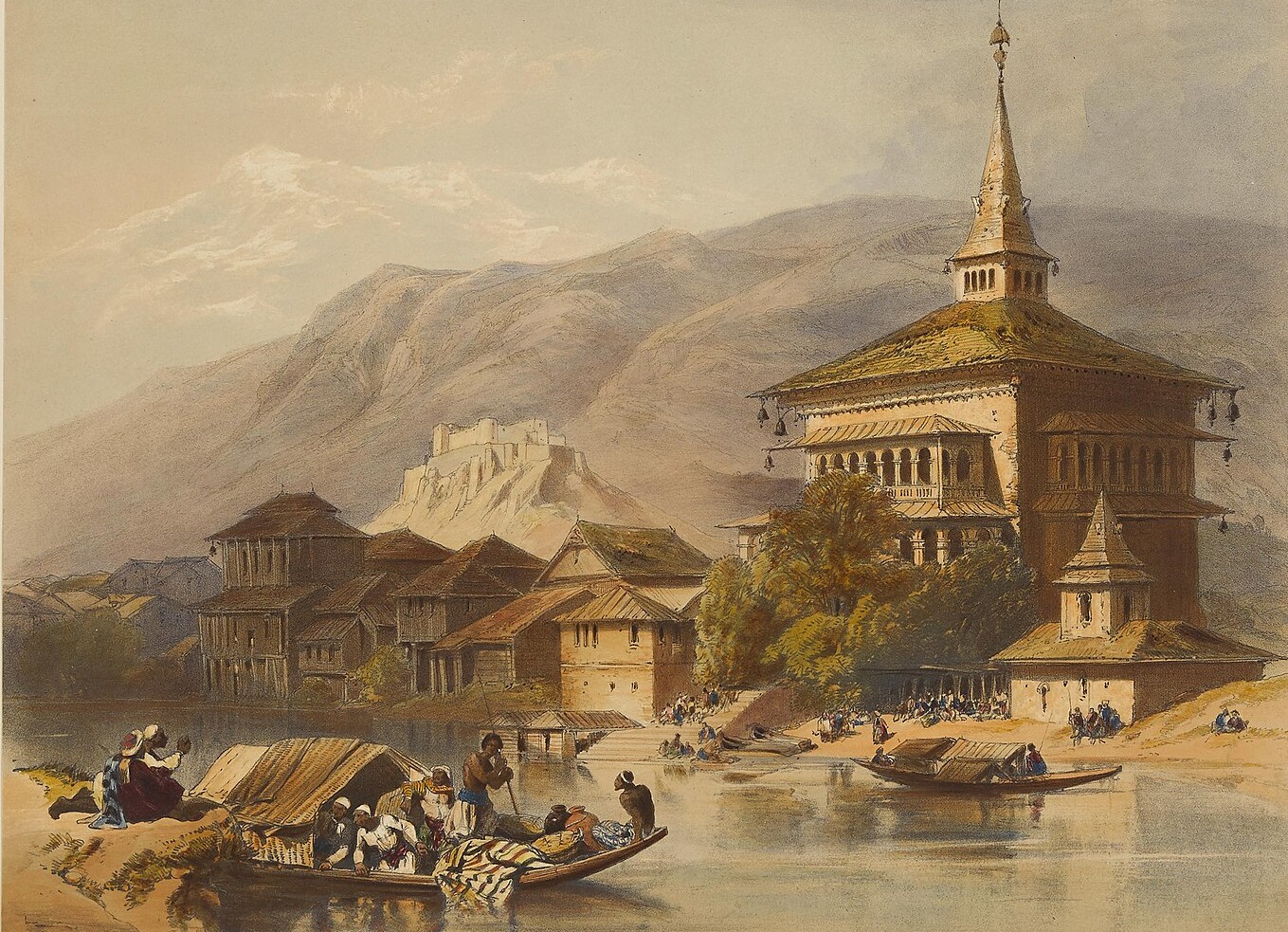
On the right bank of the Jhelum in old Srinagar stands a wooden building unlike any other mosque in the Islamic world: tiered roofs, a slender spire, carved balconies and, inside, walls glowing with painted papier-mâché. This is the Khanqah-e-Moula, raised in memory of Mir Sayyid Ali Hamadani, the Persian Sufi whom Kashmiris call Shah-i-Hamadan and Amir-i-Kabir, “the Great Master”.
Mir Sayyid Ali Hamadani
He was born in 1314 at Hamadan in western Persia and became a leading master of the Kubrawi order of Sufis, founded by Najm al-Din Kubra. A great traveller and a prolific writer in Persian and Arabic, he left treatises on Sufi practice, ethics and government, the best known being the Dhakhirat al-Muluk, “Treasure of Kings”, a guide for rulers on justice and good conduct.
He came to Kashmir in the reign of Sultan Qutb-ud-Din, in the 1370s and early 1380s. Accounts differ on how many visits he made and how long he stayed. Tradition says he arrived with a large company of disciples and craftsmen, and Kashmiris have long credited him and his followers with bringing new skills to the valley, among them the weaving of fine shawls. He died in 1384 on a journey through the mountains north-west of Kashmir and was buried at Kulob, in present-day Tajikistan.
Awrad-i-Fathiya: the litany of Kashmir
His most lasting gift to Kashmir is a prayer. The Awrad-i-Fathiya, a litany of praise and remembrance of God that he composed, is recited aloud in congregation in mosques across the valley, especially after the dawn prayer, and nowhere more movingly than in the Khanqah-e-Moula itself. For many Kashmiris it is the sound of morning. Prayers of remembrance in this tradition are gathered in The Dhikr Book of Kashmir, free to read in the Library.
The Khanqah-e-Moula
A khanqah is a Sufi lodge, a place of prayer, teaching and hospitality. The Khanqah-e-Moula stands on the spot where Shah-i-Hamadan used to pray. It was first built in the 1390s by his son, Mir Muhammad Hamadani, with the support of Sultan Sikandar. Like most of old Srinagar it was built of wood, and it burned more than once; the present building dates largely from its reconstruction in the 1730s.
It is one of the finest examples of Kashmir’s wooden architecture. Courses of deodar logs laid crosswise form the walls; the roof rises in tiers to an open pavilion and a spire, hung at the corners with small bells. Inside, the hall is covered in painted and lacquered papier-mâché and fine khatamband ceilings, the work of generations of Srinagar craftsmen. Almost every nineteenth-century visitor to Srinagar described it, and it remains one of the most revered places in Kashmir.
Read further in the Library
- Sufism in Kashmir: Origins, Orders and Saints, on the arrival of the Kubrawi Sufis and the other orders.
- The Dhikr Book of Kashmir, prayers of remembrance as recited in Kashmir.
- The Kashf al-Mahjub of Ali al-Hujwiri, the oldest Persian treatise on Sufism, for the Sufi path he taught.
- The Valley of Kashmir by Walter Lawrence (1895), for Srinagar and its shrines in the nineteenth century.
Sources and further reading
- Mohibbul Hasan, Kashmir under the Sultans, Iran Society, Calcutta, 1959.
- Walter R. Lawrence, The Valley of Kashmir, Henry Frowde, London, 1895.
- G. T. Vigne, Travels in Kashmir, Ladak, Iskardo, Henry Colburn, London, 1842.
Featured image: “The City of Kashmir with the mosque of Shah Hamadan”, lithograph by J. D. Harding after a drawing by Charles Hardinge, from Recollections of India (1847). Public domain, via Wikimedia Commons.
You May Also Like
Sheikh Nooruddin (Nund Reshi) and the Rishis of Kashmir

Sufism in Kashmir: Origins, Orders and Saints