Pashmina and Kani: The Shawls of Kashmir
For three centuries the finest shawls in the world came from the looms of Srinagar. Mughal emperors gave them as robes of honour, Persian and Afghan nobles wore them, and in the nineteenth century they became the height of fashion in Paris and London. The wool, the weaving and the patterns of the Kashmir shawl remain among the great achievements of Kashmiri craftsmanship.
Pashm: the wool
Pashm is the soft, fine undercoat that grows beneath the coarse outer hair of goats living on the high, cold plateaus of Ladakh and western Tibet, where winter temperatures fall far below freezing. It is gathered each spring, when the goats shed it naturally, by combing. For centuries the raw wool was carried over the passes to Kashmir, where it was cleaned and then spun by hand, mostly by women working at home, into a yarn of extraordinary fineness.
Finer still was shahtoosh, “the king of wools”, from the Tibetan antelope. Because the antelope must be killed for it, trade in shahtoosh is now banned internationally to protect the species.
The kani shawl
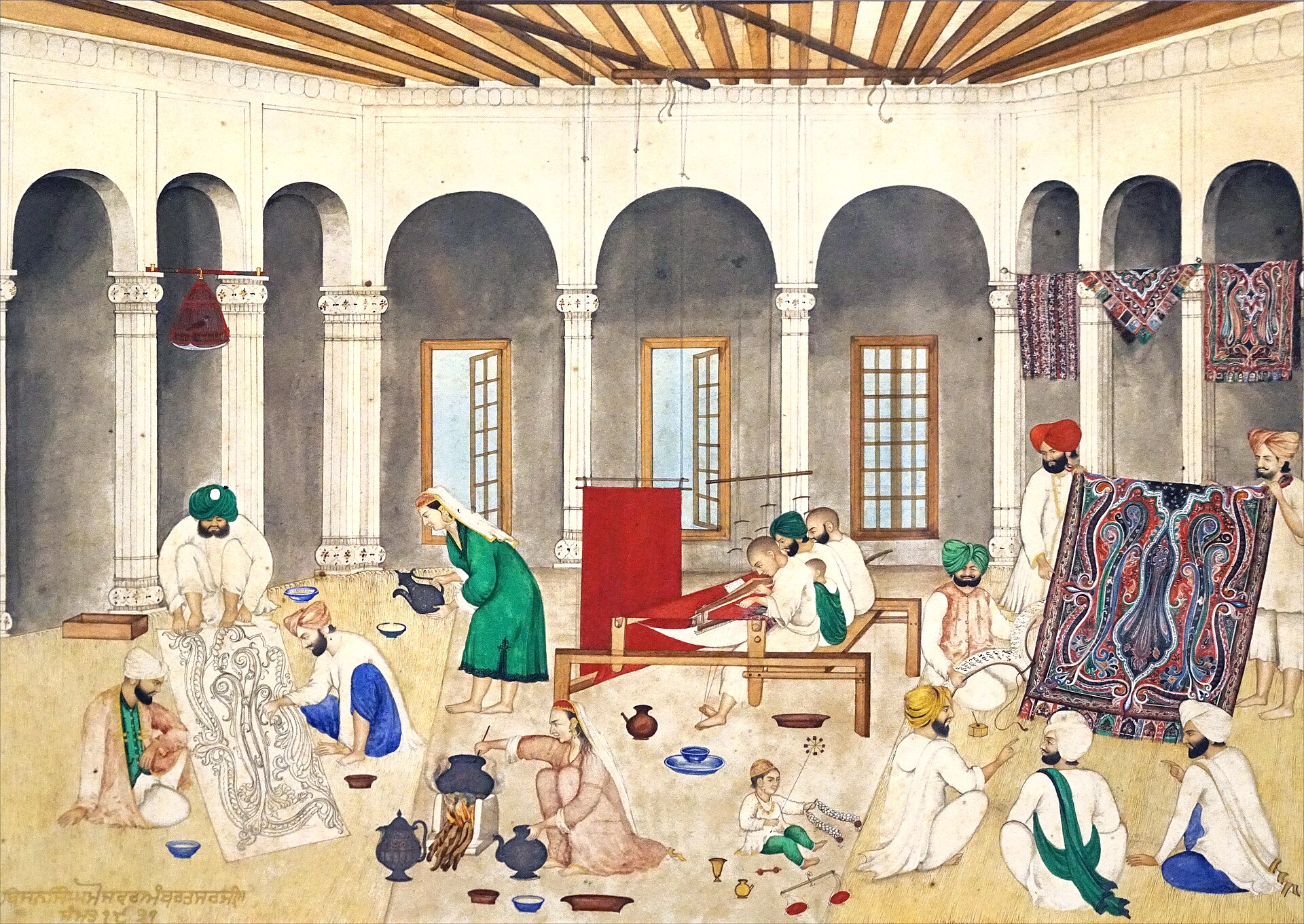
The most prized shawls were woven on the loom in a technique called kani, after the small wooden bobbins (kani) used to carry the coloured yarns. Instead of throwing one weft thread across the whole width, the weaver worked the pattern in small sections, interlocking dozens of bobbins by hand, row by row. The design was written in a coded notation called the talim, which a master read aloud to the weavers at the loom. A fine shawl could take two or three weavers many months, sometimes years, to complete.
In the nineteenth century a quicker method grew up: the amli or embroidered shawl, in which the pattern is worked with a needle on a plain woven ground. Embroidery of this kind, sozni, is still one of the glories of Kashmiri handwork.
From the boteh to the paisley
The most famous Kashmir motif is the boteh or buta, a curving, leaf-like cone, which grew over the centuries from a simple flowering plant into the elaborate, swirling form familiar today. When Kashmir shawls became fashionable in Europe, mills in France and in the Scottish town of Paisley produced cheaper imitations, and the motif has been known in English ever since as the “paisley”.
European fashion brought great prosperity, but also dependence. When tastes changed and the French market collapsed after the Franco-Prussian War of 1870, and famine struck Kashmir later in that decade, the old shawl industry declined sharply. Many weavers left the valley; some settled in the Punjab, where scenes like the workshop shown above were painted. Today Kashmir Pashmina and kani shawls are registered as Geographical Indications, and the craft continues in Srinagar.
Sources and further reading
- John Irwin, The Kashmir Shawl, Victoria and Albert Museum, London, 1973.
- Frank Ames, The Kashmir Shawl and its Indo-French Influence, Antique Collectors’ Club, Woodbridge, 1986.
- William Moorcroft and George Trebeck, Travels in the Himalayan Provinces of Hindustan and the Panjab, John Murray, London, 1841.
- Walter R. Lawrence, The Valley of Kashmir, Henry Frowde, London, 1895.
Featured image: a shawl weavers’ workshop, painted in gouache and gold by Bishan Singh, probably in Amritsar, about 1873–74. Public domain, via Wikimedia Commons.
You May Also Like
Kashmiri Silk: From Mulberry Trees to the Srinagar Silk Factory
Kashmiri Papier-mâché: The Art of Kar-i-Qalamdani